The key facts
- Hamid Sodiq believes that the modern model of education teaches an endless pursuit of results, and the current generation is “tired of endless progress.”
- Hamid Sodik believes that the modern education model teaches an endless pursuit of results, and the current generation is 'tired of relentless progress'.
- In his view, artificial intelligence emerged at a time when people were already thinking less for themselves, and it is dangerous to turn it into a substitute for human thinking.
- Sodiq warns political scientists: constant commentary on geopolitics can distract from fundamental research.
- Sodik warns political scientists: constant commentary on geopolitics can distract from fundamental research.
What this episode covers
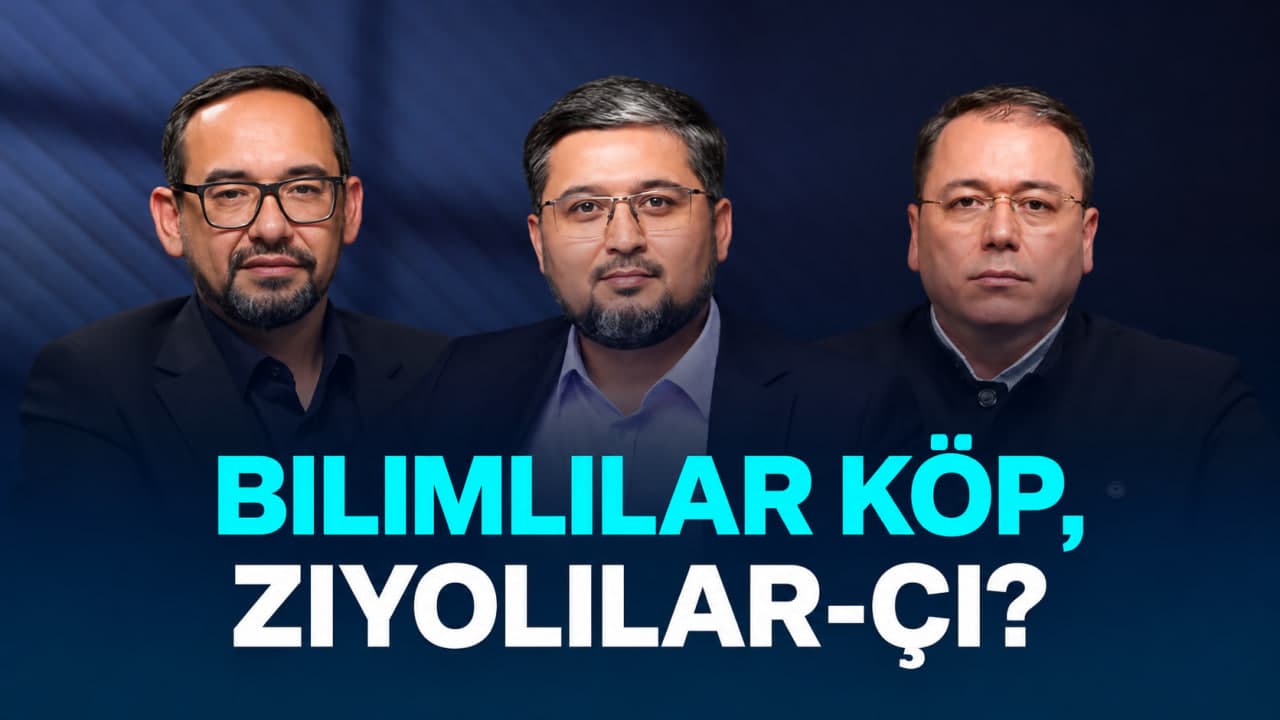
On October 24, Kun.uz published a new episode of the podcast “Nima dard?” (“What Hurts?”), whose guest was Hamid Sodiq — a lawyer, political scientist and translator who worked in education for about 20 years. The conversation covered several topics: the nature of inner “pain” as a source of will, the role of the intellectual in society, the crisis of modern education, the spread of artificial intelligence, and the growing interest in geopolitical analysis in Uzbekistan.
Who is an intellectual
Sodiq considers it wrong to measure intellectuality by a diploma, an academic degree, the number of books read, or public fame. In his view, an intellectual should not only explain the existing reality but also have his own criteria of thought for evaluating it — and therefore be ready to revise prevailing views and even his own earlier conclusions. Intellectual independence, he stressed, does not mean opposition to the state: one must think independently both of the authorities and of public sentiment. Loyalty to ideas was also discussed: the host asked how such a stance differs from fanaticism — after all, supporters of fascism were also ready to sacrifice themselves for their ideas. The guest replied that the influence of an idea does not mean its moral correctness, and society should seriously study even rejected ideas, understanding the conditions in which they arose.
The crisis of education
One of the most debated parts was the one about modern education. Sodiq said that over nearly 20 years in this field he observed a peculiar decline in motivation among schoolchildren and students. At first he attributed this to problems in legal education, but then concluded that the roots lie deeper — in the philosophy of mass education. The current model, in his words, teaches a person to constantly strive for new results: school, university, master’s degree, another diploma, a higher position — with no endpoint. “The current generation, simply put, is tired of endless progress,” he said. At the same time, part of the youth is growing up in relatively comfortable conditions created by their parents, so the aspirations of previous generations do not manifest as strongly. Sodiq himself interprets this not as laziness but as a sign of changing ideas about education and success; we note editorially that these are his personal observations, not a conclusion about all young people. He sees the way out of the crisis in reviving the “teacher — student” model: a real school is formed around a bearer of knowledge and ideas, as around Socrates and Aristotle, not around an institution or a diploma. In modern universities, in his assessment, the institution itself has come to the fore, while the personality of the teacher has receded into the background. A complete rejection of mass education was not proposed — the point concerned those who strive for deep thought and independent inquiry.
Artificial intelligence and thinking
Sodiq approached the topic of AI not as a purely technological phenomenon: in his view, the wide spread of artificial intelligence is also connected with the crisis of human thinking. “We, in essence, stopped thinking even before the arrival of artificial intelligence,” he declared. The guest himself is not an opponent of AI and uses it, but he considers it dangerous to turn the technology into an intermediary that replaces thinking: AI has no independent worldview or inner “pain,” while a person’s answers are tied to his life experience, convictions and personal responsibility. He also reminded that AI can produce plausible but incorrect information. Odilkhon Alimkhonov, a physician who took part in the discussion, expressed concern about the quality of some academic papers prepared with the help of AI. The central question of the discussion: does the technology give a person more knowledge, or does it begin to think for him.
Geopolitics and political scientists
Another topic is the growing interest in Uzbekistan in political analysis and geopolitical reviews. The host noted an increase in the number of programs about world politics amid a shortage of deep analysis and intellectual restraint. Sodiq responded sharply: “Geopolitics kills the political scientist”According to his explanation, international events change too quickly, audiences expect instant assessments, and the analyst is forced to go on air daily — leaving no time for fundamental books, studying history, or theoretical analysis. The risk is that the political scientist turns from a deep specialist into a commentator on daily news. He added that audiences often prefer simple and sharp conclusions over consistent, complex analysis, so a commentator must not only cater to demands but also raise the intellectual level of viewers. At the same time, Sodik did not view the growing interest in geopolitics as purely negative: discussing politics, even that of other countries, can develop political thinking skills and become an opportunity for deeper inquiry — provided one reads fundamental literature, double-checks conclusions, and is ready to accept criticism.
Why this matters
The episode touches on issues that directly concern readers in Uzbekistan: the quality of education, young people's attitude toward learning, and how AI is changing the habit of thinking independently. A practical conclusion follows from the facts presented: both Sodik and the discussion participant, physician Odilkhon Alimkhonov, point to real risks of using AI in science and education — from inaccurate data to declining quality of academic work — which makes verifying sources and independent analysis especially important. The full podcast episode is available on the Kun.uz YouTube channel.