The key facts
- Of 86 scientists named in GCSE and National 5 specifications, only Rosalind Franklin is mentioned
- At Key Stage 5 level, 3 women out of 181 scientists are mentioned
- Exam boards and government departments acknowledged the need for greater representation of women in science
The only woman among 86 scientists
Rosalind Franklin is the only female scientist named in the GCSE and National 5 science exam specifications in the UK. This is the conclusion of a study by the University of Cambridge, carried out jointly with institutions in the US and Australia. Specifications define the knowledge and skills students should acquire by the end of a course and the methods of assessment. The work was published in the British Educational Research Journal.
What the researchers studied
The authors analysed mentions of women in specifications for biology, chemistry, physics, environmental science, geology and astronomy across six exam organisations: AQA, Cambridge OCR, Pearson Edexcel, WJEC, CCEA and Qualifications Scotland. At Key Stage 4 level and its equivalent (GCSE and National 5), Franklin turned out to be the only woman among 86 named scientists. At Key Stage 5 level and its equivalent (A-levels, AS-levels, National Highers and Advanced Highers), three women out of 181 scientists are mentioned.
Which women made it into the specifications
Besides Franklin, at Key Stage 5 level the specifications feature American cartographer Marie Tharp, who produced the first map of the Atlantic Ocean floor in the 1950s, and Danish seismologist Inge Lehmann, who discovered in the 1930s the existence of Earth's inner core — both in the Cambridge OCR A-level Geology course. Franklin is named in the same board's GCSE Biology and Scottish Highers Biology. She created the famous DNA image known as 'Photo 51', from which Francis Crick and James Watson established the double-helical structure of DNA the following year. The 1962 Nobel Prize for the discovery was awarded to Watson, Crick and Franklin's colleague Maurice Wilkins; Franklin herself had died four years earlier.
Conclusions and recommendations of the authors
The researchers found that several major scientific breakthroughs mentioned in the specifications were made by women, but their names are not given. The article notes that many discoveries date from the 19th and early 20th centuries, when science and mathematics were predominantly, though not exclusively, a male domain, and that UK specifications reflect this historical imbalance. The authors recommended including Franklin in all specifications when the structure of DNA is studied, as well as mentioning Marie Curie, who discovered radium and polonium and introduced the term 'radioactivity', and nuclear physicist Lise Meitner, who discovered nuclear fission. One of the authors, Stephanie Buttigieg, noted that role models help retain girls in STEM by strengthening their sense of belonging to science.
Reaction of exam boards and government departments
A spokesperson for the Joint Council for Qualifications, which brings together AQA, Cambridge OCR, CCEA, WJEC and Pearson, said the boards recognise 'a clear need for greater representation in science qualifications' and will focus on this when reforming qualifications. Qualifications Scotland said that the curriculum improvement cycle provides 'an opportunity to consider gender representation in future qualifications and assessments'. The Department for Education in England said that 'girls should see women's contributions to STEM' and that it intends to improve the school curriculum in the coming years. The Scottish Government stated its commitment to reducing the gender gap in STEM and said it would carefully consider the study's findings.
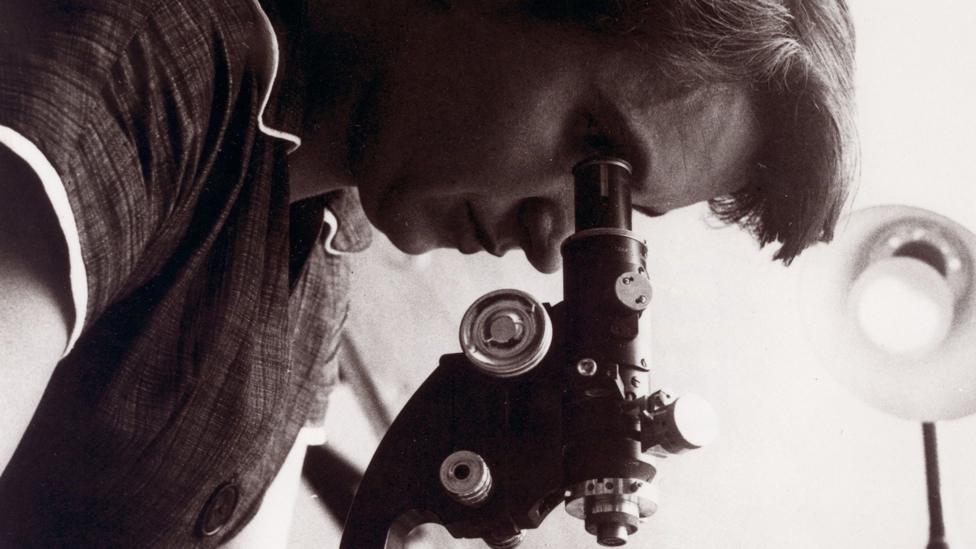 Image source, Photo12 / Universal Images Group via Getty Images
Franklin was a British chemist and crystallographer, whose X-ray diffraction work helped discover the structure of DNA