The key facts
- Unions (CGT, CFDT, CFTC) are disappointed by the meeting with Prime Minister Lecornu and are preparing strikes for November 5
- About 2,500 people taken into custody after the October 17 riots, 174 sent to prison
- Curfew extended in Paris and Lyon; Macron, from the Middle East, called for 'firmness'
Disappointment after the meeting at Matignon
Union leaders, who spent nearly two and a half hours on Wednesday in a meeting with Prime Minister Sébastien Lecornu, left it disappointed. According to CGT head Sophie Binet, the prime minister announced 'no measures' in response to the numerous protests, and the unions' demands 'were not addressed'. The unions consider the mobilization, launched by almost all of them among private and public sector workers for November 5, their central goal. Binet stated that 'it is time to move to a higher level of mobilization: from that date, strikes must take over the baton'. Marie Léon, general secretary of the CFDT, the country's largest union, expects 'social answers' to workers' expectations by that moment.
A door opens to discussion of the minimum wage
According to CFTC president Cyril Chabanier, the government nevertheless 'opened a door' to a 'discussion' on raising the minimum wage. On this topic, Prime Minister Lecornu, as reported by the outlet, called for everything to 'move quickly'. The unions also expressed regret that school and student organizations were not invited to the meeting — they are to be received on Monday by Education Minister Édouard Geffray, who promised the first measures in response to the demands of the platform created by the government. School students have been mobilized for several weeks with the support of students, demanding more funding for education, improvements to school buildings, replacement of absent teachers, and the abolition of the Parcoursup platform, which handles access to higher education and is considered deeply flawed.
Macron, from the Middle East, calls for 'firmness'
Speaking from Qatar during a Middle East tour, Emmanuel Macron called for 'firmness' toward those responsible for the violence and convened a meeting with intelligence services for Thursday to analyze the failures of October 17. At the same time, the president made no statements on the protesters' numerous demands, including purchasing power and funding for schools and universities. He then traveled to Saudi Arabia, where he was received by Crown Prince and de facto ruler Mohammed bin Salman, and stated that the French would receive a 'fair return' from this tour, including on diesel prices. On Wednesday, a number of politicians once again condemned what they saw as the government's failure: presidential candidate from Horizons Édouard Philippe criticized Macron's decision not to cancel the trip to the Gulf, former president François Hollande attacked the government, which he considers weak, and presidential candidate from the National Rally Marine Le Pen targeted what she called a 'fading government'.
Curfews extended
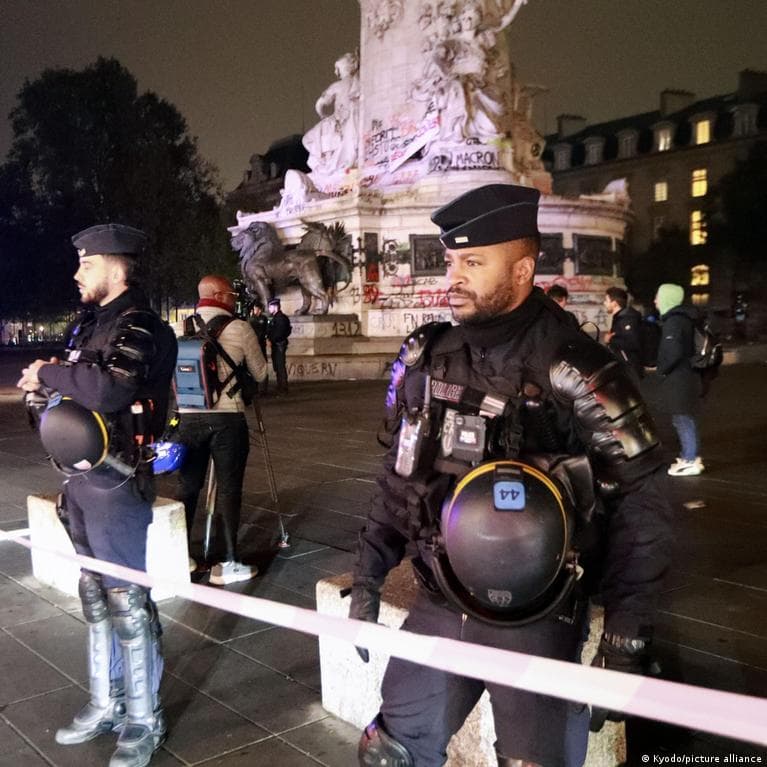
In Paris, the police prefecture introduced a new curfew for the night from Wednesday to Thursday: according to the prefecture, the decrees 'prohibit the presence of both adults and minors in zones around Place de la République and the Les Halles district from 11 p.m. today until 6 a.m. tomorrow'. In Lyon, the prefecture of the Rhône department extended the curfew and ban on gatherings in effect for the previous two nights, shifting the start time from 9 p.m. to 11 p.m. (until 6 a.m.).
About 2,500 arrested, 174 in prison
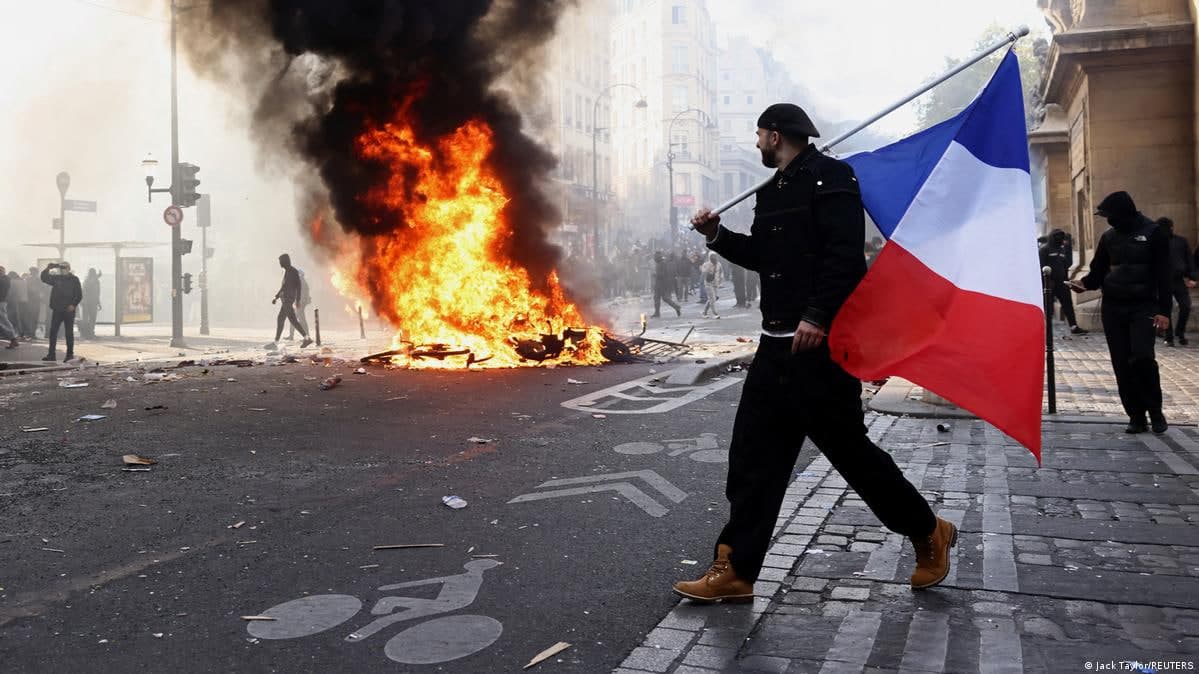
During a visit to Marseille, where fierce clashes occurred over the weekend and the city hall hall was vandalized, Justice Minister Gérald Darmanin reported approximately 2,500 people taken into custody after the violence and looting of numerous stores during the October 17 mobilization. Of them, 917 were handed over to the prosecutor's office for immediate judicial processing; the minister, who promised firm justice, said this figure had doubled or even tripled. In Paris, of the 557 arrested after the riots and looting in the capital, 300 appeared before a judge by midday Wednesday. Paris prosecutor Laure Beccuau said on Tuesday evening that no one had cited a motive 'of any political nature' — this against the backdrop of the government blaming mainly the 'far left' for the violence.
Questions about the public order strategy
The public order strategy has also been called into question for several weeks. The Defender of Rights reported on Tuesday that he had received 46 complaints since the start of the school student movement, more than ten of which concern the weekend incidents. At the same time, the IGPN, the internal police service, has ordered at least six investigations related to those two days.