The key facts
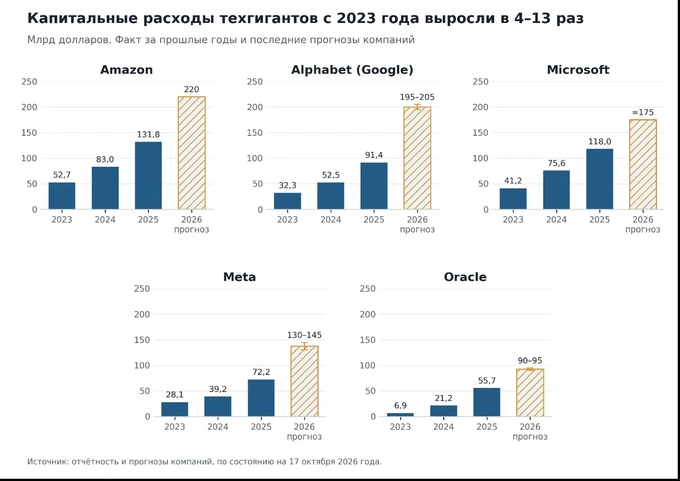
- Amazon, Microsoft, Alphabet and Meta each plan capital expenditures of $130–220 billion for 2026; data center capacity vacancy in North America is about 1.4% (JLL).
- Uzbekistan created a special regime for AI projects (UP-189) in Karakalpakstan with a tariff of $0.05/kWh, but no sites with confirmed 200–500 MW exist yet.
- Armenia launched the Firebird AI factory at 15 MW (a project worth over $5 billion), Kazakhstan signed agreements with Firebird and NVIDIA worth $10 billion; Uzbekistan plans to buy 1 MW clusters from NVIDIA.
The race for computing power and the energy shortage in the US
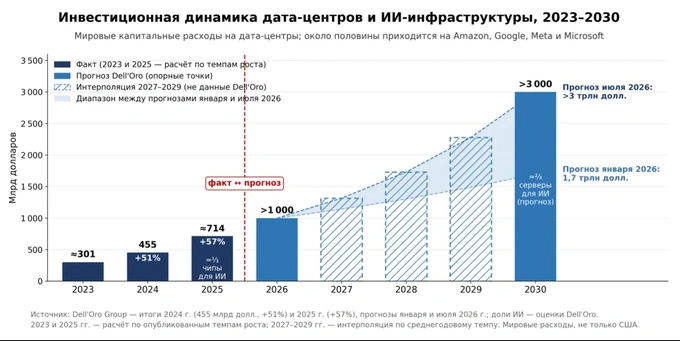
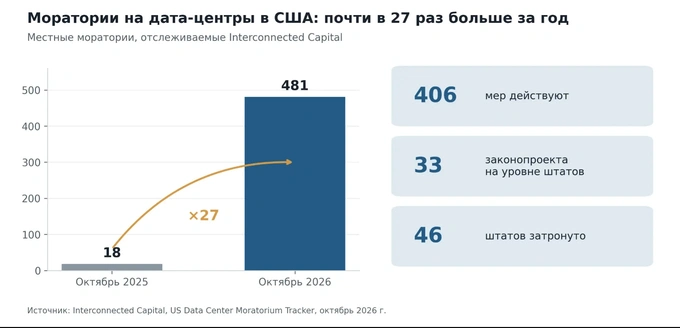
In an article for Gazeta, Bekhzodkhon Alikhanov — a senior preceptor at Harvard University and a Davis Center research fellow — examines whether Uzbekistan can attract large AI data centers. According to his data, the US is engaged in the largest infrastructure race in history: Amazon, Microsoft, Alphabet and Meta each plan capital expenditures of $130 to $220 billion for 2026. According to JLL, by the end of 2025 North America had 39 GW of operating data center capacity, and by mid-2026 another 66 GW was under construction; vacancy is about 1.4%. The Stargate program, with planned investments of $500 billion, has secured access to more than 10 GW of future capacity, while building an AI campus costs $40–60 billion per gigawatt. According to Dell'Oro Group, global data center capital expenditures grew 57% in 2025 and will exceed $3 trillion by 2030. The main constraint in the US is electricity: grid connection takes more than four years, restrictions have affected 46 states, industrial prices have risen 35% over five years, and in the first half of 2026 local opposition blocked or delayed at least 120 projects worth nearly $200 billion. According to the IEA forecast, global electricity consumption by data centers will nearly double by 2030.
What has already been done in Uzbekistan and what risks remain
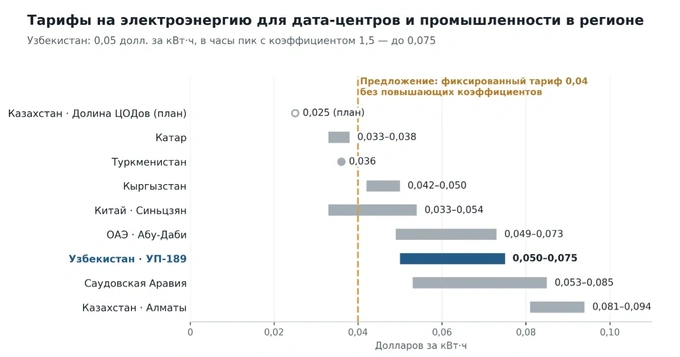
A presidential decree (UP-189) has created a special regime for AI infrastructure in Karakalpakstan: exemption from profit tax for up to 10 years, from VAT and import duties on equipment until 2040, land allocation by decision of the Council of Ministers of Karakalpakstan, and an electricity tariff of $0.05/kWh (excluding VAT) — but with a requirement to reduce load by 80% during peak hours, a 1.5 multiplier, and mandatory energy storage of 30–35% of capacity. The Enterprise Uzbekistan and TMFC regimes provide a legal framework with elements of English law and arbitration in the Tashkent International Commercial Court. By the end of 2026, nearly 6 GW of new generating capacity and about 0.9 GW of storage are planned to be commissioned. Among the risks, the author cites the absence of sites with confirmed availability of 200–500 MW, power supply interruptions, water scarcity in Karakalpakstan (closed-loop liquid cooling is needed), US export controls on NVIDIA and AMD chips (requiring a license from the US Bureau of Industry and Security), limited international internet bandwidth, and a limited market of engineers.
The neighbors' experience: Armenia and Kazakhstan are ahead
The tariff in Uzbekistan is lower than in Saudi Arabia but higher than in Turkmenistan, Qatar, Kyrgyzstan and Xinjiang; Kazakhstan is working on a tariff of about $0.025/kWh for its 'Data Center Valley'. In Armenia, the American company Firebird opened a 15 MW AI factory — the first phase of a project worth $500 million; after receiving a US export license to supply 41,000 NVIDIA GB300 GPUs, the total investment is estimated at more than $5 billion. In Kazakhstan, a package of agreements with Firebird and NVIDIA worth $10 billion has been signed, of which $1 billion is being invested by Kazakhtelecom. Uzbekistan is so far taking its first steps: the Ministry of Digital Development announced its intention to buy two clusters with a total capacity of 1 MW from NVIDIA, making contract timelines dependent on US export approvals; the largest project under construction is the DataVolt data center in Tashkent at 12 MW.
The author's proposals
Alikhanov proposes: preparing sites before public announcements, with technical passports (land, capacity, connection timelines, generation, water, communication channels); extending the UP-189 regime to the Navoi, Syrdarya and Tashkent regions; fixing a tariff of $0.04/kWh without multipliers — in his estimate, it covers the cost of new generation, so there will be no subsidizing at the expense of other consumers; revising the requirement for daily load reduction during peak hours, keeping restrictions only in case of emergency shortages with compensation; simplifying land leases for 49–99 years, creating a 'one-stop shop', allowing project companies to register under the TMFC jurisdiction, and enshrining investor protection against changes in conditions. He also advises seeking an agreement with the US on supplies of advanced chips, following Armenia's example, and first negotiating with specialized companies — Oracle, CoreWeave, Vantage Data Centers, QTS/Blackstone and Digital Realty — while in parallel holding dialogue with the largest corporations.
Conclusion
In the author's view, the electricity shortage and local resistance in the US open up an opportunity for Uzbekistan to attract investors, but the window of opportunity is closing fast: Armenia has already launched the first phase of its AI factory and obtained an American license, and Kazakhstan has signed multi-billion-dollar agreements. For the country, this is not only about investment: new generation capacity and grids, jobs, local companies' access to computing power, and exports of digital services as a new source of income will emerge. The Gazeta editorial board notes that its opinion may differ from that of the author.