The key facts
- EVs displaced ~200 million barrels of oil ($20 billion) from March to August 2026 — Ember analysis covering 56 countries
- China saved $14 billion (fleet of ~44 million EVs), EU countries $3.1 billion; six European countries — almost €2 billion
- Brent on 22 October — almost $100 per barrel, 32% above the 27 February level, on the eve of the US and Israel war against Iran
Rising oil prices and the EV response
Brent crude rose to almost $100 (about €89) per barrel on 22 October — a five-week high amid fears of escalation in the Middle East. On 27 February, the day before the start of the US and Israel war against Iran, a barrel cost $67 (€59.63) — roughly 32% less. The price rise is linked to Iran's de facto blockade of the Strait of Hormuz, a 167-kilometre corridor through which about a fifth of the world's daily oil supplies and maritime LNG supplies pass. At the same time, global electric vehicle sales grew 11% year on year, while sales of internal combustion engine cars fell 6% in the first eight months of 2026.
Ember study data
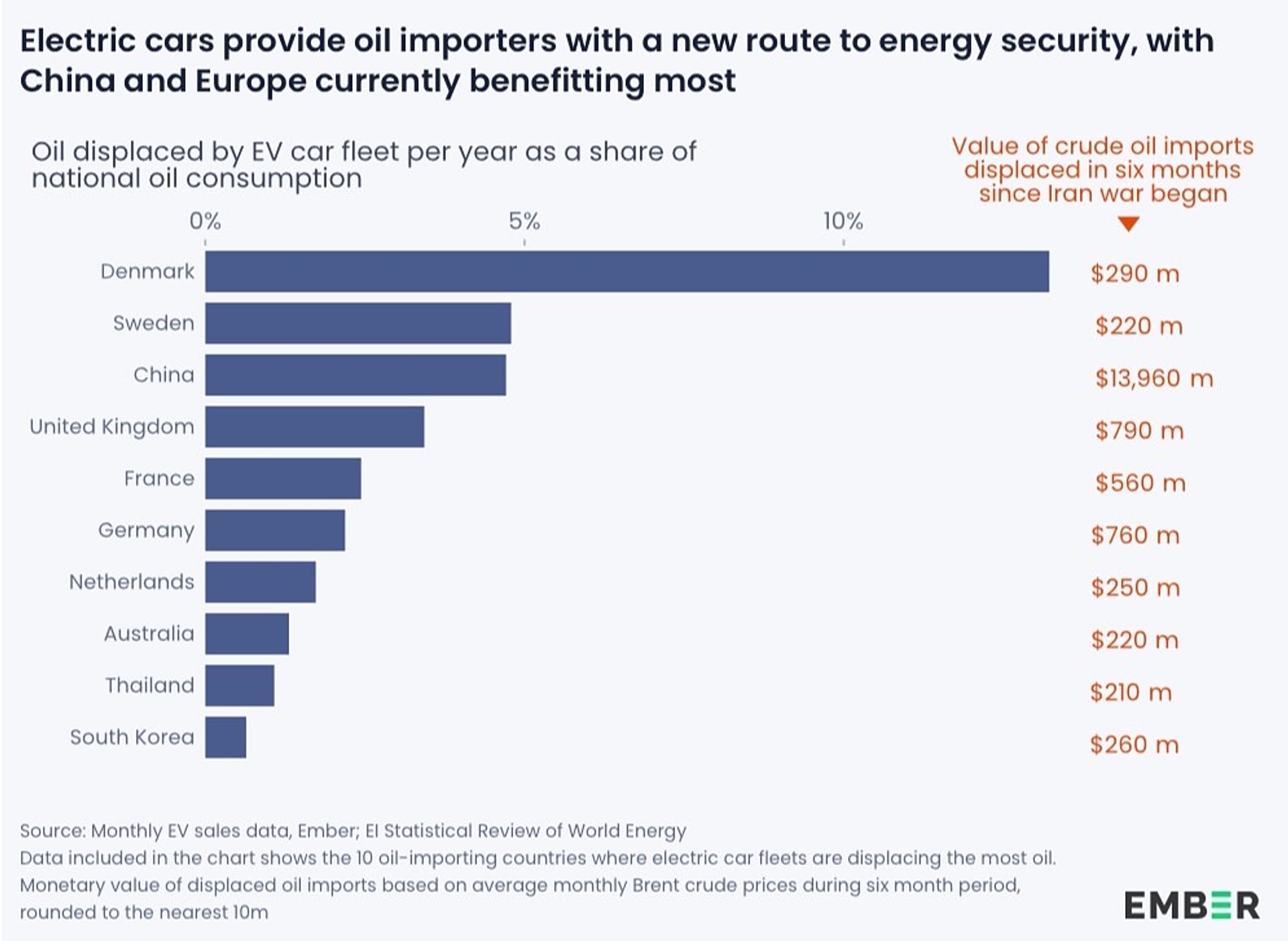
According to an analysis by the energy think tank Ember, the EV boom displaced about 200 million barrels of oil worth $20 billion (€17.82 billion) from March to August 2026. The study covered 56 countries, which account for more than 90% of global EV sales and over 80% of all car sales. China saw the largest savings: a fleet of roughly 44 million electric vehicles saved $14 billion (€12.48 billion). EU countries added $3.1 billion (€2.76 billion), of which Germany accounted for about $760 million (€677 million) and France about $560 million (€499 million).
European leaders
Denmark leads in the share of displaced oil in national consumption: as of August 2026, its EV fleet displaces 6.4 million barrels annually — 13% of oil consumption in 2025. The UK reduced its oil imports by approximately $790 million (€704 million) over the six months of the crisis; for comparison, in the 12 months to the end of August 2026 the country imported £21.5 billion (€25.64 billion) worth of oil, according to government data. Six countries — Denmark, France, Germany, the Netherlands, Sweden and the UK — together saved almost €2 billion.
Energy security and the environment
Ember senior analyst Euan Graham noted that countries that invested in electric vehicles before the crisis are now better protected, and every EV reduces vulnerability to volatile oil markets; in his words, the switch to EVs brings not only emissions reductions but also 'energy security and economic resilience'. The environmental effect depends on battery production and the charging source: according to a 2020 report by the NGO Transport & Environment, EVs are cleaner than diesel and petrol cars in all scenarios — even in Poland by roughly 30%, and at best by roughly a factor of five.
Debate around COP31
Ahead of the UN climate summit COP31, co-chair Turkey declared raising the share of electricity in global energy demand from about 20% to 35% by 2035 a 'key priority'. Experts fear the commitment will allow governments to count the expansion of gas generation as progress on electrification, which, they say, would 'seriously undermine climate goals'. Claire Smith of the Beyond Fossil Fuels coalition stated: 'We must not allow electrification to become a modern-day Trojan horse used to conceal new fossil fuel demand rather than advance renewable energy.'