The key facts
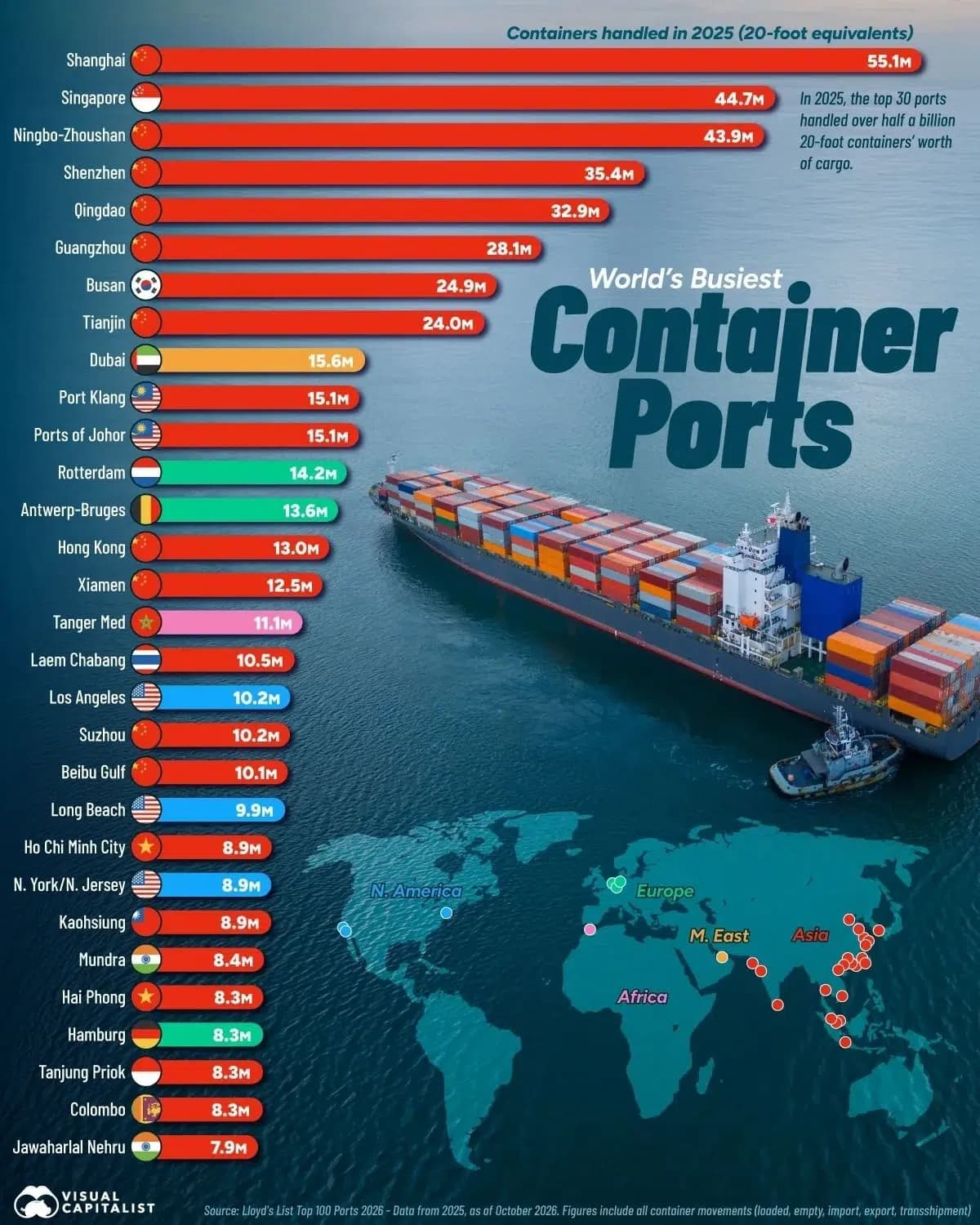
- The Lloyd's List 2026 ranking is based on 2025 container throughput in TEU (including empty containers)
- Shanghai is No. 1, its throughput more than 5 times higher than Los Angeles; Chinese ports account for nearly half of the top-30 throughput
- Singapore is No. 2, building the Tuas port with a planned capacity of 65 million TEU by the 2040s
Ranking and Methodology
The Visual Capitalist infographic is based on the Lloyd's List ranking for 2026, in which positions are determined by 2025 container throughput. Volumes are measured in TEU — conventional units corresponding to a 20-foot (about 6.1 m) container. The statistics include both loaded and empty containers.
China's Dominance
The container throughput of the Port of Shanghai is more than five times that of Los Angeles — the largest container port in the United States. Chinese ports accounted for nearly half of the total throughput of the 30 ports in the ranking; this count also includes Hong Kong with a figure of 13 million TEU. According to the publication, Shanghai serves not only the city: inland waterways and railways connect it with industrial centers in the Yangtze basin, through which products of manufacturers from central and eastern China reach foreign markets. The expansion of manufacturing in other Asian countries and the strengthening of China's trade ties with Southeast Asia are developing regional cargo networks, while Chinese ports retain an important role.
Singapore as a Transit Hub
The Singapore port model is built on linking international sea routes: the port is connected to more than 600 ports worldwide. Containers are transloaded from one vessel to another and proceed to their destination — the publication compares Singapore to a transit airport for passengers. This system, based on cargo transshipment, helped the city-state take second place in the world. Deepwater berths and automated electric cranes at the new terminals allow it to receive the largest container ships. Singapore is expanding capacity through the construction of the Tuas port, which is to consolidate container operations in one place. Full completion of the project is scheduled for the 2040s, after which the port's annual capacity is expected to reach 65 million TEU.