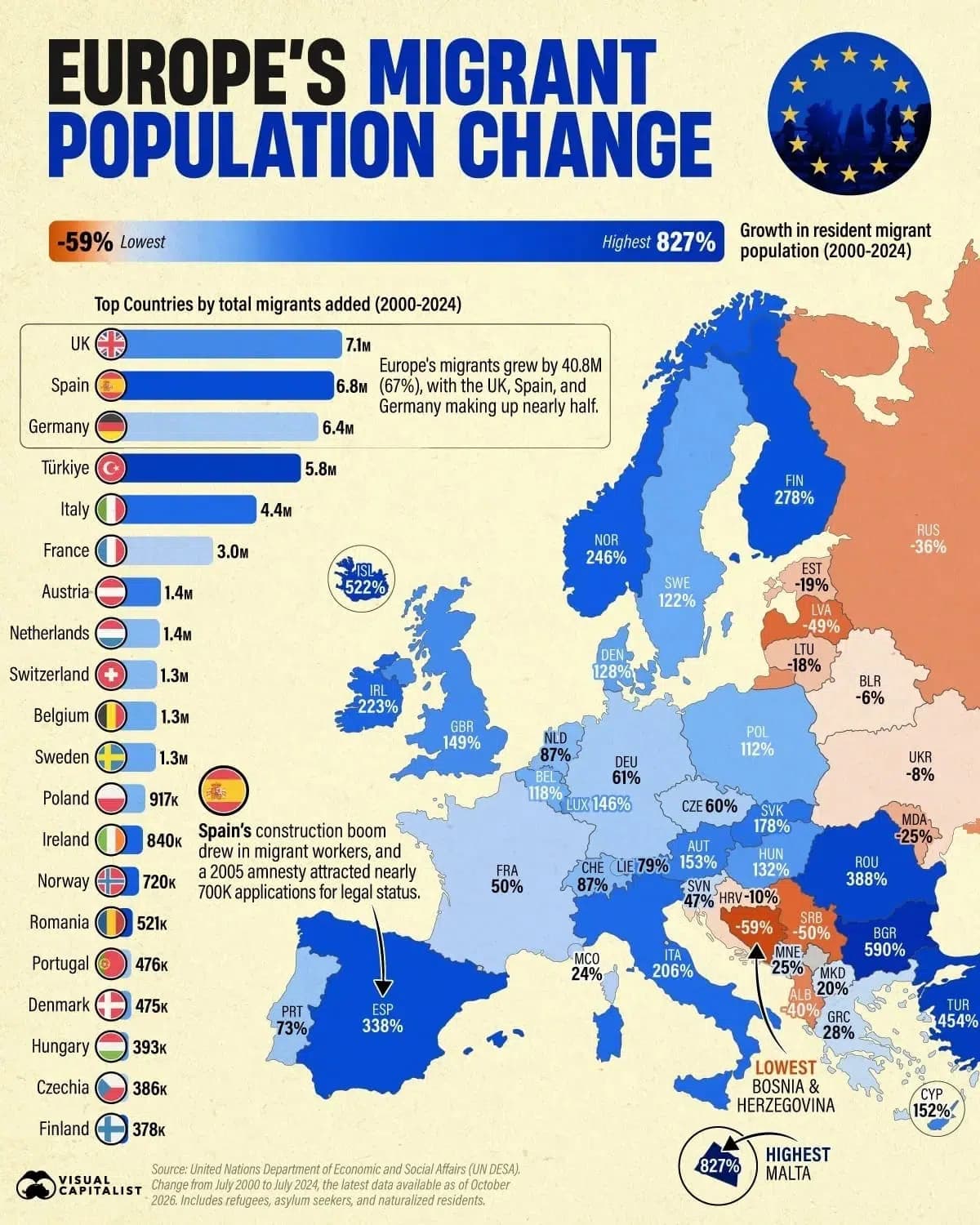
The key facts
- The UK, Spain and Germany together added about 20.4 million migrants — nearly half of Europe's overall growth.
- In percentage terms, the leaders are Malta (827%), Bulgaria (590%) and Iceland (522%).
- Russia recorded the largest absolute decline: minus 4.3 million migrants; decreases were also seen in Serbia, Ukraine and a number of Eastern European countries.
UN Data on Migrants in Europe
The infographic prepared by Visual Capitalist is based on estimates by the UN Department of Economic and Social Affairs (UN DESA). It compares the number of migrants living in European countries as of July 2000 and July 2024. The authors emphasize that these figures do not reflect the total inflow of people over 24 years or the difference between arrivals and departures — they show how the number of migrants residing in a country at a given moment has changed. Depending on national definitions, the category may include refugees, asylum seekers and persons who later obtained citizenship of the respective country.
Largest Growth in Absolute Numbers
In the UK, Spain and Germany, the number of migrants grew by a combined total of approximately 20.4 million people, accounting for almost half of Europe's overall growth. In the UK, this figure increased by 149% between 2000 and 2024. In Spain, the number of migrants grew more than fourfold; the piece partly attributes this to the construction boom of the early 2000s and the 2005 migrant legalization program, under which about 700,000 applications were submitted.
Leaders in Percentage Growth
In percentage terms, the largest growth was seen in other countries: Malta — 827%, Bulgaria — 590%, Iceland — 522%.
Decline in Russia and Eastern Europe
Growth was not observed everywhere. Russia stood out with the largest absolute decline: the number of migrants living in the country decreased by approximately 4.3 million people. A decline was also recorded in Serbia, Ukraine and a number of other Eastern European countries.
The Importance of Migration and Questions of Adaptation
According to the publication, migration helps ease labor shortages, increase the number of taxpayers and mitigate the effects of demographic decline. At the same time, if infrastructure does not develop in proportion to population growth, there may be additional strain on the housing market, schools and public services. In the adaptation of newcomers, an important role is played by work permits, housing, language learning and the recognition of qualifications and diplomas obtained abroad.