The key facts
- The exhibition “Genghis Khan and the World of the Mongols” is on at the James-Simon Gallery in Berlin from October 21, 2026 to April 18, 2027 and is dedicated to the “Mongol century” of 1250–1350.
- According to estimates cited by DW, Genghis Khan’s conquests caused the deaths of around 40 million people; at its peak the empire covered about 24 million sq. km — over 16% of the land surface.
- Curator Matthias Wemhoff emphasizes the dual legacy: reforms (writing, laws, freedom of religion, Pax Mongolica) and mass executions that changed the balance of power in Eastern Europe.
Exhibition for the 800th Anniversary of Genghis Khan’s Death
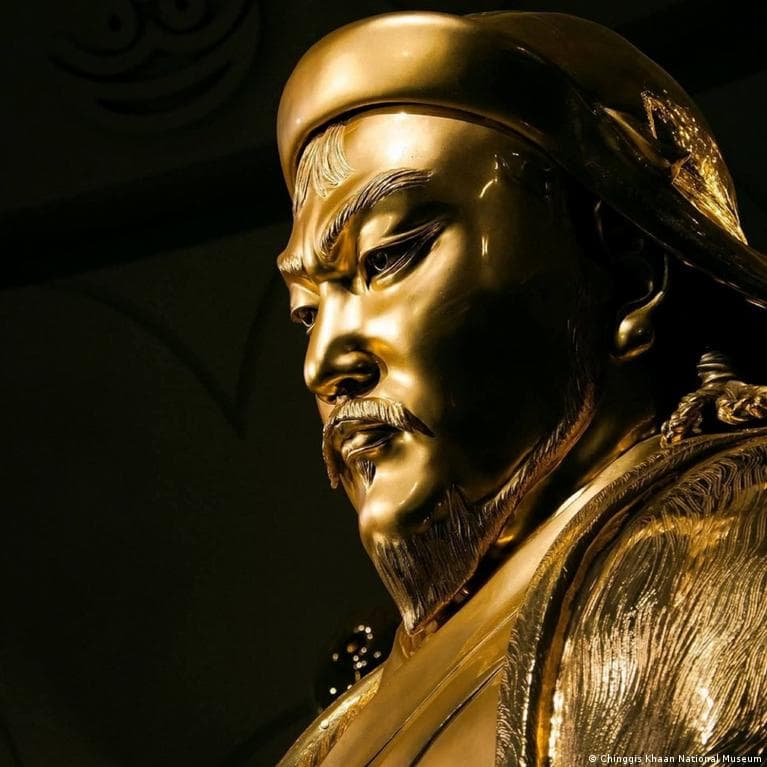
The James-Simon Gallery in Berlin presents the exhibition “Genghis Khan and the World of the Mongols,” timed to the upcoming 800th anniversary of the death of the founder of the Mongol Empire, who died in 1227. The exhibition covers the “Mongol century” — the period from 1250 to 1350 — and will run from October 21, 2026 to April 18, 2027. The head of the exhibition project, archaeologist Matthias Wemhoff, told Deutsche Welle in an interview that Genghis Khan remains an “incredibly relevant” figure to this day: his era, according to Wemhoff, vividly demonstrates how quickly established structures can collapse and vast empires can vanish from the map.
The Path from Temüjin to Great Khan
Genghis Khan was born under the name Temüjin around 1162. His father, the chieftain Yesügei, died when the boy was still a child, and the family was abandoned by the tribe. In his teenage years, Temüjin killed his older half-brother Behter to strengthen his family’s position. Thanks to his charisma, he built alliances and became the sole ruler of the Mongolian steppes, officially taking the title of Genghis Khan in 1206. At the height of its power, the empire stretched from China and Korea to parts of Eastern Europe and the Middle East, covering about 24 million square kilometers — more than 16% of the Earth’s land area. In Mongolia, Genghis Khan is revered as the founding father of the nation who united the warring steppe tribes.
Reforms: Army, Writing, Laws and Trade
Wemhoff lists a number of innovations of the Genghis Khan era. In military affairs, commanders were promoted for skill, discipline and loyalty rather than aristocratic origin or tribal affiliation; soldiers were organized into decimal units of 10, 100, 1,000 and 10,000 men. Despite being illiterate by modern standards, Genghis Khan promoted the creation of the first writing system for the Mongolian language, which made it possible to build a state bureaucracy, conduct population censuses and tax registers, record decrees and court decisions, and conduct diplomacy. Fragmented tribal customs were replaced by a unified code of laws; trade was simplified by the introduction of paper money; a policy of freedom of religion took hold throughout the empire. Mongol rule united the Silk Road, fragmented by conflicts and extortion, under a single administration, making long journeys considerably safer. The paiza — a prototype of the passport — gave official travelers protection and safe passage across Eurasia. Historians call this period of relative stability, economic growth and cultural exchange the “Pax Mongolica.”
The Cruelty of the Conquests and the Battle of Legnica
According to Wemhoff, all of this was “accompanied by an incredible level of cruelty”: mass executions and violence against women occurred on a previously unseen scale, and the total death toll of the Mongol conquests is estimated at around 40 million people. The exhibition opens with the theme of the Battle of Legnica in Silesia (Poland) in 1241 — after Genghis Khan’s death, just about 260 kilometers from Berlin. The light, mobile Mongol horsemen in lamellar armor with open faces, according to Wemhoff, could fire 20 or more arrows per minute, and the heavy European cavalry had no chance: under a hail of arrows, horses fell, and the knights lay helpless on the ground — “the two styles of fighting simply did not match each other.”
The Shift of Centers of Power and the Memory of the Mongols
The Mongols’ western campaigns shifted the historical centers of power in a way that still affects world politics today, Wemhoff notes. After the invasion of Kievan Rus — the first East Slavic state — the flourishing Kyiv turned into depopulated ruins, while Moscow became a key regional power, partly because it chose cooperation with the Mongols over resistance. According to the curator, in Western European collective memory the Mongol invasion plays an almost anecdotal role and is barely mentioned in school curricula; many Germans know the name Genghis Khan primarily through the pop group Dschingis Khan, which represented West Germany at Eurovision 1979 with the song of the same name. In Eastern Europe, however, Wemhoff emphasizes, the Mongol invasions “changed everything fundamentally — so much so that we still feel the consequences.” Wemhoff also wonders whether world politics is shaped by individual personalities or by groups and sociological processes: in Genghis Khan’s case, he believes, the answer is obvious — without him, the course of world history would have been completely different. Wemhoff is a co-author of a book about this ruler published in 2026.