The key facts
- Amazon's robot fleet has exceeded one million units, with more than 1.5 million employees
- Professor Brad Greenwood: robots are working ever closer to people and may set the pace of work
- Questions about AI in personnel management and occupational safety are being discussed; there is no statistics linking robots and injuries
A million robots in Amazon warehouses
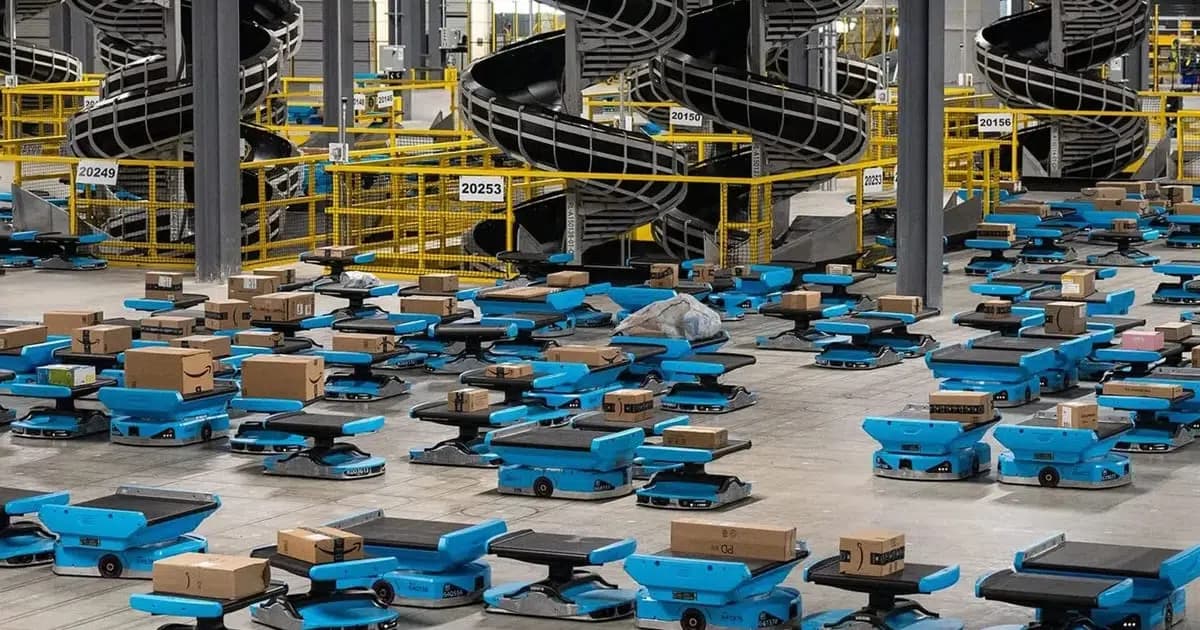
As reported by Kun.uz, citing an Ars Technica article, the number of robots at Amazon has exceeded one million. The fleet includes mechanical manipulators, mobile cargo platforms, and large machines for sorting pallets; they speed up the movement and sorting of goods in the company's logistics system. At the same time, Amazon employs more than 1.5 million people on a full-time or part-time basis, and the expansion of automation affects their daily routine.
Robots closer to people and setting the pace
Brad Greenwood, a professor of business at George Mason University, highlighted two aspects of the changes in an interview with Ars Technica. Previously, automated systems often operated in areas separated from employees, and when handing a dangerous task over to a machine, efforts were made to exclude its direct proximity to humans. Now the work zones of people and robots in warehouses are increasingly converging. In addition, machines are gaining the ability to set the pace of work: according to Greenwood, as operations accelerate, people will be required to adapt to this pace, which may become a new source of pressure.
Consequences for the company and workers
For the company, automation makes it possible to reduce logistics delays, lower costs, and increase efficiency. According to the expert, a reduced need for human labor may weaken employees' positions in negotiations with the employer — both individual and collective.
Occupational safety and AI in personnel management
The article also touches on occupational safety: against the backdrop of extensive media coverage of technological news about robots, the problem of workplace injuries may remain less visible. At the same time, the text provides no clear statistics on the link between the growing number of robots and injuries. Another topic worrying workers is the use of artificial intelligence in personnel management, in particular the automation of performance evaluation and personnel decisions, which raises questions about the role of human oversight in labor relations.