The key facts
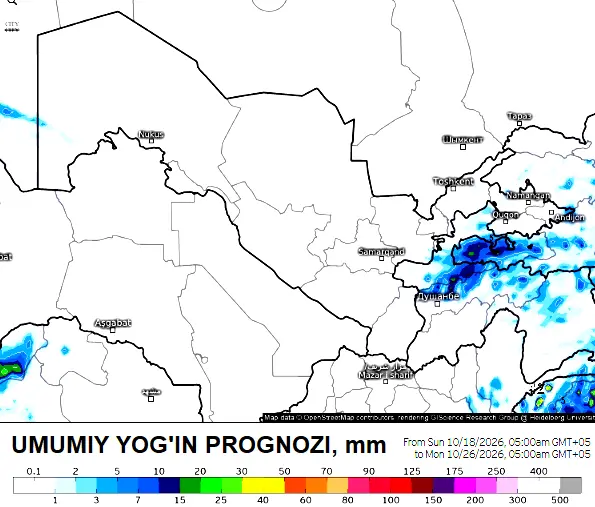
- The week will be very dry: no precipitation even in the mountains (Uzhydromet and ECMWF forecasts).
- At night in the Ustyurt and Kyzylkum deserts — down to 0 °C, in the mountains and in the north +1…+3 °C.
- Weakening winds and inversion may temporarily worsen air quality in Tashkent and the valleys.
A dry and cold week
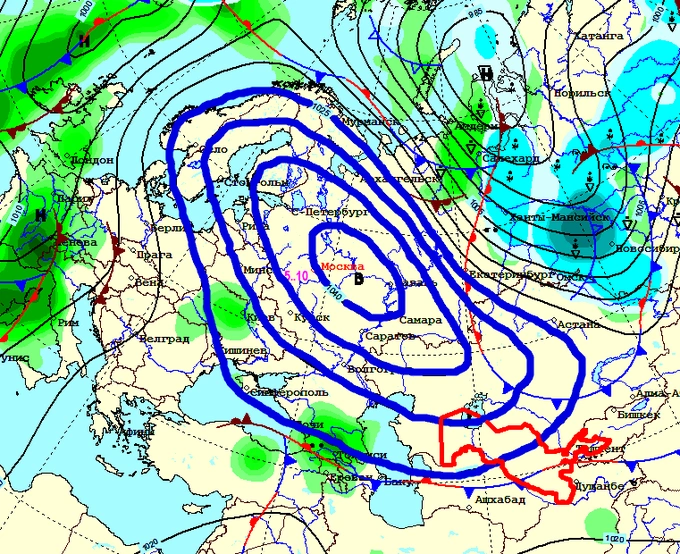
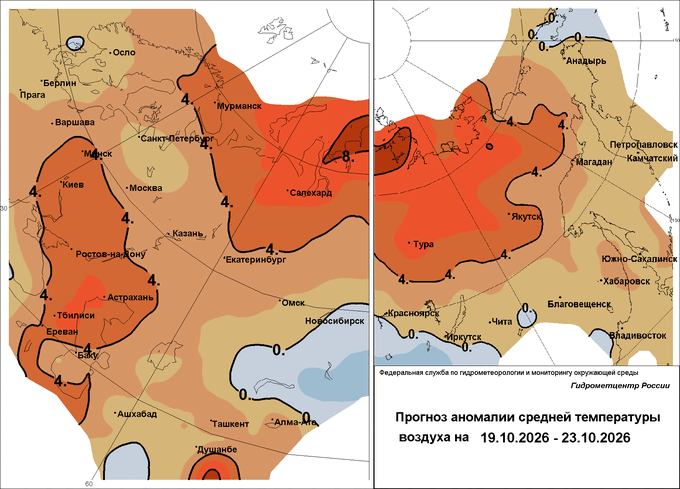
In Uzbekistan, from October 19 to 25, the weather during the working days of the week will be determined by the southeastern and then southern edge of a cold anticyclone with atmospheric pressure of up to 1045 hPa at its center. According to the foreign weather bureau (Meteoinfo.ru), the average temperature across most of the country will be around the long-term climate norm and 1–2 degrees higher — that is, warm. According to forecasts from Uzhydromet and the European center ECMWF, the week will be very dry: no precipitation is expected even in the mountains, which will make it noticeably drier than the third decades of October in previous years.
Temperature regime
At the beginning of the week, maximums of +23…+28 °C are expected across most of the republic, dropping to +17…+22 °C by October 22–23. At night, temperatures in the deserts of Ustyurt (Karakalpakstan) and the Kyzylkum (Navoi region) may drop to zero, and in the north of the country and in the mountains — to +1…+3 °C. In other regions, nighttime temperatures of +5…+8 °C are expected at the beginning of the week, slightly lower by midweek, and nighttime temperatures will rise noticeably by the weekend. Meanwhile, data on the weekly temperature differ: Meteoinfo.ru indicates 1–2 degrees above the norm, while Uzhydromet and ECMWF indicate 1–2 degrees below the norm (warmer in the mountains).
Air quality and health
Weakening winds and stagnant air on the edge of the anticyclone may temporarily worsen air quality, especially in Tashkent and the valleys, where the risk of accumulation of fine PM2.5 particles in the surface layer increases. A sharp increase in dust levels is not expected for now. The difference between nighttime and daytime temperatures may reach 20 degrees; according to international epidemiological studies, an increase in the daily temperature amplitude may raise risks to the respiratory and cardiovascular systems. Children, the elderly, and people with asthma and cardiovascular diseases should be more careful. The Sanitary and Epidemiological Committee has prepared recommendations for different age groups and patients in case of deteriorating air quality.
Bioclimate and space factors
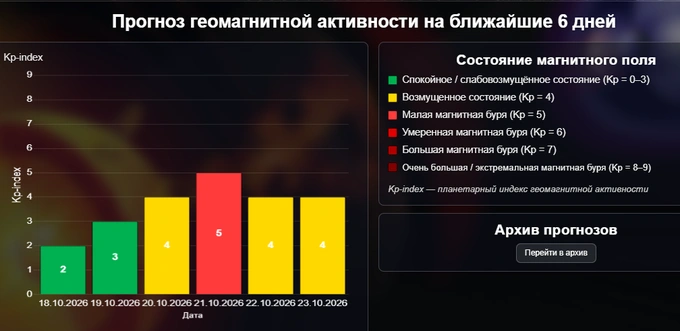
In the middle of the week, warmer clothing will be needed during the day: at +15…+17 °C, the felt temperature will be lower due to wind and humidity. By the weekend, the morning cold will weaken. According to solar activity forecasts (Spaceweather), at the beginning of the week magnetospheric disturbances will remain at the green, safe level, and in the middle of the week red-level disturbances are possible. At the same time, science does not yet have definitive conclusions about the effect of magnetic storms on health, so claiming their clear impact would be a mistake, the publication notes.