The key facts
- The Naked Science ranking takes into account laureates' place of birth within modern borders, not citizenship or place of work
- As of October 17, the Nobel organization's database contained 1,000 individuals and 28 organizations; each laureate was counted once
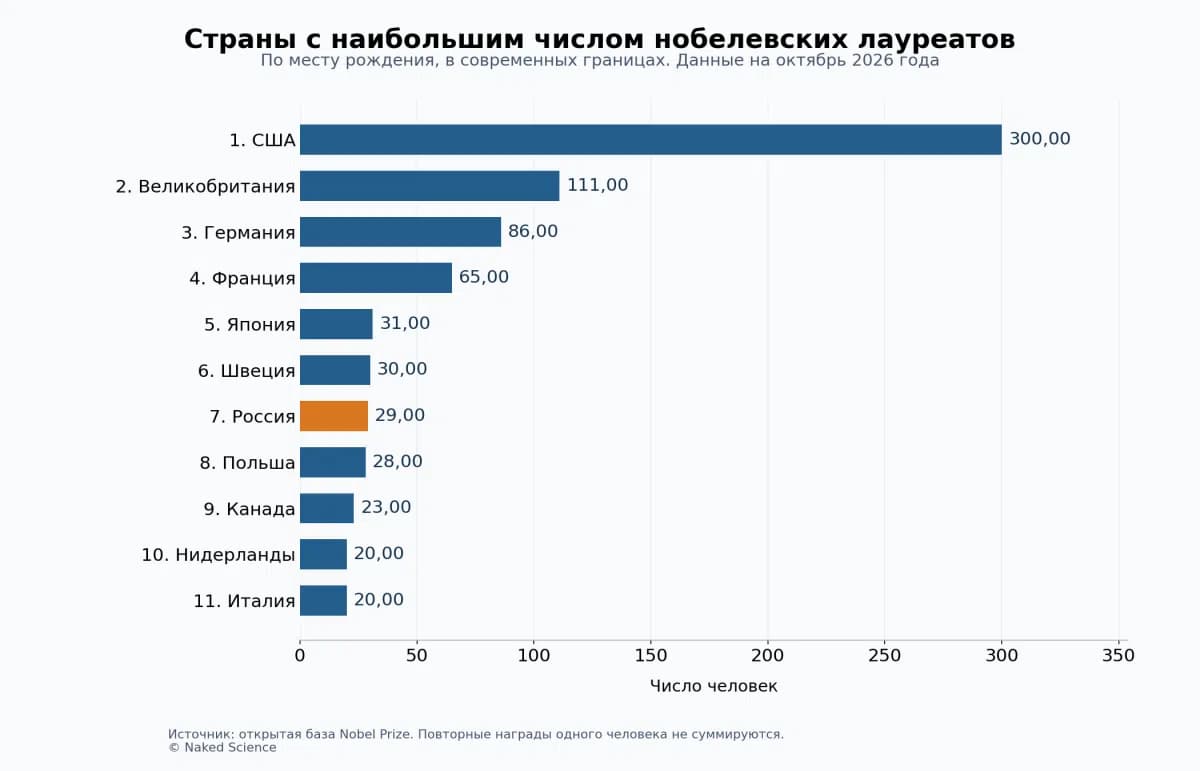
- The US — 300, the UK — 111, Germany — 86, France — 65, Japan — 31
Ranking methodology
The publication Naked Science compiled a ranking of countries by the number of Nobel laureates born there, relying on the Nobel organization's open database. As of October 17, the database contained information on 1,000 individuals and 28 organizations; only people were included in the ranking, and each laureate was counted once — for example, two-time prize winners Marie Curie, John Bardeen, or Frederick Sanger were not counted as two people. Neither citizenship nor place of work was taken into account: countries were distributed by place of birth with modern borders taken into account. Thus, Francis Halzen, who received the 2026 Nobel Prize in Physics and works in the US, was assigned to Belgium, where he was born. Laureates born on the territories of former empires and the USSR were distributed according to which modern country contains their place of birth. For the UK, records where the country is listed as United Kingdom, Scotland, or Northern Ireland were combined.
Leaders of the ranking
The largest number of Nobel laureates was born in the US — 300. They are followed by the UK (111), Germany (86), France (65), Japan (31), Sweden (30), Russia (29), Poland (28), Canada (23), as well as the Netherlands and Italy — 20 each. Since the results of two countries coincided in the last position, the list includes 11 states in total.
Laureates of 2026
Of the ten new laureates of 2026, three were born in the US — Karl Deisseroth, Robert Hall, and Michael Woodford. Peter Hegemann and Georg Nagel were born in Germany. One new laureate each was added to the tally of Belgium, France, Japan, Canada, and South Africa.