The key facts
- Benchmark announced $2 billion across two funds this summer — only the second time in its 31-year history that it has departed from small funds
- The partners maintain a pace of two to three new investment decisions per year per partner and dismiss panic over an AI correction
- Cerebras went public at $185, jumped to $350, and returned to ~$185; the partners see the volatility as a result of the 'X echo chamber'
The firm is changing, but the pace remains the same
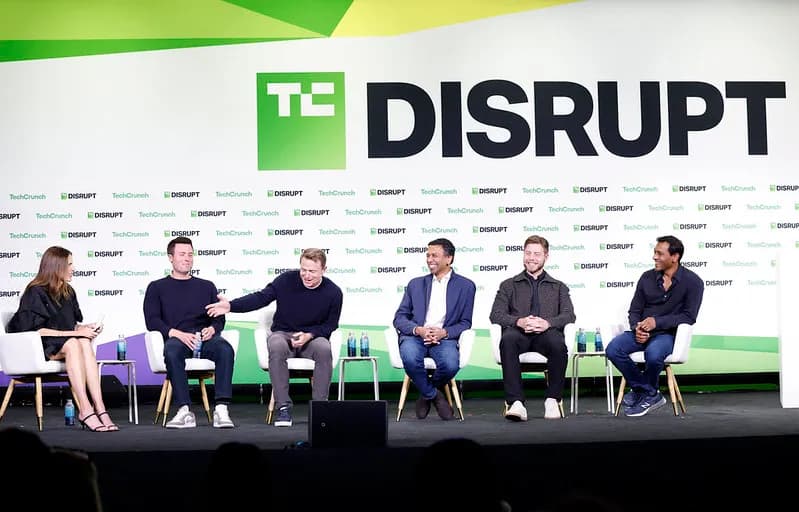
At TechCrunch Disrupt, five of Benchmark's active general partners — Peter Fenton, Ev Randle, Jack Altman, Chetan Puttagunta, and Eric Vishria — presented a picture of a firm that is in no hurry to speed up, even as the market around it is in a frenzy. Three years ago, of the four partners TechCrunch spoke with, three no longer work at the firm. This summer, Benchmark announced it had raised $2 billion across two funds — only the second time in its 31-year history that it has departed from its tradition of raising significantly smaller funds. Nevertheless, the partners maintain their usual pace: two to three new investments per year per partner, and the Monday partner meetings are held without an agenda.
Bigger funds, same approach
Peter Fenton explained that the 'craft' of the core fund remains unchanged — close work with founders at an early stage, usually stretched over 10–15 years, which, in his words, does not scale. The core fund was held at $500 million for 20 years and was increased due to inflation, which Fenton called probably a tactical mistake — something they had not done before. He called the $1.25 billion growth fund an expansion of the mandate: previously, Benchmark missed opportunities that could have returned 10 to 1,000x due to early-stage constraints. In his estimate, the growth fund will make four to six, possibly seven or eight investments, since if the fund succeeds, one or two of them will account for about 90% of the returns.
New partners and a culture without hierarchy
Ev Randle, who previously worked at Founders Fund, Bond, and Kleiner Perkins, said he was drawn to small partnerships with high 'throughput and precision' in conversations, without a 'Byzantine corporate structure.' Jack Altman, who joined in February, had raised a second fund of $275 million for his own firm a year earlier — in one week, according to him — and hosted a popular podcast. He explained the move by saying that Benchmark wants to be the first ones founders call and genuinely cares about them. On the decision-making process, the partners said there are no formal veto rules: 'nobody knows' how it works, and the rarity of deals makes the absence of formal procedures an advantage. Fenton added that Benchmark is 'not a Shark Tank': if someone in the room dislikes a founder, 'we are not the right partner.'
Conflicts of interest and Altman's first deals
Eric Vishria noted that Benchmark has avoided 'crazy direct conflicts' like the recent one between Factory and Cognition, but acknowledged that companies evolve quickly and conflicts are inevitable. Chetan Puttagunta added that in the AI era, when the cost of building products is trending toward zero, founders are more ambitious and collisions will happen more often. Altman confirmed that he has already made several investments — in chips, robotics, and infrastructure — and noted that without the partners, he might not have been able to 'get to a yes' on those deals.
Cerebras: betting on 'heretics'
Vishria said that Benchmark invested in Cerebras in the spring of 2016 in its first round, without making hardware investments for ten years. The day before the pitch, Peter Fenton said the deal contradicted all of his venture experience, but after the founders' presentation he changed his mind. Fenton called the founders 'heretics' and emphasized: 'If it's consensus, why do a startup at all?' Cerebras went public this year priced at $185, jumped to $350, and returned to around $185. Vishria showed the company charts of CoreWeave, Datadog, DoorDash, and Amazon, where swings reach 500% within a year, and remarked that being a public company requires a 'titanium stomach.' Asked about direct listings, which his former colleague Bill Gurley championed, Vishria replied that for the current generation of AI companies it is unlikely: they need large amounts of capital, and an IPO raises money — Cerebras raised $6 billion.
Panic in the X echo chamber and the role of San Francisco
Answering a question about a possible sharp correction — given the first AI bankruptcy of Character.AI — Randle called macro forecasting 'a fool's game' and said that Character.AI's Chapter 11 — of the 'remains' of a company whose team was absorbed by Google through an acqui-hire a year and a half ago, and which had already been sold for $2.3 billion — reads as a sign of an AI cooling only because of the 'hyperactive echo chamber of X.' According to him, the valuations of CoreWeave and Nebius depend on the ARR of two private companies, and the enormous capital expenditures flow through the projected health of OpenAI and Anthropic. He believes the AI ecosystem is healthy — companies cannot get enough compute for paying demand — and that what is unhealthy is the volatility from unverified data; he called the public listings of OpenAI and Anthropic helpful. About San Francisco, Altman said that being there is not mandatory for a founder, but it is 'by far the easiest place' for access to talent, capital, and customers. Fenton noted that historically more than 90% of capital returns came from companies founded in the region, and Randle added that over the past 18 months he has hardly encountered companies outside San Francisco that were not opening an office there or planning to relocate.