The key facts
- More than 2,000 arrests, over 600 injured police officers and firefighters (Interior Ministry); DW cites figures of nearly 2,400 arrested and about 1,000 injured officers
- 550,000 participants according to the Interior Ministry, nearly 800,000 according to the CGT estimate; the historic town hall in Limoges destroyed
- Macron addressed the nation; Prime Minister Lecornu blamed the 'far left', the opposition demands Minister Nunez's resignation
Scale of riots and arrests
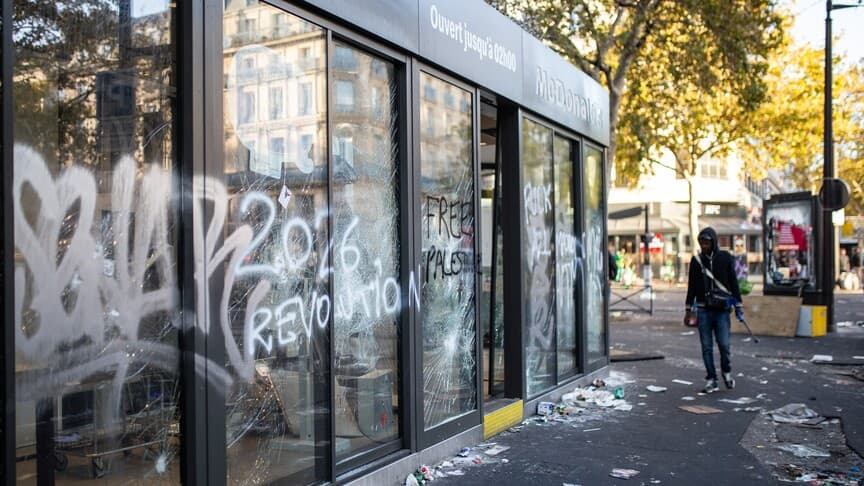
After nationwide protests against the cost of living, in which 'yellow vest' groups, trade unions, students and farmers took part, French authorities reported mass arrests. Interior Minister Laurent Nunez said on X that more than 2,000 people had been arrested and over 600 police officers, gendarmes and firefighters had been injured; he stressed that the casualty figures were preliminary. Deutsche Welle, citing the authorities, reports nearly 2,400 arrested and about 1,000 injured officers according to the Interior Ministry. Paris police reported 855 arrests, calling the figure a record; the prosecutor's office reported 720 arrests, including 517 people in custody, among them 171 minors (according to DW). Most arrests in the capital are linked to suspicion of handling stolen goods, participation in a group with intent to commit violence, and vandalism. Several hundred businesses suffered significant damage; the head of the Trade and Distribution Federation and Carrefour CEO Alexandre Bompard estimated the number of affected retailers at 1,500 and the damage at 'hundreds of millions of euros'.
Casualties and destruction
According to the Interior Ministry, 550,000 people took part in the protests across the country, including 110,000 in Paris; organisers and the CGT union put the turnout at nearly 800,000. The main march in Paris passed without major incidents, but violence flared on the fringes of demonstrations in a number of cities. A demonstrator died after cardiac and respiratory arrest on Boulevard Magenta in Paris. Le Parisien and Le Figaro reported that a 17-year-old teenager lost a hand to a police grenade in Saint-Étienne; the police and gendarmerie are conducting an investigation. In Limoges, fire destroyed almost the entire historic section of the town hall — Haute-Vienne prefect Maurice Barat said the fire was nearly extinguished, but the historic section was almost completely lost. Mayor Guillaume Guérin told LCI: 'There are no words to condemn what happened, it is so terrible. The country is in chaos.' Looting and damage to buildings were also recorded in Marseille, Lyon, Bordeaux, Avignon and Grenoble; police used tear gas, batons and water cannons.
Government response
Paris mayor Emmanuel Grégoire announced the creation of an emergency task force to help affected businesses and said at a meeting with businesses, insurers and government agencies: 'Nothing can justify such actions. No anger, no demands, however legitimate they may be, can justify attacks on those who work.' Prime Minister Sébastien Lecornu blamed the violence on the 'far left' and promised Limoges state financial support and accelerated reconstruction. The interministerial crisis meeting, originally scheduled for Sunday evening, was moved to 10 a.m. Monday; Lecornu will also meet with the mayors of Paris, Marseille and Lyon, who demanded explanations about police resources. The Association of Mayors of France called for gatherings outside town halls at noon on Monday to condemn the attacks on public buildings. President Emmanuel Macron addressed the nation at 8 p.m. on Sunday, saying that 'nothing justifies' the violence, called for separating protesters with 'legitimate demands' from those who 'destroyed, smashed and looted', and promised 'full transparency' regarding police actions.
Opposition and political context
National Assembly speaker Yaël Braun-Pivet, according to BFMTV, is considering creating a parliamentary investigative commission and will meet with faction leaders on Tuesday. Green politician Marine Tondelier and deputy Alexis Corbière called for Minister Nunez's resignation; the same demand is made by the 'National Rally'. Presidential candidate Marine Le Pen accused Jean-Luc Mélenchon's party of 'legitimising violence', while Mélenchon himself, who supported the protests, urged demonstrators to stay away from looting. US President Donald Trump blamed immigration for the protests in a post on Truth Social. DW notes that the riots have heightened tensions ahead of the 2027 presidential election against the backdrop of high debt and a budget deficit that limit the government's spending options. Social media saw calls for new gatherings on Sunday, including a rally at Place de la République at 2 p.m.; new clashes occurred there on Sunday — police used tear gas and a water cannon, there were arrests, and protesters built barricades. The 'yellow vest' movement emerged in 2018 from protests against fuel tax increases.