The key facts
- Protests against rising prices took place in Milan, Turin and Bologna after similar actions in France on 17 October
- In Milan, 50 people were detained (60 according to Kun.uz), half of them minors; 25 injured, including 10 police officers
- Meloni condemned the violence; opposition politicians noted that a peaceful protest cannot be criminalized
Protests spread from France to Italy
On the wave of mass demonstrations in France held on 17 October against the rising cost of life and for reform of school and higher education (reportedly attended by 500,000 to 800,000 people, with more than a thousand detained), actions against rising prices also took place in Italy. They escalated into violent clashes with police.
Milan: street battles in the city centre
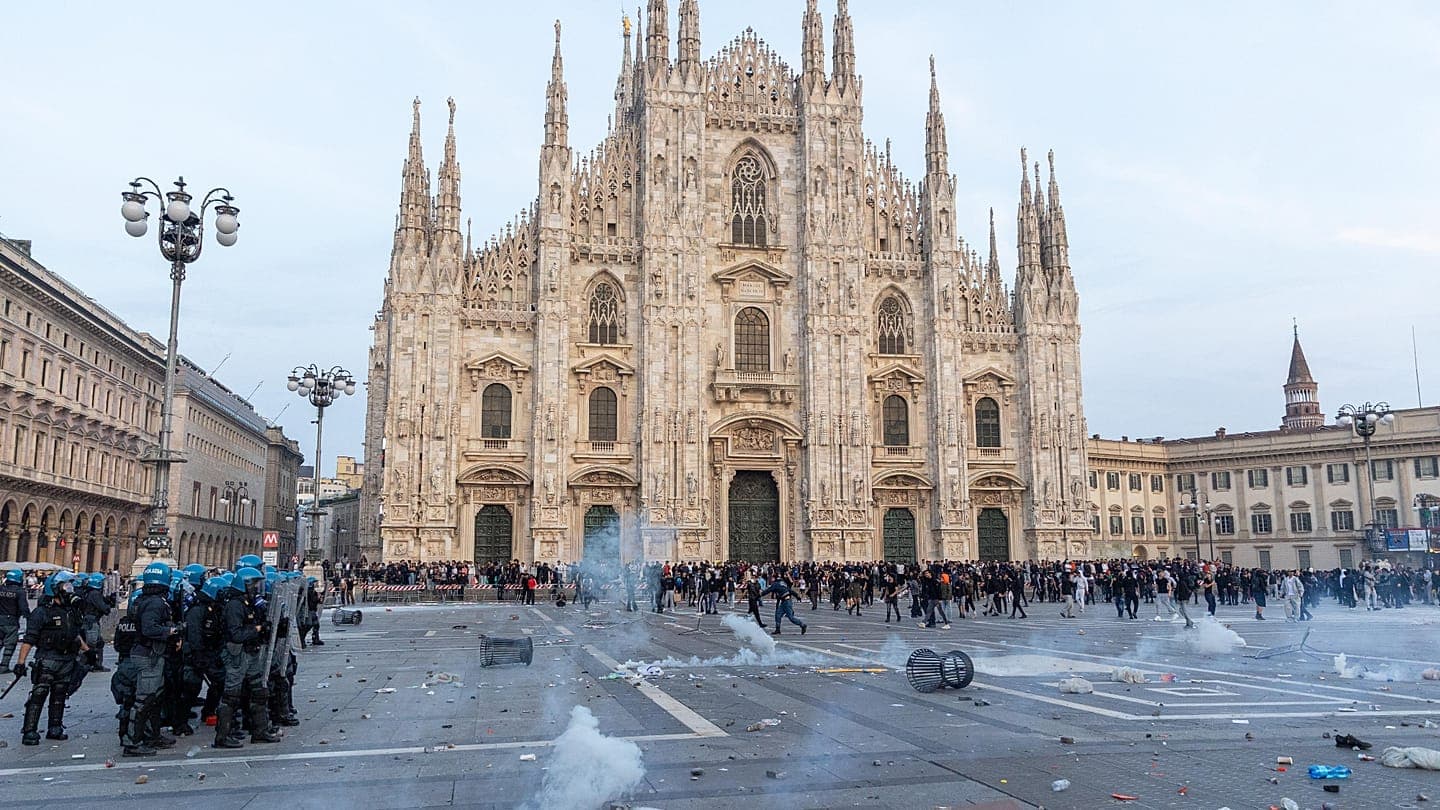
The greatest tension was recorded in Milan, where the march got out of control first on Via Brolletto and then in the centre, above all on the Duomo square. Police used tear gas, water cannons and hydrants; demonstrators used fire extinguishers, firecrackers and fireworks, and threw bins and barriers. A police cordon passed through the Galleria Vittorio Emanuele II, and metro stations M1 and M3 were closed. Several shops in the centre were vandalized, and a portable toilet was set on fire on the Duomo square. According to euronews, 50 people were detained, half of them minors; Kun.uz reported 60 detainees. 25 people were injured and taken to hospitals, ten of them police officers; no one was in critical condition.
Turin and Bologna
In Turin, riots involving young hooded demonstrators continued for about an hour: garbage containers were rolled onto the road, tables and chairs from terraces were used as barricades, and bottles, firecrackers, sticks and stones were thrown at the police. 12 people were detained, 10 of them minors; Molotov cocktails, firecrackers, cobblestones and hammers for breaking windows were seized from them. In Bologna, clashes concentrated near the railway station and on the Piazza Medaglie d’Oro: a group of protesters broke away from the march, throwing smoke bombs, bottles and barriers, and dozens of rental bicycles were knocked over. Police used water cannons and tear gas, and seven people were detained. According to Kun.uz, in Bologna the station had to be closed as a precaution due to the riots.
Politicians' reaction
Prime Minister Giorgia Meloni, referring to the CGIL trade union demonstration, said that taking to the streets is a right, but condemned the riots: according to her, in Milan stones were thrown at police officers and there are injured among the staff, in Turin people were detained with stones and hammers for breaking shop windows, and in Bologna the station was closed. “I once again address the opposition: do not be ambiguous about this. Any evasiveness turns into an excuse,” she wrote on X. Deputy Prime Minister Antonio Tajani stated that “it is unacceptable that part of the centre-left opposition pours fuel on the fire,” and Matteo Salvini called the rioters “street rabble and rotten left-wing scum.” Mayor of Milan Giuseppe Sala noted that the causes of the protest were understandable, but violence and damage to the city were unjustified, and expressed hope that politics would choose the path of wisdom rather than speculation. Leader of the Democratic Party faction in the Lombardy regional council Pierfrancesco Majorino stated that episodes of violence must be decisively condemned, but they cannot be used to criminalize students who peacefully raise issues of the right to housing, education and the future.