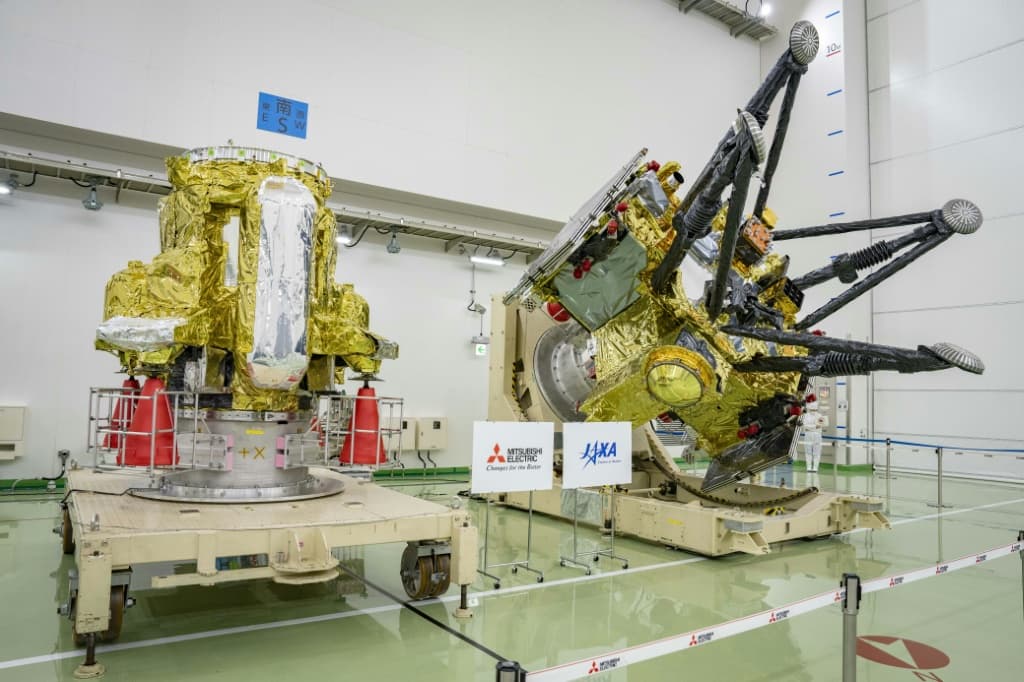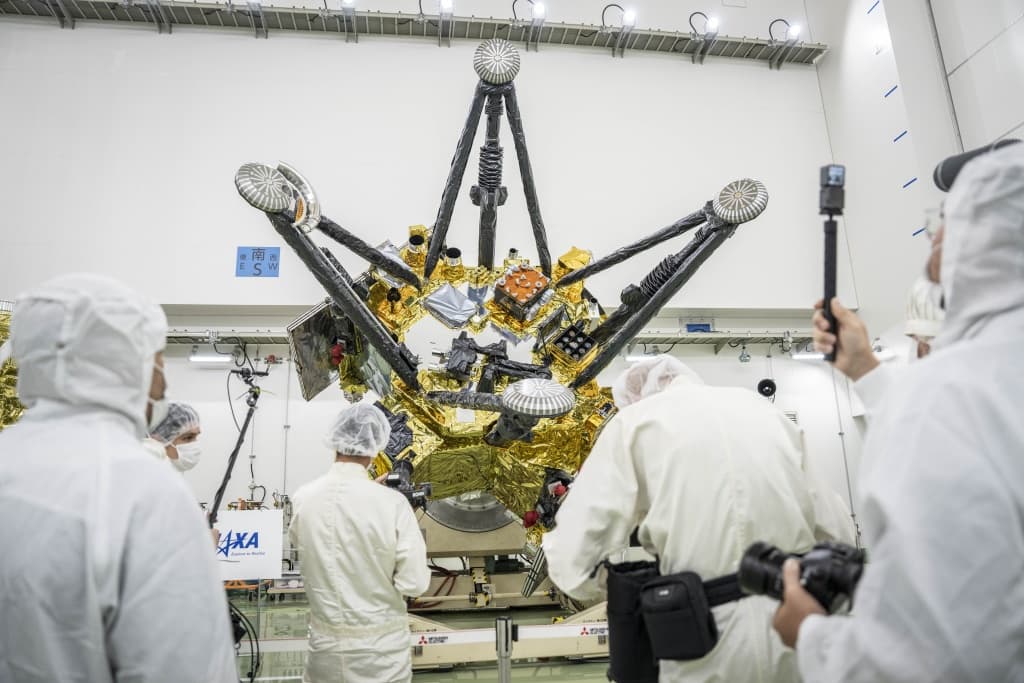
The key facts
- The MMX launch on an H3 rocket is scheduled for October 20, 2026, at 4:41 a.m. local time, from the Tanegashima spaceport
- The spacecraft will collect at least 10 grams of Phobos soil; return to Earth is expected in 2031 (per NHK, in the fiscal year ending March 2032)
- An international JAXA project involving NASA, ESA, CNES, DLR and about 20 universities and companies; development cost — 55.3 billion yen (~$350 million)
History's First 'Round Trip' to the Martian System
The Japan Aerospace Exploration Agency (JAXA) is preparing to launch the unmanned Martian Moons eXploration (MMX) spacecraft, which is to become the first mission to make a round trip to the Martian system: it will fly to Mars, land on its moon Phobos, collect samples and return them to Earth. The launch on the flagship H3 rocket is scheduled for October 20, 2026, at 4:41 a.m. local time (19:41 GMT on October 19) from the Tanegashima Space Center in Kagoshima Prefecture. According to NHK, the total development cost of the three-module spacecraft was 55.3 billion yen (about $350 million).
Mission Plan
The spacecraft will reach the vicinity of Mars about a year after launch — according to the BBC, arrival at Phobos is expected in August 2027. First, MMX will study Mars's second moon, Deimos, without landing on it, and then focus on Phobos, around which it will operate for up to three years. A small rover, IDEFIX (the name references Asterix's dog, Dogmatix/Idefix), developed with the participation of France's CNES, will be deployed onto the surface of Phobos: it will conduct surface observations and help select a safe landing site. Then the spacecraft itself will land on Phobos, deploy a robotic arm and two samplers, and collect at least 10 grams of material. The capsule with samples will return to Earth in 2031 and land in the Woomera desert in South Australia; NHK reports that the return module will likely deliver the samples in the fiscal year ending in March 2032.
Why the Samples Are Needed
The main scientific goal is to find out how Phobos and Deimos formed. There are two competing hypotheses: the 'giant impact' hypothesis, according to which the moons formed from debris after a large body struck Mars, and the 'capture' hypothesis, under which they are asteroids captured by the planet's gravity. Professor Sara Russell of the Natural History Museum, responsible for sample analysis in the mission, noted that the chemical and mineral composition of the samples will quickly determine which version is correct. Scientists also hope that the soil of Phobos, which orbits just 6,000 km above the surface of Mars, may contain particles of material ejected from the planet — this would provide direct information about Mars's composition and history. French astrophysicist Patrick Michel added that Phobos and Deimos may preserve traces of mechanisms that delivered water, volatiles and organic compounds from the outer Solar System to the inner planets.
Technical Challenges and Japan's Experience
Landing on Phobos, which is about 20 km in size (Deimos is about 10 km), will be challenging: the moon's gravity is extremely weak, and Mars with far stronger gravity is nearby. According to Russell, no one has ever managed to land a rover on such a small body; the development of the spacecraft's landing legs was particularly difficult, JAXA notes. MMX project manager Yasuhiro Kawakatsu emphasized that, unlike JAXA's previous asteroid missions, the spacecraft now needs to 'get very close to Mars and return,' overcoming its powerful gravity. Japan has relevant experience: in 2020, the Hayabusa-2 spacecraft delivered 5.4 grams of material from an asteroid to Earth, and the SLIM lander tipped over during its 2024 Moon landing but continued transmitting data and survived several two-week lunar nights.
Context: The Race for Martian Samples
Delivering Martian soil to Earth is a long-standing goal of planetary science. NASA's Perseverance rover has been collecting samples on Mars since 2021, but the joint NASA and ESA Mars Sample Return program, which was supposed to return them to Earth, has effectively been cancelled: funding was suspended by the US Congress in January, and, according to AFP, the project was shut down by the administration of President Donald Trump. China, for its part, plans the Tianwen-3 mission with a launch around 2028 and the return of samples to Earth as early as 2031 — potentially earlier than MMX's return. Martian meteorites already exist on Earth, but they are rare and become contaminated after falling, so scientists are counting on pristine samples from Phobos. JAXA also notes that the mission will study the possibility of using Phobos as a 'natural space station' and will test requirements for a round trip that are important for a future crewed expedition to Mars.