The key facts
- An H3 rocket carrying the MMX probe lifted off from the Tanegashima Space Center at 4:41 a.m. (1941 GMT Monday); JAXA confirmed the spacecraft's successful separation.
- MMX is expected to arrive at Mars around August next year, enter orbit around Phobos, collect at least 10 grams of soil and study the Mars system for three years.
- The mission involves the Franco-German IDEFIX rover, NASA and European agencies; China plans the Tianwen-3 mission around 2028 with sample return by 2031.
Successful launch toward the moons of Mars
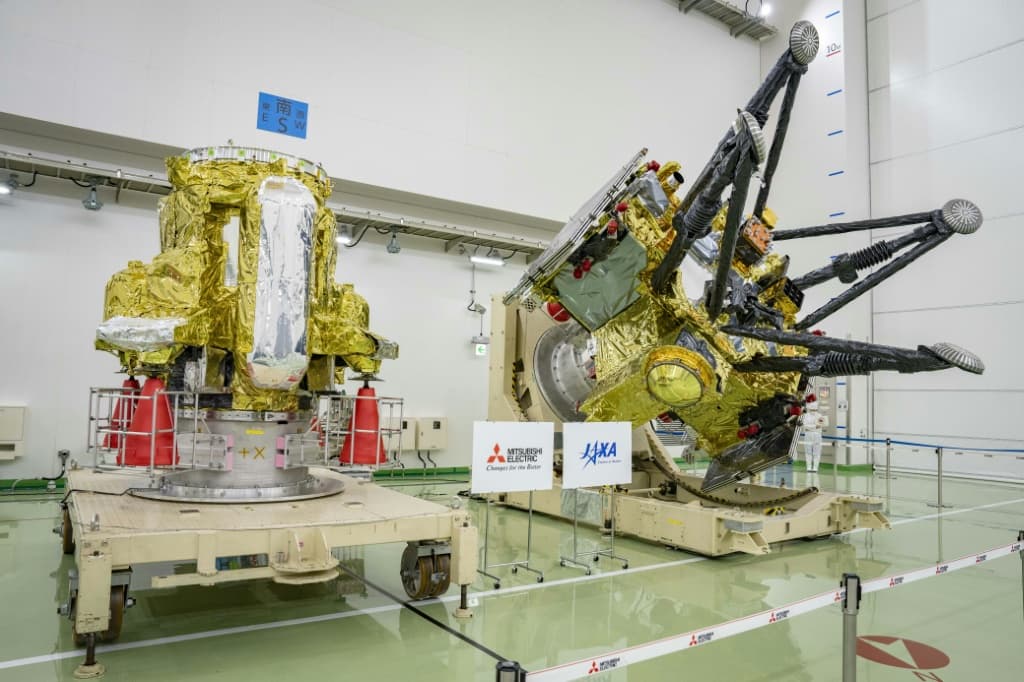
Japan's aerospace agency (JAXA) on Tuesday launched an H3 rocket carrying the unmanned Martian Moons eXploration (MMX) probe, which is set to become the first spacecraft to deliver samples from one of Mars's moons. The liftoff took place at 4:41 a.m. local time (1941 GMT Monday) from the Tanegashima Space Center, with the broadcast streamed on JAXA's website. Despite the early hour, thousands of spectators watched the launch, leaving messages of support. More than an hour later, the agency announced that the probe had successfully separated from the rocket and had 'begun its journey to the Martian system.' 'I dreamed of this day, so I am incredibly happy. Right now I feel enormous relief,' said JAXA scientist Mari Aida.
Mission plan
The spacecraft is expected to arrive at Mars around August next year and enter orbit around Phobos. Later, MMX will land on the moon and collect at least 10 grams (0.35 ounces) of material from its surface during three planned years of operations in the vicinity of the Red Planet. The mission will also observe Mars's second moon, Deimos, although no landing on it is planned. The first spacecraft to traverse the surface of Phobos will be the Franco-German rover IDEFIX (named after the dog in Asterix), which will conduct surface observations to ensure a safe landing. According to AFP, the mission claims the first 'round trip' to the Martian region.
Scientific goals
JAXA expects the mission to show how Mars and its two moons formed — a key to understanding the birth of the Solar System. There are two hypotheses: the 'giant impact' hypothesis, under which the moons formed after a celestial body struck Mars, and the 'capture' hypothesis, which suggests they are asteroids pulled in by Martian gravity. Determining the correct hypothesis, according to JAXA, will help understand 'how a habitable environment could arise on terrestrial planets' — Mercury, Venus, Earth and Mars. The agency will also study the possibility of using Phobos as a 'natural space station,' determining the requirements for a round trip — which, according to JAXA, is 'necessary for crewed exploration of Mars.'
International cooperation and competition
The mission is being carried out in cooperation with American and European space agencies, as well as a number of universities and technology companies. 'MMX's samples will bring paradigm-shifting science on the Mars system for future generations, especially as NASA prepares to send the first humans to Mars,' said Nikki Fox, administrator of NASA's Science Mission Directorate, in a message shown during JAXA's broadcast. The United States and China are also competing for primacy in returning Martian samples. NASA's Perseverance rover, operating on Mars since 2021, has already collected samples, but the mission to return them was effectively cancelled by the administration of President Donald Trump after a vote in Congress in January. China's Tianwen-3 spacecraft is planned for launch around 2028 and could return samples to Earth by 2031 — potentially earlier than the Japanese mission.