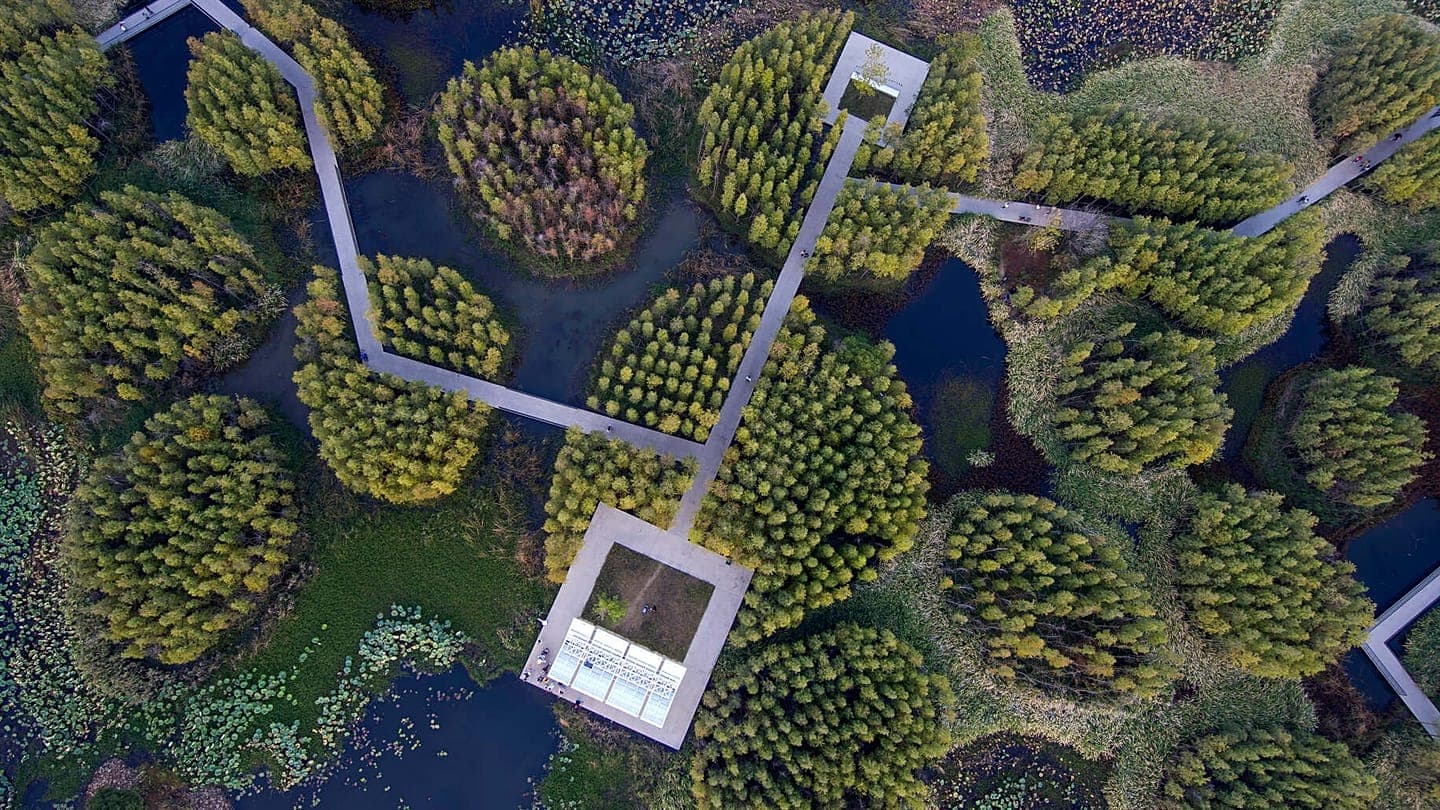
The key facts
- The sponge city concept was developed by Chinese landscape architect Kongjian Yu in the early 2000s; by 2030 China plans to convert 80% of urban built-up areas to this model.
- In Europe, examples exist in Malmö (the Augustenborg district), Rotterdam (Benthemplein) and Copenhagen (Tåsinge Plads); the EU is developing a 'Sponge Facility' mechanism.
- According to Justin Abbott of Arup, sponge cities do not replace traditional drainage infrastructure — the 2024 floods near Valencia showed the limits of such solutions.
Water as a double threat and a resource
Abrupt weather swings have made water a double threat for European cities: during storms there is too much of it, and in droughts too little. In the view of a number of experts, the 'sponge city' concept — a nature-based approach to urban planning first tried out in China two decades ago — could solve the problem. The model involves upgrading urban areas with green spaces, permeable surfaces and water storage systems that absorb, retain and reuse rain instead of channeling it into the sewer system. This reduces the load on drainage networks and preserves water supplies for dry periods. 'One of the most effective ways cities can adapt is to rethink a century of urban planning practices that treated precipitation as waste rather than a valuable resource,' says Justin Abbott, a fellow and head of the European water practice at the engineering consultancy Arup.
Origins of the concept
The sponge city model was developed in the early 2000s by the Chinese landscape architect Kongjian Yu. He proposed using ponds, wetlands and planted drainage channels to intercept rainwater before it enters sewers and rivers. Slowing the runoff, by his calculations, reduces flood risk, while the collected water can replenish groundwater or be used to irrigate parks during droughts. Greenery also cools streets during heatwaves, and in some cases healthy soil and wetlands help protect against wildfires. After the catastrophic 2012 flood in Beijing, which killed 79 people, Yu's ideas began to be taken more seriously. In 2014 China adopted national guidelines for sponge city development, in 2015 launched a pilot programme in 16 cities including Wuhan, Xiamen and Chongqing, and in 2016 added 14 more, among them Shanghai and Shenzhen. By 2030 China plans to turn 80% of built-up urban areas into sponge cities.
European experience
Similar projects have been implemented in Europe for several decades. From 1998 to 2002, Sweden's Malmö transformed the flood-prone Augustenborg district, installing green roofs, creating wetlands, retention ponds and six kilometres of water channels; during the severe storms of 2007 and 2014 the district suffered significantly less damage than other parts of the city. In Rotterdam (the Netherlands), the water square Benthemplein, opened in 2013, serves as a basketball court and recreation area in dry weather, while during rains its three basins temporarily hold up to 1.7 million litres of water. Tåsinge Plads, opened a year later in Copenhagen (Denmark), collects water from nearby roofs using underground reservoirs and rain gardens — shallow planted areas through which water seeps into the soil. The European Commission expects to expand such projects: the Water Resilience Strategy adopted in 2025 provides for the development of sponge cities and the restoration of wetlands, and the EU is currently working on a 'Sponge Facility' mechanism to support such initiatives.
Limitations and implementation difficulties
The changes are not easy: protected buildings, narrow streets and underground utilities complicate the reconstruction of historic centres. According to Abbott, this is no reason to abandon unconventional solutions: 'These complexities should spur a more targeted approach, not inaction.' He proposes small interventions — removing asphalt from courtyards, planting more trees, installing green roofs partially or fully covered with vegetation. At the same time, even the greenest city can absorb only a limited amount of water: during extreme storms the soil becomes saturated, reservoirs fill up, and the excess water has nowhere to go. The catastrophic floods in the vicinity of Valencia in 2024 showed what consequences can follow when extreme rainfall overwhelms urban defences. 'Sponge city measures are indeed a powerful tool, but they cannot on their own solve all the problems,' Abbott stresses.
An integrated approach
In Abbott's view, cities still need traditional drainage systems, large reservoirs and specially designated overflow routes along which floodwaters can escape when rain gardens and wetlands reach capacity. It is not only about engineering: responsibility for stormwater management, the expert believes, lies with city authorities, water operators, developers and landowners, and one participant's decisions can affect entire neighbourhoods. 'When planning and designing cities, water must be thought about first of all. We need


