The key facts
- Le Pen promises to stop financial aid to Ukraine after six months due to the state of French finances and to limit France's net contribution to the EU budget to €5 billion instead of €8 billion
- Since 2022, France has sent Ukraine about €27 billion: €7.9 billion in bilateral aid and €19 billion through European mechanisms (Kiel Institute)
- Zelensky called Le Pen's position insufficiently informed; Meloni confirmed the course of supporting Ukraine, pressuring Russia, and Euro-Atlantic unity
Le Pen's promises on Ukraine and the EU budget
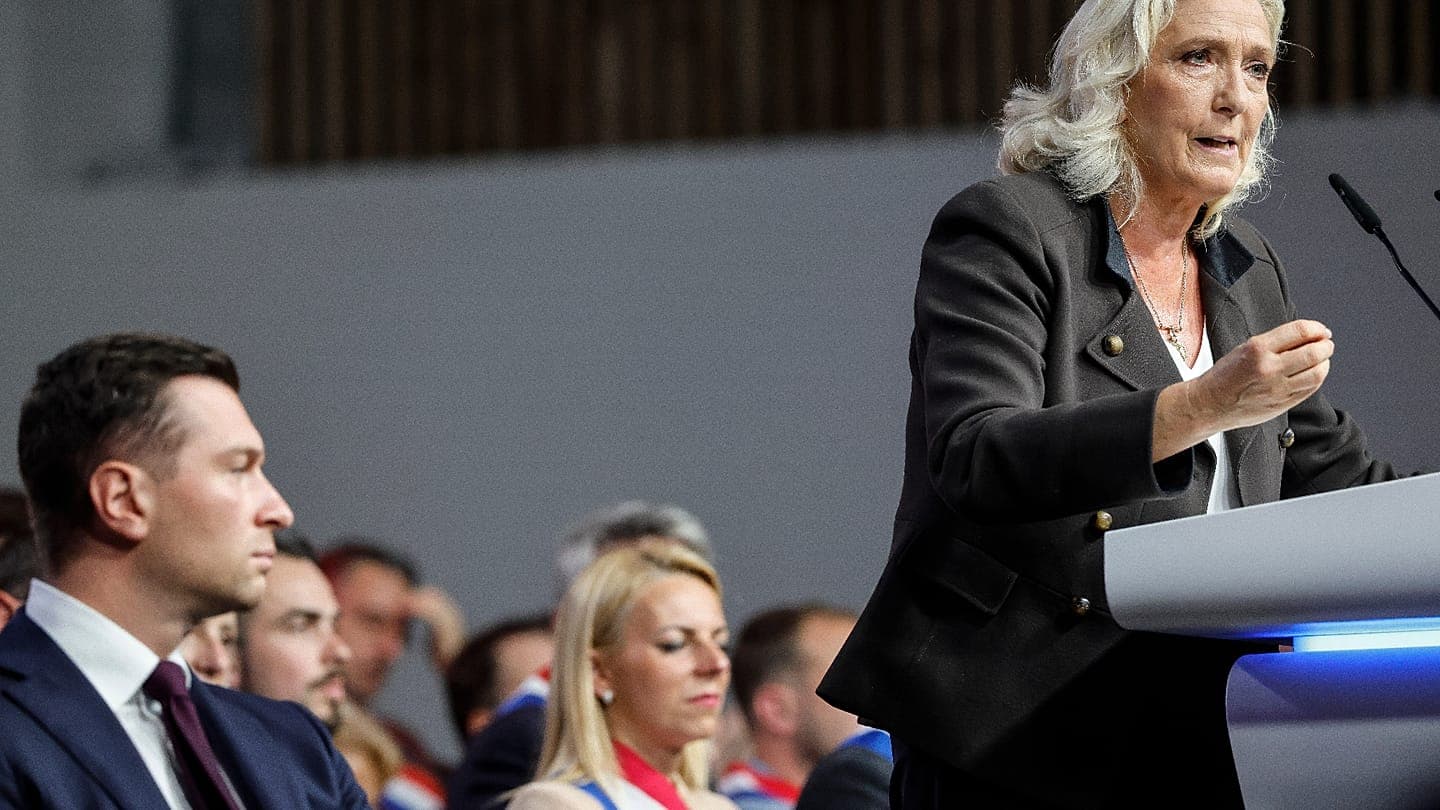
Marine Le Pen, leader of the National Rally, is running for president of France on a hard anti-Brussels platform: she promises to cut the country's contributions to the EU budget and stop funding Ukraine. In Brussels, she stated that due to the 'shaky' state of French finances, the country could only maintain funding for six months. 'This funding will stop, and the question of honesty is to tell [Volodymyr Zelensky] the truth,' she told Euronews. Le Pen also advocates lifting EU sanctions against Russia but allows for the continuation of training Ukrainian soldiers and supplying weapons to Kyiv. Her position is close to Donald Trump's line and sharply contrasts with the approach of Giorgia Meloni, who stated in the Italian Senate: 'Support for Ukraine is not an alternative to peace, it is what makes it possible,' confirming the course of supporting Kyiv, pressuring Russia, and Euro-Atlantic unity.
Zelensky's reaction and the scale of French aid
Zelensky in an interview with the Financial Times responded: 'The price to pay is not as high as the value of people's lives. Therefore, I think Mrs. Le Pen is not fully familiar with some details.' He added that if elected, she would have to use 'the most powerful working European system,' and Ukraine's combat experience could be useful to European countries. According to the Kiel Institute, France since February 2022 has committed to providing Ukraine with about €27 billion: €7.9 billion in bilateral aid and €19 billion through European mechanisms. Germany remains the largest donor in absolute terms — more than €50 billion; relative to GDP, Denmark and Estonia lead. Elie Tenenbaum (French Institute of International Relations) noted that France's support goes far beyond aid and is primarily diplomatic in nature — including the 'coalition of the willing' with the United Kingdom and the €90 billion Ukraine Support Loan, whose implementation depends on political support from major countries. According to him, if France not only stops bilateral aid and contributions to the EU budget but also actively opposes such mechanisms, 'the entire system of European aid to Ukraine will be under threat.'
Reducing contributions to the EU budget
Six months before the election, Le Pen is betting on tightening immigration control, national sovereignty, and fighting rising prices amid discontent over expensive fuel. Her party proposes to limit France's net contribution to the EU budget to €5 billion per year instead of €8 billion (according to the French Senate). Under Macron, France, unlike Germany, supported increasing the EU budget and new own resources. Eulalia Rubio (Jacques Delors Institute) called Le Pen's proposals a reflection of a 'misunderstanding' of EU institutions: expenditures change annually, so one cannot promise to pay a fixed €5 billion. She warned that with reduced contributions, the deficit would have to be compensated by other countries — which is especially contentious, given that France is the largest recipient of agricultural subsidies under the CAP. On Wednesday, the National Assembly rejected the National Rally's proposal for a unilateral reduction of contributions for 2027, supporting the funding level planned by the government.
EU budget for 2028–2034 and institutional proposals
In an interview with the Financial Times, Le Pen called attempts to agree on the EU budget for 2028–2034 before the end of 2026 'anti-democratic,' accusing the European Commission of undermining 'democratic processes' by promoting the budget before elections in France, Spain, Italy, and Poland. Macron, meanwhile, is placing allies in key positions, including the central bank, and on Thursday at a closed meeting told EU leaders that Paris advocates for a deal this year. Le Pen also stated her intention to 'build new coalitions' with like-minded people against Brussels' 'anti-growth' approach and proposed revising the ECB mandate led by Christine Lagarde, shifting the focus to economic growth — even though the bank's mandate is independent and focused on price stability. Experts are skeptical: Andreas Eiselle (Jacques Delors Institute) believes that member states have little appetite for a new major reform after the revision of the Stability Pact in 2024, and future changes are likely to be 'reinterpretations' of existing rules. Le Pen calls EU regulation a 'regulatory hell' and promises to reduce it to a minimum; Thierry Chopin (Sorbonne) warned that if all member states did this, 'the EU would no longer be able to function as a union based on the rule of law.' She also promises to 'stop' the European Green Deal and abolish bodies such as the Committee of the Regions. Phuc-Vinh Nguyen (Jacques Delors Institute) noted that the dismantling of the Green Deal 'is already underway,' and the election of Le Pen, according to some estimates, will only intensify this process.
France's influence in the EU under threat
Chopin believes that the victory of the National Rally could mean a break with France's traditional role as the engine of European integration and with Paris's 'intellectual contribution' of recent years — ideas of European sovereignty, strategic autonomy in defense, and trade protection. According to him, France's influence has already weakened during Macron's second term due to decreased economic credibility amid the budget situation, public debt, and difficulties in public finances, as well as the weakening of the executive branch.