The key facts
- The next-generation Roadster performed aerial tricks using a compressed-air system: 600-liter tanks holding 250 kg of air and ten nozzles
- Three versions: Performance (0–100 km/h in under 1.6 s), Thrust (0.9 s, limited run) and Rocket (single-seat, up to 370 km/h, invitation only)
- Production is planned for 2028; sources differ on the pre-order amounts
Demonstration at the SpaceX Facility
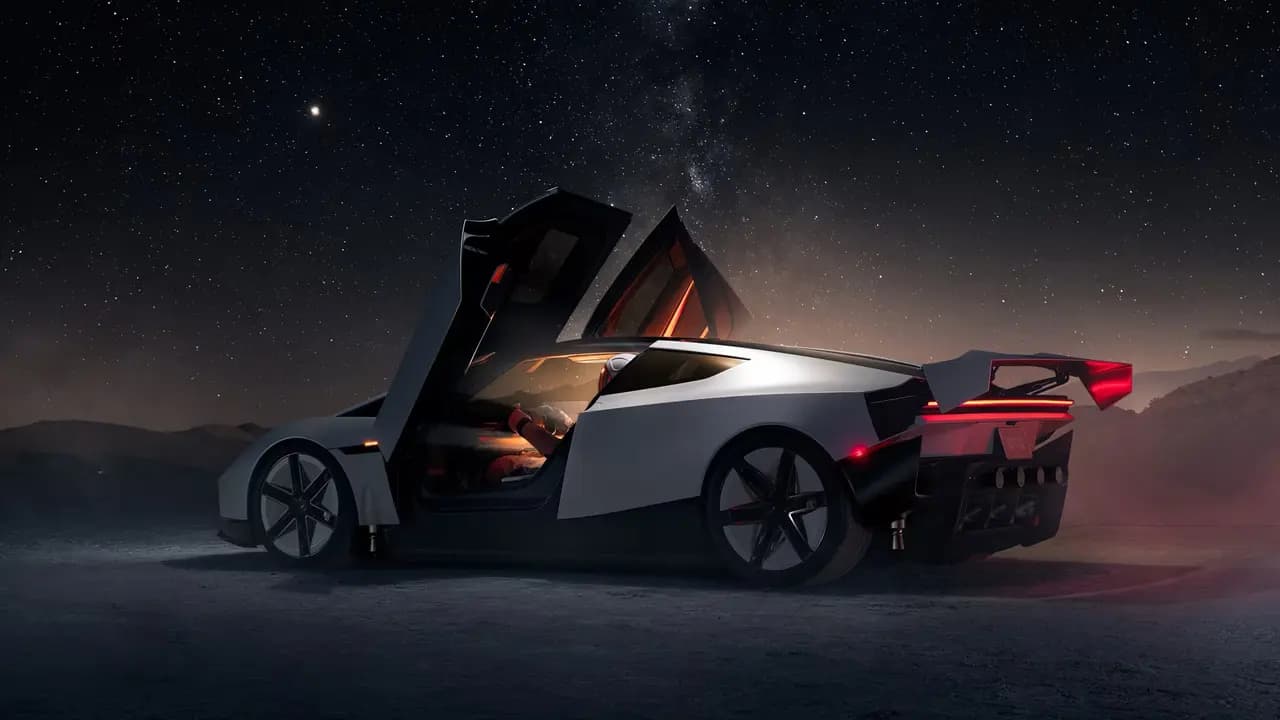
On October 15, 2026, Tesla held a presentation of the next-generation Roadster electric car. According to The Verge, the event took place at the SpaceX test facility in McGregor, Texas (this detail is reported by Daryo.uz citing Reuters). The white two-seater sports car climbed a vertical ramp, holding onto the surface thanks to a special module developed by SpaceX that creates a suction force of up to 2 g beneath the underbody. At the top, the car detached from the structure, rotated in the air, and landed softly using compressed-gas thrusters.
A 'Kickflip' Over Other Teslas
The Roadster then flew over other Tesla models without a ramp, performing a 360-degree rotation around its longitudinal axis in flight. Tesla's Vice President of Vehicle Engineering Lars Moravy called the trick a 'kickflip.' The tricks were enabled by a compressed-air system: the car was fitted with ultra-high-pressure tanks with a total volume of 600 liters, designed for roughly 250 kg of air, and ten nozzles. The system generates thrust to lift the car and control its movement in the air; the tanks are refilled by the car itself.
Musk's Words and the Design
Elon Musk said the Roadster 'can fly like a rocket, do flips, do crazy tricks — anything at all,' adding that it is 'not the most optimal car in terms of safety, but on the fun scale it's an 11 out of 10.' According to Daryo.uz, Musk noted that the developers created a technology the likes of which audiences had not even seen in movies. Tesla said the exterior design is inspired by the American SR-71 and F-35 fighter jets; Electrek writes that the design has changed noticeably compared to the 2017 prototype. Inside, the steering wheel is replaced by a yoke, there are two displays in front of the driver, a touchscreen on the center console, and the two seats are mounted directly to the chassis in a fixed position.
Three Versions and Specifications
After the presentation, Tesla published the specifications of the three versions. Performance — a two-seat configuration with an active aerodynamic package and a suction module: 0–100 km/h in under 1.6 seconds, range over 480 km. Thrust — a limited-run two-seat version with nozzles for releasing compressed air at the rear: 0–100 km/h in about 0.9 seconds. Rocket — a single-seat version with nozzles around the entire perimeter, allowing the car to leave the ground and rotate in the air: top speed over 370 km/h, 0–100 km/h in under 0.6 seconds; it is sold by invitation only and is not approved for use on public roads. Lars Moravy, according to Daryo.uz, said the car accelerates from 0 to 60 mph (97 km/h) in under a second.
Pre-Orders and Contradictory Figures
Tesla has opened pre-orders. According to Spot.uz, buyers pay a $5,000 deposit, which the company says is fully refundable, and must then pay an additional $45,000 within 10 days, otherwise the reservation is canceled. Daryo.uz cites different amounts: a $50,000 deposit for the Performance version and $250,000 for the Thrust. The final prices of the versions have not been announced by any of the sources. Production, according to Musk, is supposed to begin in 2028.
History of the Model
The Tesla Roadster is a sports car presented by the company in 2006; serial production ran from 2008 to 2012. In 2017, Tesla showed an updated second-generation version, opened pre-orders and promised to start production in 2020, but the timeline was repeatedly pushed back: in 2023 Musk spoke of plans for 2024, in November 2025 he scheduled the presentation for April 1, 2026, then the event was moved to late April, October 10, and finally October 15, 2026.


