The key facts
- From 2021 to June 2025, over 2.6 million women underwent screening, cancer detected in 6,702 (about 0.25%), 5,227 (78%) at early stages
- In 2025, 4,843 new breast cancer cases (26 per 100,000 women) and 2,085 deaths were registered in Uzbekistan
- Of the 6,702 patients, 6,215 underwent surgery: 54.2% breast-conserving, 38.6% radical mastectomy; remission in ~56%
Results of the screening program
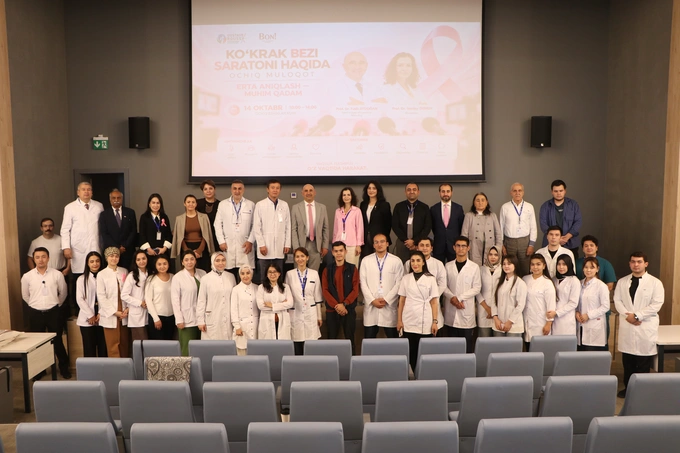
The Republican Specialized Scientific and Practical Medical Center of Oncology and Radiology held an Open Day dedicated to the early detection of breast cancer. The event took place as part of 'Pink October' — the international month of raising awareness about this disease. The center presented screening results for the period from 2021 to June 2025, data on patient treatment, and the organization of examinations in the country.
Disease statistics
According to the center, in 2025, 4,843 new cases of breast cancer were registered in Uzbekistan — 26 cases per 100,000 female population. In the same year, 2,085 people died from the disease, of whom 2,069 were women. During preventive examinations, 61.9% of cases were detected; in 70.8% of patients the disease was identified at stage one or two, and in 96.9% of cases the diagnosis was confirmed by examination of cells or tissues. A total of 27,736 patients were under follow-up, of whom 47.8% had been observed for five years or more.
Results of the screening program
From 2021 to June 2025, more than 2.6 million women were examined under the screening program. Breast cancer was detected in 6,702 — about 0.25% of those examined. In 5,227 patients (78%), tumors were identified at stage one or two. Of these patients, 6,215 received surgical treatment: breast-conserving surgery was performed on 3,631 women (54.2%), radical mastectomy on 2,584 (38.6%). By June 2025, 4,187 patients (62.5%) had completed the full course of treatment, 2,270 were continuing treatment, 123 refused it, and 122 deaths were recorded. Clinical remission was noted in 3,749 women (about 56%) — this figure reflects the status at the time of observation, not a final recovery.
Organization of examinations
Examinations are conducted at the primary healthcare level, including in 'onko-nazorat' offices, using stationary and mobile equipment. The system includes 16 stationary and 16 mobile mammography units. A unified center has been established for assessing images, where mammography specialists are also trained. Breast ultrasound is used in diagnostics; work is underway on using artificial intelligence to help doctors interpret images. Since 2024, free screening has been introduced for women over 45: a presidential decree of November 22, 2024 provides for examinations funded by the state budget and the training of specialists in breast and cervical cancer screening. An electronic database of women aged 30–65 has been created.
Risk factors and symptoms
Age is one of the main risk factors. The likelihood of the disease is also influenced by reproductive factors: early onset of menstruation, late menopause, absence of full-term pregnancies and older age at first birth, as well as excess body weight (especially after menopause), alcohol consumption, and certain types of hormone therapy to relieve menopause symptoms. According to the US CDC, about 5–10% of cases are associated with inherited gene changes, including BRCA1 and BRCA2. Reasons to see a doctor should include a new lump in the breast, even if painless, a change in the size, shape, or appearance of the breast, skin dimpling, puckering, redness, changes in the nipple, or unusual — especially bloody — discharge from the nipple. Most lumps are not cancer, but their nature cannot be determined by touch. To clarify the diagnosis, mammography, ultrasound, and biopsy are used — it is biopsy that determines whether the tumor is malignant.
Screening and early diagnosis
Early detection allows treatment to begin before the tumor spreads; treatment at early stages is more effective and better tolerated. The choice of treatment depends on the extent of the disease, the biological characteristics of the tumor, and the patient's condition; in addition to surgery, radiation and drug therapy may be required, so breast-conserving surgery does not mean the end of treatment. Screening is performed before symptoms appear; its main method is mammography. The WHO describes mammographic screening primarily for women aged 50–69, however, according to the publication, doctors in Uzbekistan recommend starting examinations at age 40 and continuing until 74, tailoring the plan to individual risk, including family cases of the disease and inherited gene changes. To reduce mortality, it is important that the detection of suspicious changes is accompanied by timely diagnostic clarification and accessible treatment without long delays.