The key facts
- The Bundestag held debates on recognizing the Herero and Nama genocide (1904–1908), in which at least 100,000 people died
- Descendants of the victims demand unconditional apologies and reparations; the €1.1 billion aid agreement over 30 years remains unsigned
- Historians criticize the government for rolling back progress in coming to terms with the colonial past
Descendants of the Victims in the Bundestag
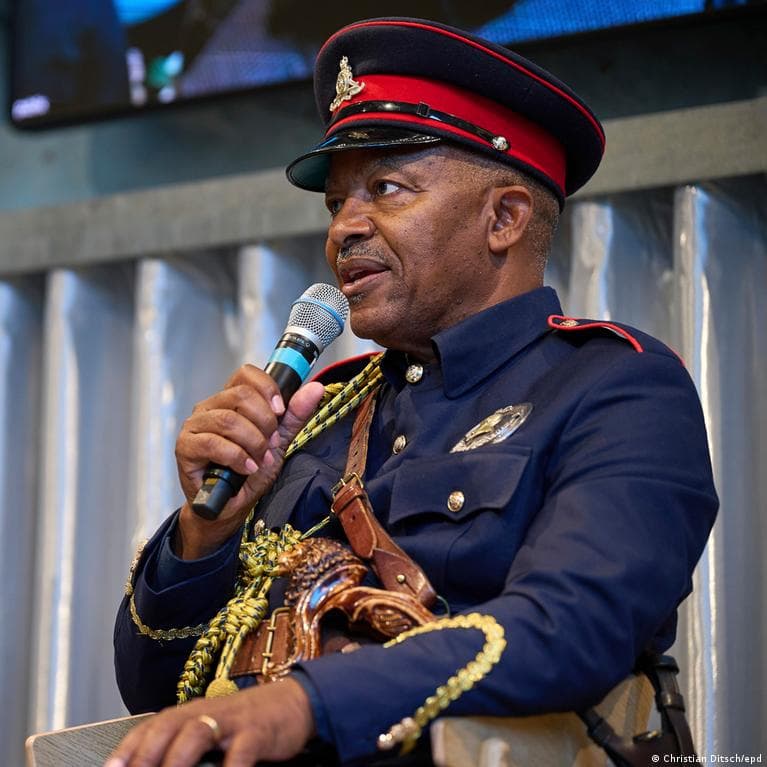
Gaob Daniel Timotheus Frederik, who arrived from Namibia, attended the debates in the Bundestag: for almost 120 years his family has been waiting for the return of the remains of his ancestor Cornelius Frederik, who led Nama resistance to German colonial rule and died on Shark Island in the first German concentration camp. As a member of the Nama Traditional Leaders Association (NTLA), he demanded from Germany 'unconditional apologies.' Next to him was the supreme chief of the Ovaherero, Mutjinde Katjiua, who stated: 'We call on the Bundestag to unequivocally recognize the genocides committed against the Ovaherero and Nama peoples.'
Historical Context
From 1904 to 1908, the German Empire waged a war of extermination against the indigenous peoples of south-west Africa — the Ovaherero (Herero), Nama, Damara and San. At least 100,000 people died, and as many were displaced; many were subjected to forced labour and forced prostitution. The land seizures and expropriations of that time continue to affect the descendants. Professor of history at the University of Hamburg Jürgen Zimmerer noted that the Bundestag adopted resolutions on the Armenian genocide, the Holodomor and the genocide of the Yazidis, but has not recognized the genocide of the Herero and Nama — according to him, with political will this could happen very quickly.
Reconstruction or Reparations?
The debates were initiated by the Left Party, which proposed a resolution on full recognition and compensation in cooperation with representatives of the descendants for the sake of 'restorative justice.' Chief Katjiua rejected the existing agreement between the governments of the two countries: 'Development aid cannot replace comprehensive reparations.' Since 2021, the parties have been discussing a joint declaration on providing Namibia with €1.1 billion ($1.24 billion) in reconstruction aid over 30 years; after signing, the German president is to offer official apologies. The German Foreign Ministry warned that 'legal claims for compensation cannot arise from the recognition of the genocide,' calling the negotiations unique on a global scale. Political scientist Andreas Mehler (University of Freiburg) called the plan 'chequebook diplomacy,' and Zimmerer suggested a financial calculation: recognizing reparations obligations, given the millions of victims of the Second World War, would 'ruin' Germany.
The Government's Position
In the 144-page coalition agreement of the ruling CDU/CSU and SPD coalition, only four lines are devoted to this topic: a promise to intensify efforts to come to terms with colonialism, including research on artefacts, restitution of cultural assets, creation of a dignified memorial and repatriation of human remains. Political scientist Alexander Stroh-Steckelberg (University of Bayreuth) noted that compared with the SPD-led government of 2021–2025, 'the topic has lost visibility.' Zimmerer believes the current government is 'rolling back' the progress achieved in recognizing colonial injustices.
Restitution and Memorials
According to available information, the remains of tens of thousands of people are still in Germany. In March, Germany created a coordination council headed by the Foreign Ministry, which stated that it does not intend to 'dictate to countries and communities of origin' which artefacts and remains to request. Minister of State at the Foreign Ministry Serap Güler, who heads the council, defends the government's actions, citing recognition of her approach during her trips — she visited Togo and plans a trip to Rwanda and Burundi. Zimmerer sees an attempt to 'marginalize German colonial crimes' in the proposal of culture minister Wolfram Weimer to create a memorial in Bremen without the participation of victim groups; in his view, Berlin and Hamburg — colonial capitals of the empire — should also become places of remembrance. 95% of the colonial troops sailed from Hamburg's Baakenhöfe, including commander Lothar von Trotha, who gave the orders to exterminate the Herero and Nama; Zimmerer called the construction of a new opera house there instead of a memorial 'art-washing of history.' Mehler hopes for a productive discussion about memorials. Frederik called for giving the affected communities 'a seat at the table' to discuss the way forward.


