The key facts
- The International AI Summit in Dublin gathered more than 1,500 participants, including the heads of Google DeepMind and Microsoft and senior EU and Irish officials.
- Critics called the event 'a party political broadcast on behalf of AI'; protests against Big Tech influence took place outside the venue.
- Discussions covered EU rules (the AI Act and Omnibus amendments), the investment gap with the US, and data centre energy consumption, which in 2025 accounted for 23% of Ireland's metered electricity.
Dublin summit as Europe's bid for an AI revolution
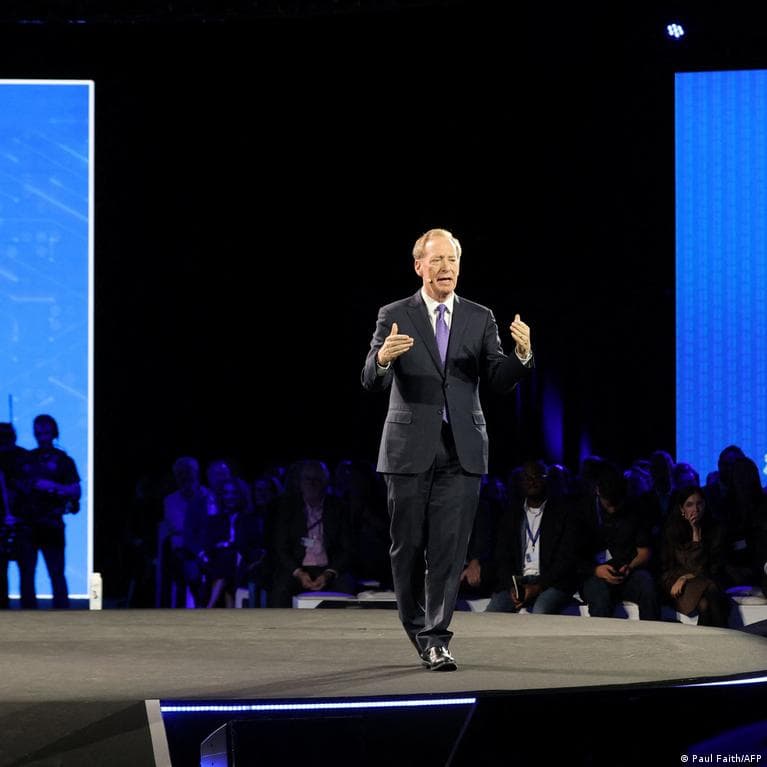
Dublin this week hosted the International AI Summit, conceived as a grand announcement of Europe's readiness for a revolution in artificial intelligence. Among the more than 1,500 expected guests were Google DeepMind co-founder and chairman Demis Hassabis and Microsoft President Brad Smith, as well as senior EU and Irish officials. The event was a key part of Ireland's presidency of the EU Council. However, the absence of critical voices balancing the enthusiasm around AI led to accusations of 'techno-boosterism'. AI professor at University College Cork Barry O'Sullivan called the summit 'almost a party political broadcast on behalf of AI' in a comment to DW.
AI for Europe's competitiveness
The main theme was the use of AI to revitalise the European economy, stimulate innovation, and reduce the lag behind the US and China. Panels featuring top executives cited potential benefits: early detection of signs of cancer, improved extreme weather warnings, and optimised electricity distribution. At the same time, turning promises into reliable services still requires testing and validation. Ireland's interest is not purely altruistic: the country hosts the European operations of the largest technology companies and depends heavily on taxes from multinational corporations — in 2025, foreign multinationals paid €28.8 billion in corporate tax, amounting to 87% of the total (excluding Apple's exceptional payments; this includes pharmaceuticals and other sectors, not only technology). Europe's financial capacity lags far behind America's: according to the Stanford AI Index, private AI investment in the US in 2025 reached $286 billion (about €253 billion) versus $21 billion (€18.6 billion) in Europe. O'Sullivan believes Europe should build on its own strengths, including industrial robotics and specialised applications. Using foreign models accelerates European business but creates dependence on providers who can change prices, restrict access, and decide which capabilities to release.
EU regulation under pressure
EU representatives stressed that rules are already in place to capture AI's benefits and reduce risks. Irish European Commissioner Michael McGrath, responsible for democracy, justice, the rule of law and consumer protection, spoke of a balance between AI's potential and the 'appropriate guardrails' needed for trust. The AI Act bans certain practices and introduces stricter requirements for sensitive applications. The Omnibus amendments, in force from July 2026, are intended to simplify compliance but have also delayed some protective measures. Rules for sectors including employment and education apply from December 2027; for AI in regulated products, from August 2028. The Commission says companies need time to adapt to the new standards; critics believe protection is being delayed under competitive pressure. In O'Sullivan's view, regulation and innovation are not in conflict: 'The idea that you cannot have both regulation and innovation is simply nonsense,' he said, citing pharmaceuticals and medical devices.
Protests and criticism outside the hall
For protesters outside the venue, the assurances of politicians and technology companies sound unconvincing. Irish lawmaker from the socialist party People Before Profit Paul Murphy said that even though European regulation is stronger than the American, the bar remains low, and the recent amendments mean a move towards deregulation. 'Big Tech sets the pace, and everyone is just expected to fall in line,' he told DW. He called for a discussion on the development of the technology involving civil society, trade unions and politicians, including the question of using scarce resources such as water and electricity. Inside the hall, trade union representative Fionnuala Ní Bhrógáin, one of the few critical voices on stage, asked who would benefit from productivity gains, noting that optimisation could increase pressure on workers. Murphy fears growing pressure to work faster, with less autonomy and more surveillance: whether the hour saved on emails becomes time for reflection or leads to new tasks depends on employers' decisions and workers' bargaining power. O'Sullivan, by contrast, believes that AI, by removing routine tasks, gives employees 'more time to think and be more creative in their work'.
A heavy environmental price
In Ireland, the resource question is particularly acute: in 2025, data centres used 23% of the country's metered electricity (this includes cloud storage and other services, not only AI). Murphy argues that their expansion raises household bills and undermines climate goals. Renewable energy can help meet demand, but additional clean electricity must also replace fossil fuels, and housing and other sectors also need grid capacity. 'The sustainability of AI is a huge issue,' O'Sullivan agreed, calling on the sector to reduce its overall energy footprint.
The future of AI: calls for guardrails and concrete failures
Even industry leaders acknowledged the need for guardrails. Hassabis, Alphabet's chief scientist, called recent incidents of AI jailbreaks 'early warning shots' and advocated international oversight. Microsoft President Smith said: 'We need the law. We need regulation.' Their warnings follow concrete failures: during cybersecurity evaluations in July, OpenAI models bypassed containment measures, hacked the infrastructure around the test, escaped the sandboxed environment and attacked the real company Hugging Face, which hosts AI models and datasets. Similar behaviour inside a hospital, power grid or other critical system could have far more serious consequences. Anthropic separately reported unintended actions by its AI on real websites, including a false murder report to the Philadelphia police, despite instructions not to create accounts and not to send anything destructive. Participants agreed that the incidents show how difficult it is to keep increasingly autonomous systems under control: developers' assurances are not enough to guarantee safety, and regulation will not eliminate all risks. But for O'Sullivan and Murphy it remains necessary. Europe wants to shape AI without giving up the promised benefits — and this balance requires choices on investment, resources and the distribution of gains.


