The key facts
- New NHS England guidance requires transgender patients to be placed by biological sex rather than gender identity
- The guidance follows the UK Supreme Court ruling of April 2025 on the meaning of 'sex' in equality legislation
- The organisations Sex Matters, TransActual and the Trans+ Solidarity Alliance expressed differing positions on the document
The essence of the new guidance
NHS England (NHSE) on Thursday, 15 October 2026, published guidance stating that transgender patients must receive care in single-sex wards or bays corresponding to their biological sex rather than their gender identity. If this is 'clinically impracticable', alternative arrangements must be made that preserve the dignity and safety of all patients. Staff are also instructed to use facilities according to biological sex, and hospitals must provide a sufficient number of alternatives to single-sex facilities, such as single-person toilets. The guidance emphasises that, to avoid discrimination, gender-neutral spaces must be offered to transgender people, and decisions may be made individually taking clinical needs into account. In emergency departments, clinical necessity takes priority.
Previous rules and the Supreme Court ruling
Previous NHSE guidance allowed patients and staff to be accommodated according to gender identity: a transgender woman (a biological man who identifies as a woman) could choose a female ward, and a transgender man a male one. These rules were withdrawn after the UK Supreme Court ruling of April 2025, which determined that in equality legislation the term 'sex' means biological sex, and 'woman' means a biological woman. The court stated that a space or service can only be considered single-sex if it is used by persons of one biological sex.
Context: pressure on hospitals
Due to pressure on hospitals, many were already struggling to maintain single-sex wards. According to NHSE, the number of breaches of the previous rules on mixed-sex accommodation has been rising annually since 2021: in August 2026 there were 5,520 breaches, compared with 3,853 in June 2025.
Reaction of organisations
The charity Sex Matters, which campaigns for sex-based rights, welcomed the guidance as 'a landmark return to reality', but expressed concern about its application. Its chief executive Maya Forstater said that NHS patient data is 'in a mess' and, in her words, thousands of transgender people may be recorded as members of the opposite sex. The transgender rights organisations TransActual and the Trans+ Solidarity Alliance, by contrast, said that NHS staff may not understand how to care safely for transgender patients, and that the guidance 'will not survive contact with reality' in hospitals with resource shortages and will create unworkable operational problems.
Related court cases
The NHS has found itself at the centre of a number of high-profile disputes over the interpretation of equality legislation. In January 2026, a tribunal ruled that Darlington Memorial Hospital had indirectly discriminated against a group of nurses who complained that a transgender colleague (a biological man who identifies as a woman) used the female changing room; the nurses were offered somewhere else to change. The nurses are demanding £400,000 from the NHS to cover legal costs. One of the claimants, Bethany Hutchison, now president of the Darlington nurses' union, welcomed the 'clear and necessary guidance', but noted that the test will be its implementation by hospital trusts. In Scotland, in December 2025, a tribunal found that nurse Sandie Peggie had been harassed by NHS Fife over the interpretation of the rules on single-sex facilities; she had complained about a transgender woman doctor in the female changing room and was suspended after voicing concerns. Her other claims of discrimination and victimisation were dismissed. An appeal is expected in the courts next year.
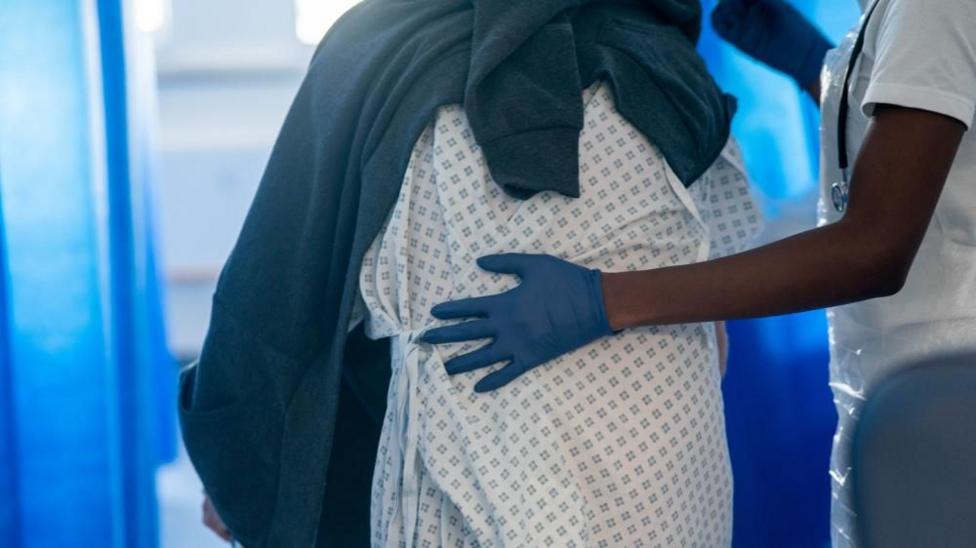 Image source, PA Media