The key facts
- Dörrie's film 'Frau Winkler verlässt das Haus' deals with ageing, assisted suicide and a mother-daughter relationship in a world with care robots.
- A robot named Pavlovich helps the heroine regain her zest for life; the EOL function permits assisted death given explicit desire and medical criteria.
- Dörrie does not demonise AI but calls for its swift international regulation.
Plot and context
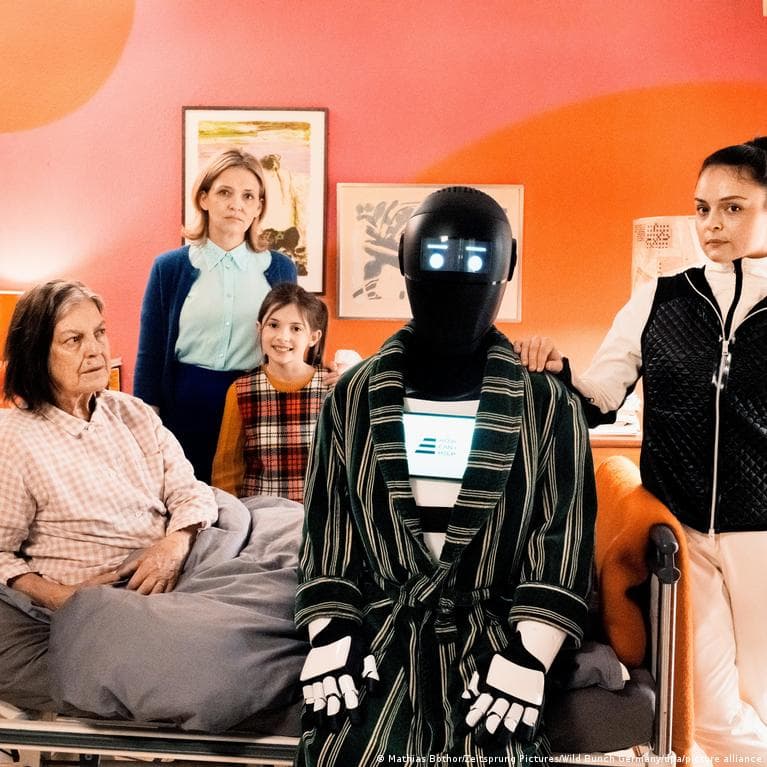
The new film by renowned German director Doris Dörrie, 'Frau Winkler verlässt das Haus' ('Mrs Winkler Leaves the House'), is set in the Hamburg of the near future: robots deliver parcels, serve in cafés and walk dogs — or people walk robot dogs. At the centre of the plot is an elderly woman who, after a fall, can no longer live independently. Since her only daughter cannot provide constant care, the solution seems simple: a care robot with a built-in EOL ('End of Life') programme, which not only helps with everyday tasks but, under certain conditions — a person's explicit wish and compliance with medical criteria — can provide an assisted death.
Themes raised
The film addresses the problems of ageing societies such as Germany, Japan and China, the question of dying on one's own terms, and a mother-daughter relationship with themes of guilt and responsibility. Dörrie asks what will happen when AI begins to calculate the cost of caring for an elderly person and weigh whether she is 'worth' anything to society. She points to the Japanese legend of Narayama, mentioned in the film: the elder children would take their ageing parents to a mountain to die because of food shortages. 'This is, to a certain extent, the same debate we are having today: can we afford for the old to live ever longer?' Dörrie said. In the film, elderly people can make the decision in a certain state of health but cannot change their minds. Dörrie notes the complexity of the question of freedom of choice: a person may come under pressure — economic and because of not wanting to be a burden to loved ones. The film raises these questions indirectly, with dark humour: a care consultant presents the EOL function to the heroine as an attractive and simple option.
The director's position
Dörrie does not seek to demonise AI: the robot, named Pavlovich by the heroine, helps her regain her zest for life and leave the house. 'Travelling around Germany, you see small houses, and statistics show that every second one is home to a lonely elderly person. If AI can help in such circumstances, why not use it?' the director said. The film crew was surprised at how quickly people form an emotional bond with robots: 'We perceive everything that moves and speaks as a living being. We cannot do otherwise.' In Dörrie's view, the problematic moment comes 'when we can no longer distance ourselves from the technology and stop forming our own thoughts.' She sees the main difference between humans and robots in the ability to play: a robot can start a game, but the game itself is deeply human, since it has no particular meaning or purpose.
A call for regulation
Dörrie advocates regulating AI: 'At some point we had to discuss nuclear weapons at the international level. We discussed many issues in the past — and not just discussed them, but found solutions. And I believe that here we need to move very quickly.' Dörrie, whose breakthrough came with the comedy 'Men' (1985), is also known for the films 'Cherry Blossoms' (2008) and 'Greetings from Fukushima' (2016). The DW article was originally written in German.