The key facts
- India calls on Russia and Ukraine to stop attacks on commercial vessels and restore free shipping in the Black Sea
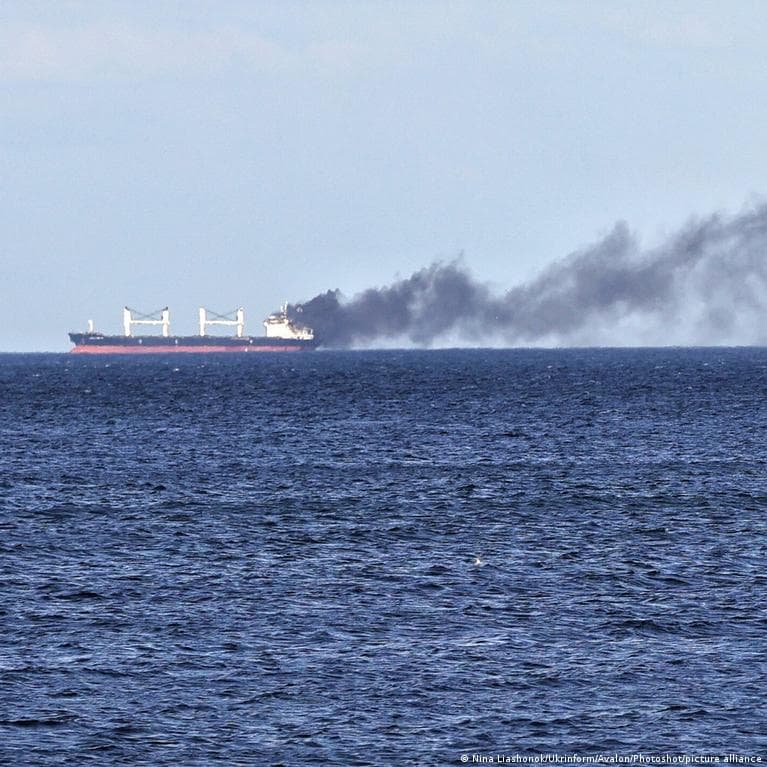
- The bulk carrier MV Royad Mammadov, carrying grain from Ukraine, caught fire and sank after an attack; two crew members died, three Indians survived and were hospitalized in Romania
- Russia has not publicly supported a binding agreement on safe passage, despite welcoming New Delhi's peace efforts
New Delhi's calls amid attacks on vessels
India has called on Russia and Ukraine to ensure safe passage for commercial shipping through the Black Sea, as attacks on merchant vessels put Indian seafarers at risk and threaten supplies of food and energy resources. According to the Indian government, consultations with both countries are underway. 'Attacks on commercial shipping and seafarers in the region must stop, and free and unimpeded navigation and trade through international waterways must be restored as soon as possible,' said Randhir Jaiswal, official spokesperson of India's Ministry of External Affairs, last week.
Indian seafarers under threat
India supplies more than 12% of the world's maritime personnel — 311,936 seafarers, according to an industry report from 2026. Attacks on commercial vessels in and around the Black Sea in recent months have exposed the risks to civilian crews. The Turkish-owned bulk carrier MV Royad Mammadov, carrying grain from Ukraine, caught fire and sank after an attack on Monday; two crew members died. Three Indians on board survived but were injured and taken to Romania for treatment. Ukrainian President Volodymyr Zelensky blamed Russia for the strike. Russia's Defense Ministry separately reported strikes on two Ukrainian cargo vessels in the Black Sea without naming specific ships. Also, according to Russian authorities, a Liberia-flagged Aframax oil tanker, Rio, was attacked by unmanned vessels off the Russian coast near Sochi; there were 23 Indians on board, all of whom were rescued.
Diplomatic efforts and assessments
Former Indian diplomat Anil Wadhwa noted that India's proposal to halt attacks on shipping covers energy infrastructure, safe passage for grain and energy export shipments, and an end to strikes on merchant vessels. 'Getting an ironclad guarantee depends entirely on a broader cessation of hostilities between Russia and Ukraine in the maritime theater,' he told DW. India, maintaining close ties with Russia while expanding engagement with Ukraine, has access to both sides, but this does not guarantee compliance with agreements. Ukrainian Foreign Minister Andrii Sybiha called India's proposal for a possible ceasefire 'the broadest' of the four received by Kyiv. Russia has not publicly supported the binding agreement on safe passage proposed by India, although it has welcomed New Delhi's peace efforts. Rajan Kumar of the Centre for Russian and Central Asian Studies at Jawaharlal Nehru University believes India could use diplomatic leverage with Moscow to facilitate dialogue, including by coordinating with China, Brazil and South Africa.
Context of the 'energy truce' and economic risks
India's initiative came after US President Donald Trump announced an 'energy truce' between Russia and Ukraine over the weekend, although its scope and implementation mechanism remain unclear. Harsh Pant, vice president of the Delhi-based think tank Observer Research Foundation in New Delhi, believes Trump's involvement could help India's efforts but may lead to a narrower agreement: 'An energy truce could serve as an initial confidence-building measure, whereas an agreement on Black Sea shipping requires additional commitments regarding attacks on merchant vessels, ports, sea routes and the safety of commercial traffic.' Wadhwa added that an energy truce could benefit Indian seafarers by ensuring safe passage of energy cargoes, although, according to Ukraine's claims, Russia has already violated it. Shipping disruptions also have economic consequences for India: according to Lekha Chakraborty, professor at the National Institute of Public Finance and Policy, a prolonged disruption of Black Sea shipping would raise the country's import costs, mainly due to rising freight charges on Russian oil and limited supplies of soft oils, which would most strongly affect domestic vegetable oil prices and food inflation.


