The key facts
- Felix Yanov-Yanovsky died on October 12 in Tashkent at the age of 92
- His legacy includes nine operas, four ballets, five symphonies, music for 60 films and 15 theatrical productions
- From 1961 he taught at the Tashkent Conservatory, becoming a professor in 1988
Death of the composer
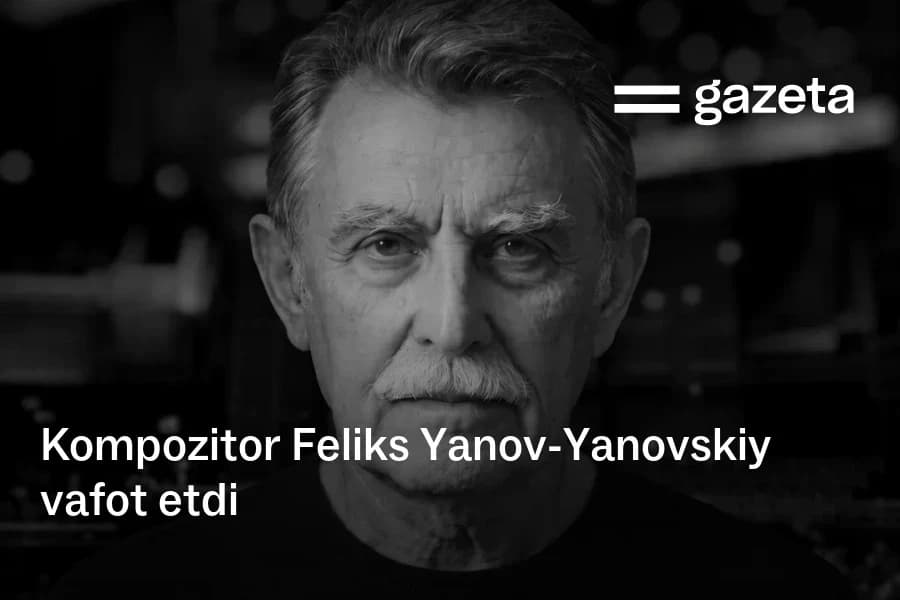
In Tashkent, on October 12, composer, Honored Art Worker of Uzbekistan and professor Felix Yanov-Yanovsky died at the age of 92. His death was announced by the Union of Composers and Bastakors of Uzbekistan, which expressed condolences to his family, relatives, students and colleagues.
Biography and education
Felix Yanov-Yanovsky was born in 1934 in Tashkent. In 1957 he graduated from the Tashkent State Conservatory in violin under Naum Bronfman, and in 1959 in composition under Boris Nadezhdin. While still a student he began working as a musician: he played in the orchestra of a drama theater, the State Symphony Orchestra and the string quartet of Uzbek Radio. From 1961 he taught at the Tashkent Conservatory, in 1988 received the title of professor and the title of Honored Art Worker of Uzbekistan.
Creative legacy
According to the Union of Composers, the composer's legacy includes nine operas, four ballets, five symphonies, instrumental concertos, chamber, vocal and choral works. Among his works are the operas 'The Orchestra' and 'The Accompanist', the ballet 'Urashima Taro', and a Requiem. He wrote music for 60 films, including animated ones — for example, the cartoon 'There Will Be a Soft Rain' — and for 15 theatrical productions. His works were performed in Great Britain, Germany, France, the USA, Japan and other countries; his music was awarded prizes at international competitions and festivals.
Assessments by contemporaries
In an obituary on the Kultura.uz website, musicologist Inessa Gulzarova noted the versatility of Yanov-Yanovsky's work: he worked in genres from symphonies and operas to chamber music and pop songs, combining folklore traditions with modern artistic techniques. 'Felix Markovich possessed an amazing gift for creating a unique sound-color atmosphere, paying attention to the smallest nuances of timbre and intonation,' she wrote, adding that in every work one could feel a 'deep connection with roots, with folk wisdom,' and that the composer knew how to find a 'universal language understandable to everyone.' Gulzarova also emphasized his role in educating several generations of musicians: 'His pedagogical activity was no less significant than his compositional work.' According to her, he helped students develop individuality and find their own musical style. Sources of inspiration for the composer included the works of Alexander Pushkin, Oscar Wilde, Émile Verhaeren, Matsuo Basho, Federico García Lorca and other authors.