The key facts
- Macron announced 'strong measures' and admitted the authorities 'completely failed to foresee' the scale of the October 17 protests
- 70,000 police officers were deployed for the October 24 protests, with 1,435 arrests; the curfew helped maintain order
- Prime Minister Sébastien Lecornu's government is preparing measures in response to students' demands on education and university admissions
Macron announced the government's response to the protests
The French government is preparing a series of 'strong measures' designed to calm the protests that have shaken the country in recent weeks. On Monday, October 26, President Emmanuel Macron announced this while speaking in Marseille, Deutsche Welle reports. He warned that new demonstrations planned for the coming Saturday are 'risky' and said that protest routes will remain outside city centers to protect public order.
The authorities admitted they underestimated the scale of the unrest
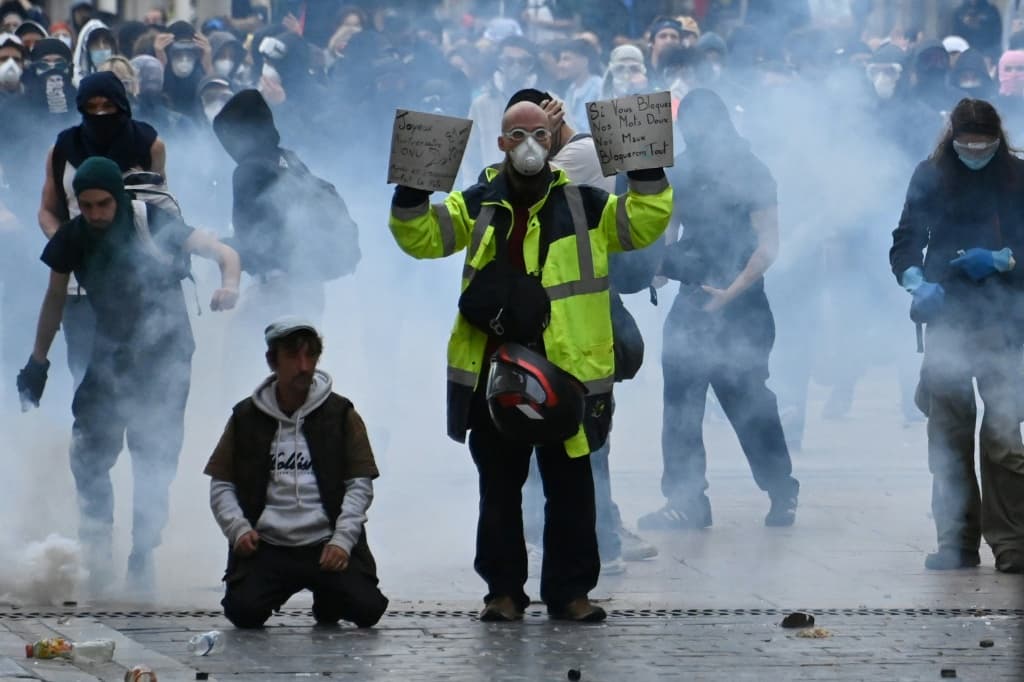
Before Macron's arrival in Marseille, the Élysée Palace said the president intended to 'pay tribute to and thank the internal security forces that helped restore republican order' in the country's second-largest city, where protesters briefly stormed the city hall on October 17. Macron himself admitted that the French authorities 'completely failed to foresee' the scale of the demonstrations, which escalated into mass violence and looting in several major cities, fueling talk that the state had lost control of the streets. He also suggested that the security forces had underestimated how early the 'far-left forces' would gather on October 17.
Social media and the confrontation between the far right and the far left
Macron specifically pointed to the role of social media, calling them 'instruments of mobilization of the worst impulses' and saying that they 'damage our democracies,' leading young and not-so-young people 'to places where criminal acts, assaults and looting took place.' Interior Minister Laurent Nuñez, in an interview with BFM, spoke about another phenomenon: organized far-right groups in a number of cities, including Nice and Montpellier, arrived as organized formations, mainly to attack the far-left movement, following calls from 'nationalist movements' to protect shops.
Curfew and 70,000 police officers
For the protests last Saturday, October 24, the authorities deployed across the country 70,000 police officers; 1,435 arrests were made. According to Macron, the curfew helped maintain relative order. 'The state won this weekend. The state was strong,' government spokesperson Maud Bregeon said on RTL radio. Nuñez, however, warned BFM that he expects new unrest on October 31: 'Halloween evening has traditionally always been a bit lively. We expect it to be difficult again.'
A response to students' 'legitimate demands'
Despite the tough rhetoric, Macron said he had instructed the government led by Prime Minister Sébastien Lecornu to 'respond to the legitimate demands underlying this social movement.' According to him, after nationwide consultations with representatives of schoolchildren and students, the government will soon announce several 'concrete and far-reaching' measures on education and university admissions. Bregeon confirmed: 'There are demands that must be heard and answered,' but added that the precondition is 'a return to calm,' since 'social dialogue cannot function in a climate of violence.'
Why this matters
The event matters because it captures the French state's dual response: coercive pressure (70,000 police officers, 1,435 arrests, a curfew) is combined with recognition of the protesters' 'legitimate demands,' which directly affect schoolchildren, students and their families, whose grievances about the education system and university admissions have become, in Macron's words, the root of the movement. In practical terms, this means that in the near future we should expect an announcement of concrete education measures from Lecornu's government, as well as continued restrictions on protest routes and heightened policing through October 31. Editorial analysis: the simultaneous admission of a forecasting failure on October 17 and the claim to a 'strong state' point to an attempt by the authorities to restore control without ignoring the social dimension of the protests, though the content of the announced measures has not yet been disclosed.