The key facts
- The Prime Minister accepted the conclusions of the Milburn report on young people who are not in education or work and called it a 'watershed moment'
- The initial cost of around £500 million for 2027–28 will be covered by reallocating existing budgets
- Milburn has been appointed to lead the new Youth Opportunities Unit, reporting to Andy Burnham; a white paper is expected in the new year
Government accepts the Milburn report
The UK Prime Minister described Alan Milburn's report on employment, training and benefits for young people as a 'watershed moment', thereby accepting its argument for change and taking on the task of implementing it. The proposals concern young people who are not in education or work: for some of them, benefits are proposed to be reduced, but with a view to long-term employment. The stated horizon for the changes stretches over a decade — through at least two general elections.
Funding and next steps
In an interview with The Times, the Prime Minister said that initial spending of around £500 million on employment support in the 2027–28 financial year will be covered from existing government budgets, which means cuts elsewhere: 'I have asked the Cabinet to reprioritise.' A white paper will follow in the new year, and then legislation. A key open question is who exactly will be the 'winners' and 'losers' of the proposed changes in the short term.
New structure and Milburn's role
Milburn, a former MP, has been appointed chair of the government's new Youth Opportunities Unit; the unit will report directly to Andy Burnham and is intended to tie together the proposed changes spanning several departments. Burnham has promised to act 'quickly' on the report's findings. Importantly, for Scotland, Wales and Northern Ireland, many decisions on implementing these ideas will remain within the competence of the devolved governments in Edinburgh, Cardiff and Belfast.
Disputes over employment law and ministers' positions
In the report (on page 66), Milburn notes that the Employment Rights Act 2025 'could have serious consequences at a time when the labour market for young people is already weak'; the Conservatives have already used this remark to criticise Labour. The Prime Minister responded on BBC Breakfast that 'a balance needs to be struck': stronger employment protections, he said, can create more sustainable jobs in which young people stay longer. Work and Pensions Secretary Pat McFadden told the BBC's political editor Chris Mason that people 'with the most severe and lifelong disabilities, for whom work is unrealistic' should receive more support than they do now, and a separate benefit will be introduced for some of those who face 'additional costs'. How exactly both categories will be defined remains unclear — this will shape the next stage of the debate.
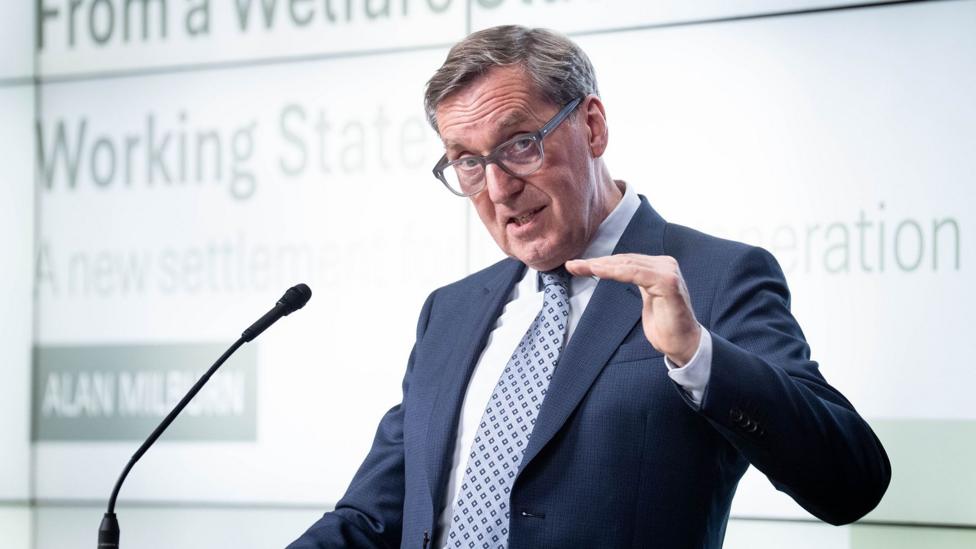 Image source, Press Association
Alan Milburn's proposals to help young people who are neither learning nor earning would reduce benefits for some young people but aim to get them jobs in the long run