
The key facts
- The Carbon Chill technology replaces drilling mud with liquid carbon dioxide, which cools the drill bit and electronics
- Mazama's CEO reports a 20% increase in drilling speed and a well with temperatures above 700 °C
- In September, the startup raised $135 million from Centaurus Capital and Doerr Capital; a well of up to 15 MW is planned by next year
Carbon dioxide cooling instead of drilling mud
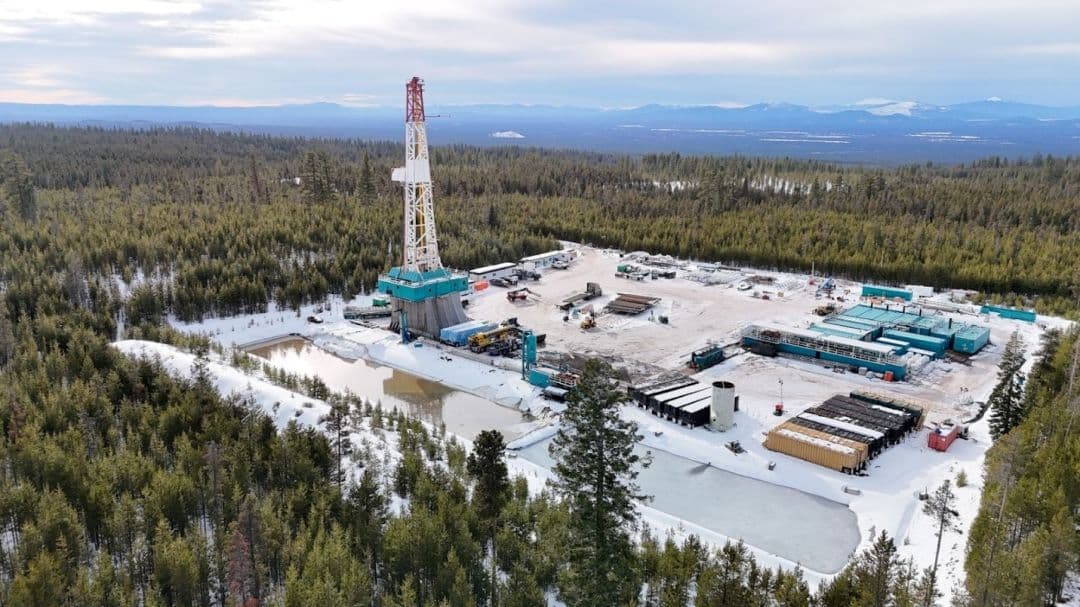
Geothermal startup Mazama Energy, backed by Khosla Ventures, has shown TechCrunch its new drilling technology called Carbon Chill. Instead of traditional drilling mud — a mixture of water and other compounds that geothermal companies use to cool the drill bit and carry rock out of the wellbore — Mazama injects liquid carbon dioxide into the drill string. As it descends, the CO2 heats up from the surrounding rock and transitions to a supercritical state, and just before the drill head the gas passes through a valve resembling a rocket nozzle: as it expands, it cools sharply and draws heat away from the electronics and the drill bit.
Why it matters: the electronics problem at depth
Conventional drilling mud stops coping at great depths: at extreme temperatures, the electronics inside the drill bit, which keeps it on course, fails. Existing high-temperature electronics, according to company co-founder and CEO Sriram Vasantarajan, would be too expensive. Carbon Chill, the founder claims, allows the company to drill not only deeper but also faster: 'The rate of penetration increased by 20% compared to the already very high rates we had achieved.' Speed also matters economically: drilling accounts for about 25–30% of the total cost of building a geothermal power plant, so reducing drilling time significantly cuts costs.
Record temperatures and plans for 15 MW
Mazama has been working on the problem for several years. As TechCrunch reports, in October 2025 the startup announced a well drilled in Oregon with a temperature of 629 °F (331 °C), and a newer well, according to Vasantarajan, exceeded 700 °C. In September the company raised $135 million in a round led by Centaurus Capital and Doerr Capital. By next year, Mazama hopes to complete a single well capable of generating up to 15 megawatts of electricity. 'What was once just a dream or a search is now, I can say with confidence, a promise,' the founder said.
Betting on superhot rock
Mazama needs the technology to prove the viability of geothermal energy in superhot rock — formations with temperatures above 752 °F (400 °C). At such temperatures, water transitions to a supercritical state and carries five to ten times more energy than water from conventional geothermal wells, allowing more energy to be extracted from each well and fewer wells to be drilled. Interest in the field is also being fueled by major tech companies: Google and Meta are already exploring the use of geothermal energy. According to a report by the National Renewable Energy Laboratory cited by TechCrunch, geothermal energy in the United States alone could generate between 26.5 and 57 terawatts; developing even 10% of the conservative estimate would more than double the country's peak generating capacity.