The key facts
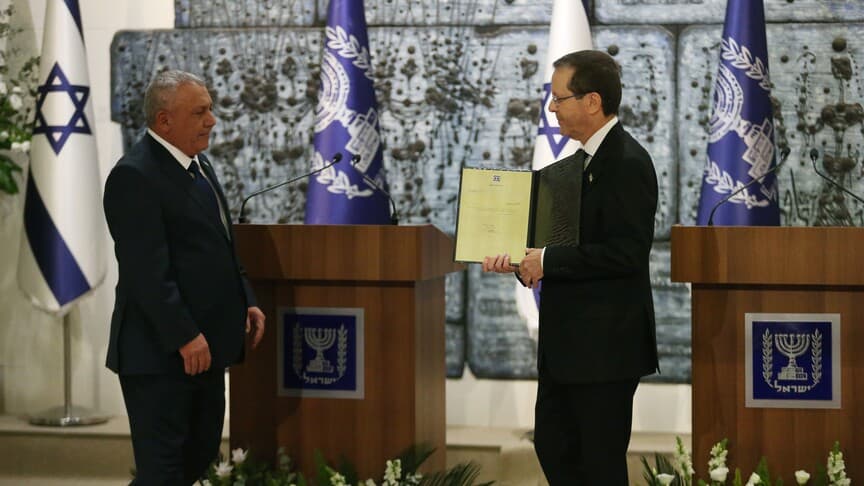
- Eisenkot received the mandate from President Herzog: 67 recommendations against 46 for Netanyahu; 28 days to form a coalition, with a possible 14-day extension.
- Eisenkot and Lieberman agreed to first negotiate with the ultra-Orthodox parties, postponing the option of a minority government relying on Arab parties.
- According to Channel 12, the ultra-Orthodox put forward four conditions, the main one being a temporary suspension of ultra-Orthodox conscription.
Mandate received, negotiations begin
Yeshar party leader Gadi Eisenkot and Yisrael Beiteinu chief Avigdor Lieberman agreed at a Monday meeting to 'exhaust all avenues of negotiations with the ultra-Orthodox parties' before moving to the alternative government option, Anadolu reports, citing Channel 13. Eisenkot asked Lieberman to help him in these negotiations. According to the channel, this means postponing the option of a minority government backed by Arab parties until the outcome of the talks becomes clear; Eisenkot's contacts with the Torah and Zion party have already begun.
Coalition arithmetic and the main obstacle
Two parties represent the ultra-Orthodox in the Knesset: United Torah Judaism (seven mandates, mostly the Ashkenazi community) and Shas (six mandates, the Sephardic and Eastern community). Together they hold 13 of 120 seats, and it is precisely their full accession that would bring Eisenkot's bloc (48 seats) to a majority of 61 mandates. Both parties belong to the camp of outgoing Prime Minister Benjamin Netanyahu, but the election results opened up the possibility of luring them into an alternative coalition. The main stumbling block is the conscription of the ultra-Orthodox: their parties insist on maintaining the exemption from service for religious seminary students, while the parties of the 'Change Bloc' demand broader conscription. According to Israel's public broadcaster, United Torah Judaism said it was ready to negotiate with the 'Change Bloc,' but has not yet received an official invitation.
The ultra-Orthodox's four conditions and Lieberman's position
Lieberman, a well-known opponent of exempting the ultra-Orthodox from service, expressed readiness to make concessions for the sake of a government without Netanyahu, but on Sunday stressed that a compromise does not mean abandoning the principle of service for all or crossing 'red lines'; he proposed his 2018 conscription bill as the basis for agreements. Meanwhile, Channel 12 reported that the ultra-Orthodox parties put forward four conditions for supporting Eisenkot's government: a temporary order suspending the conscription of the ultra-Orthodox, a suspension of arrests of draft evaders during that period, a renunciation of sanctions against them, and approval of the arrangement by the government's legal adviser and the legal adviser of the Knesset Foreign Affairs and Defense Committee. These demands show the scale of the disagreements the sides still have to overcome.
The fallback option and the timeline
If the negotiations fail, Eisenkot could form a minority government of the four parties of the Jewish opposition bloc (48 seats), relying on the external support of the Arab factions — another 19 mandates, that is, up to 67 votes. However, Lieberman himself rejects this option. On Sunday evening, President Isaac Herzog officially handed Eisenkot the mandate to form a government: 67 Knesset members recommended his candidacy against 46 for Netanyahu, and seven abstained. Under Israeli law, Eisenkot has 28 days to form a coalition, with a possible 14-day extension at the president's discretion.