The key facts
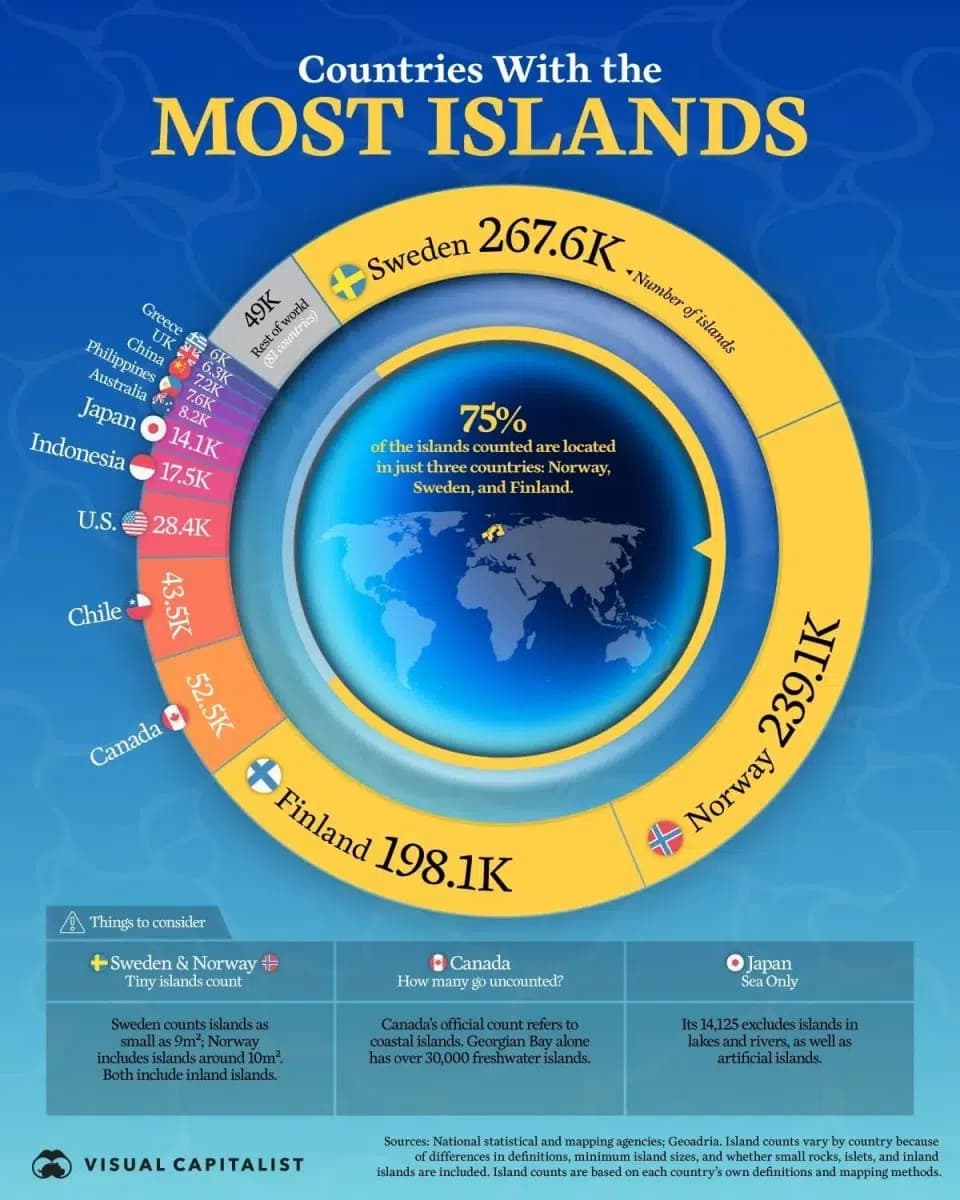
- Sweden leads the ranking with 267,570 islands, followed by Norway (239,057) and Finland (198,146)
- The list counts 945,247 islands in total; the three Nordic countries account for 74.6% of that sum
- The data are not directly comparable: the term 'island' is defined differently in different countries
Northern Europe — the world's center of island wealth
Sweden has topped the list of countries by number of islands: it has 267,570 islands. It is followed by Norway with 239,057 and Finland with 198,146 islands. Together, these three Northern European countries account for 704,773 islands — 74.6% of the total counted in the list. This was reported by Kun.uz citing a list compiled from data of national statistical and cartographic agencies and published on Wikipedia.
A caveat on data comparability
In total, the list counts 945,247 islands. However, as the publication itself emphasizes, these figures cannot be considered the result of a single worldwide count under a common standard: the definition of the term 'island' differs from country to country. This means that countries' positions in the ranking reflect national counting methodologies rather than strictly comparable measurements.
Who follows the top three
Fourth place goes to Canada with 52,455 islands, followed by Chile (43,471) and the United States (28,449). Notably, for Canada the figure covers only marine coastal islands: the country's inland bodies of water are not included. For example, Georgian Bay on Lake Huron in the province of Ontario alone contains more than 30,000 islands, while the Canadian Arctic Archipelago comprises over 36,000 islands, including Baffin Island — one of the largest islands in the world. Off the southeastern coast of Alaska lies the Alexander Archipelago of roughly 1,100 officially named islands, including Prince of Wales Island and Admiralty Island.
Why there are so many islands in the north
The region's high figures are explained, in part, by the history of the Ice Age: during the last glaciation, glaciers shaped and altered the terrain, and after their retreat, numerous rocky outcrops, shallow coastal areas, and lake systems remained. The Stockholm archipelago extends far into the Baltic Sea and includes about 30,000 islands, islets, and rocks rising from the water; nearby is Finland's Archipelago Sea with thousands of islands, and to the west of Bergen in Norway stretches the Øygarden group of islands with an indented coastline of numerous rocky islands separated by narrow straits.