The key facts
- The symposium in Muscat gathered about 250 participants and continued the series of presentations of the Center of Islamic Civilization
- Memoranda were signed with the Sultan Qaboos Higher Center for Culture and Science and the Bait az-Zubair museum
- Omani institutions received the facsimile of the Katta Langar Quran and 120 books from the Center
The symposium in Muscat and its participants
On 4 November 2026, an international symposium titled “Uzbekistan — Oman: Cultural Ties. Maverannahr — the Light of Islamic Civilization Spreading Through the Centuries” was held in Muscat, the capital of the Sultanate of Oman. According to Zamon.uz, the event continued the series of international presentations of the Center of Islamic Civilization in Uzbekistan — an authorial project of President Shavkat Mirziyoyev — held as part of the initiative to promote the heritage of Islamic civilization on the international stage.
Exhibition, program and reports
The organizers were the Center of Islamic Civilization in Uzbekistan, the Ministry of Foreign Affairs of the Republic of Uzbekistan and the country's embassy in the Sultanate of Oman. About 250 people took part in the forum: senators, representatives of government institutions, scientific and cultural organizations, ambassadors of foreign diplomatic missions, scholars and cultural figures of the two countries. Welcoming remarks were delivered by the Center's director Firdavs Abdukhalikov, Uzbekistan's Ambassador to Oman Abdusalom Khatamov, and Habib bin Muhammad Riyami, Secretary General of the Sultan Qaboos Higher Center for Culture and Science.
Exhibition and scientific session
Before the opening, guests viewed the Center's exhibition: more than 150 book publications on the historical, scientific, spiritual and artistic heritage of Uzbekistan, as well as miniatures, sculpture and other exhibits. The first to visit the exhibition was Oman's Minister of Endowments and Religious Affairs, Dr. Muhammad bin Said bin Khalfan Maamari.
Scientific session
At the scientific session, scholars of the two countries discussed Uzbekistan's and Oman's contributions to the development of Islamic civilization and prospects for cooperation. From the Omani side, presentations were given by State Council member Dr. Muhammad Said Amur Hajri and Professor of Sultan Qaboos University Dr. Saif bin Salim bin Saif Hadi, whose report was devoted to peaceful coexistence in Omani society. Uzbekistan was represented by Vice-President of the Academy of Sciences Bahrom Abduhalimov (preservation and digitization of the manuscript heritage of the two countries), Rector of the Imam Bukhari Tashkent Islamic Institute Uygun Gafurov (the history and modern experience of Islamic education), and Professor of the Tashkent State University of Oriental Studies Shorustam Shomansurov (cooperation between universities).
Practical outcomes
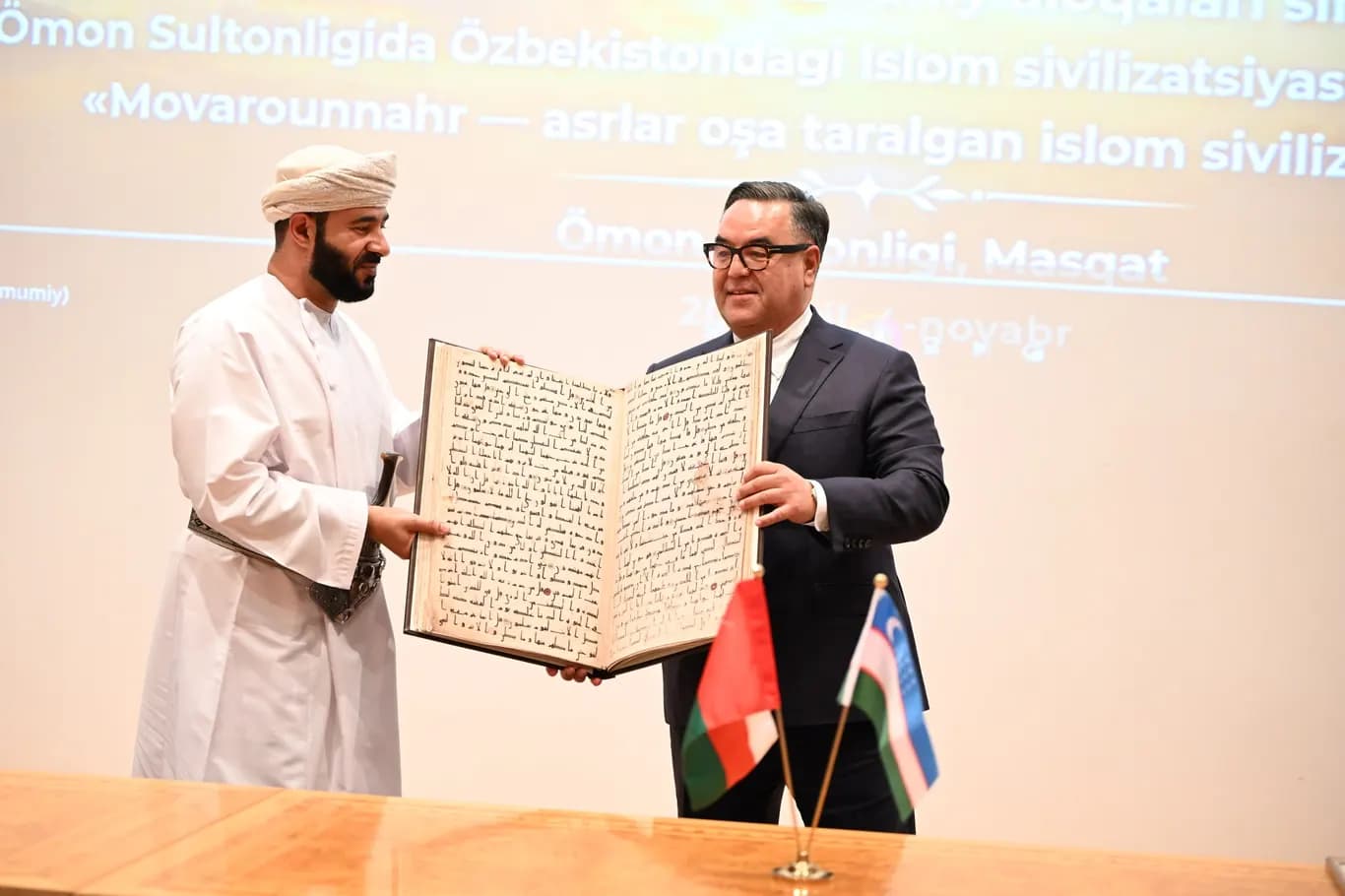
The main practical outcome of the symposium was the signing by the Center of Islamic Civilization of memoranda of cooperation with the Sultan Qaboos Higher Center for Culture and Science and the Bait az-Zubair museum — they create a foundation for joint scientific and cultural projects, exhibitions and exchange of experience. A book exchange also took place: the facsimile edition of the Katta Langar Quran copy was presented to Oman's Minister of Endowments, and the Secretary General of the Sultan Qaboos Higher Center received the book “The Foundation of the Third Renaissance” and a certificate for 120 books published by the Center. The Center's publications were also given to the library of the Sultan Qaboos complex and Oman's National Center for Documents and Archives.
Visit program
During the visit, the Uzbek delegation toured a number of cultural and educational institutions of Oman, including the National Museum of the Sultanate of Oman: museology, preservation of cultural heritage and scientific research were discussed, and several additional memoranda were signed. A separate meeting took place between Oman's Minister of Endowments and the leadership of the Center of Islamic Civilization — the discussion concerned the development of bilateral ties and possible joint projects. Thus, the signed documents move the centuries-old cultural dialogue between the two countries into the realm of concrete joint projects, although their content and implementation timelines are not disclosed in the publications.