The key facts
- Seven homes demolished: one in Karawat Bani Hassan (Salfit), one in Furush Beit Dajan (Nablus) and five in Beit Duqqu near Jerusalem
- More than 20 Palestinians displaced; in Beit Duqqu, according to the Jerusalem governorate, the demolition took place without prior warning
- A stop-work order was issued to one Salfit resident; about 10 demolition notices had previously been issued in the same area
Demolitions in three areas of the West Bank
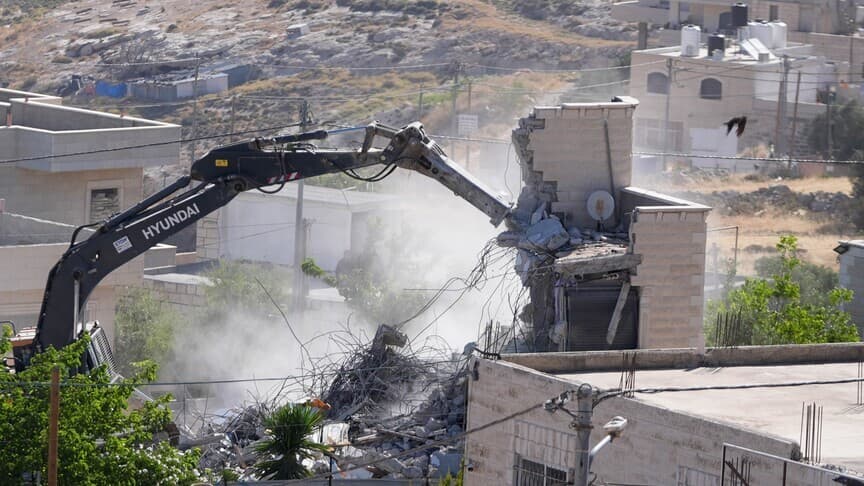
The Israeli army on Thursday, November 5, demolished seven Palestinian homes in the occupied West Bank, leaving more than 20 people homeless. This was reported by the Anadolu agency citing Palestinian sources and officials.
Salfit and Nablus
According to Palestinian sources, on Thursday morning Israeli forces, accompanied by a military bulldozer, entered the town of Kafr Qasim — no, the town of Karawat Bani Hassan west of Salfit in the northern West Bank — and demolished a one-story house of about 100 square meters in the al-Aqda area. Another resident of the same locality was issued a stop-work order for his house. Sources added that the authorities had previously issued about 10 demolition notices for inhabited homes in the area. In addition, in the village of Furush Beit Dajan east of Nablus, bulldozers demolished another house.
Beit Duqqu: demolition without warning
The greatest impact was in the town of Beit Duqqu northwest of Jerusalem, where, according to the Jerusalem governorate, army bulldozers demolished five homes without prior warning, leaving more than 20 Palestinians homeless. The governorate said the demolition was carried out on the grounds that the structures were built without permits. According to its statement, Israeli forces entered Beit Duqqu with demolition equipment after land was leveled and trees uprooted near the military checkpoint of the neighboring town of Beit Iksa.
Context
Israeli forces regularly demolish Palestinian homes and structures, citing the lack of building permits. Palestinian, Israeli and international human rights organizations, as Anadolu notes, point out that such permits are rarely granted to Palestinians, while the construction of Israeli settlements continues to receive approval. The agency also recalls that since the start of Israel's war in the Gaza Strip in October 2023, the occupied West Bank, including East Jerusalem, has been experiencing an escalation of military operations and violence: these include the killing and detention of Palestinians, home demolitions, the burning of mosques and cars, the plowing of agricultural land, restrictions on farmers' access to their fields, and the displacement of Palestinian communities amid settlement expansion.