The key facts
- Uzbekneftegaz denies receiving Saneg assets or shares after the licenses were annulled
- The company did not say who currently manages the fields
- The 2019 transfer of fields to Saneg features in the criminal case against the former head of Uzbekneftegaz
Uzbekneftegaz has distanced itself from Saneg's assets
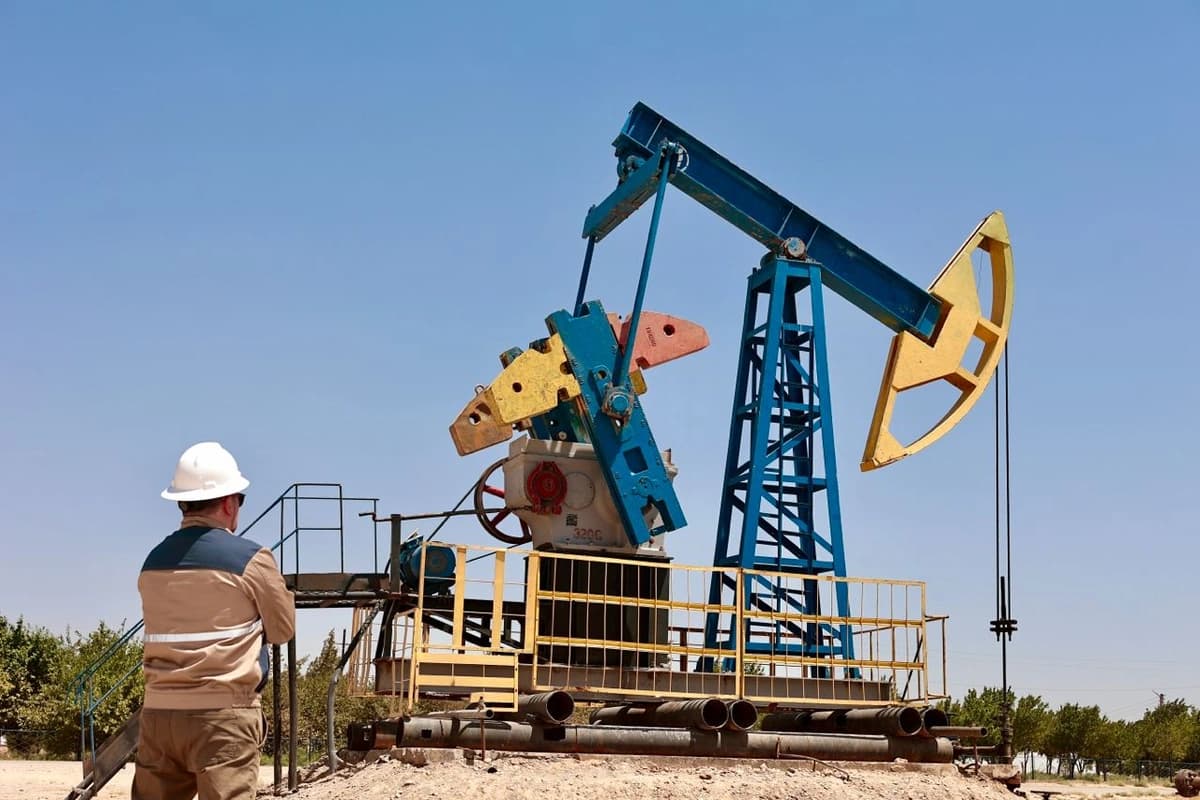
Uzbekneftegaz did not receive any assets or shares of the company Saneg after the announcement that part of its licenses for the use of oil and gas fields had been annulled. Representatives of the state company made this statement at a press conference on October 27, answering a Gazeta correspondent's question about the fate of the fields whose rights had previously been transferred to the private company Sanoat Energetika Guruhi (Saneg).
What the company's representative said
The journalist recalled that in early October the head of the Agency for Management of State Assets, Sohibjon Murodov, announced the annulment of Saneg's licenses, and asked who now carries out the operational and financial management of these fields. Uzbekneftegaz's deputy head for processing, Abrorjon Khudoyberganov, replied that Saneg is a separate organization not subordinate to the state company, and that the information about the annulment had not been published by them: 'I think it would be more correct to contact the agency that published it.' 'No assets or shares were transferred to us,' he clarified. At the same time, the company did not say who currently manages the fields with annulled licenses or whether the rights to develop them are planned to be transferred to other companies.
Why Saneg lost its licenses
On October 8, the director of the Agency for Management of State Assets, Sohibjon Murodov, said that Saneg's licenses for the use of oil fields had been annulled due to non-fulfillment of the terms of the permits and the absence of economic development of the fields. According to him, the fields themselves were not transferred into private ownership — the company received only subsoil use licenses, and the Ministry of Geology is now developing measures for the effective use of the fields. Murodov did not specify how many licenses were annulled, which fields were affected, or how many fields remain with Saneg; the company's website previously stated that it held subsoil use rights to 103 oil and gas fields.
The history of the fields' transfer
In 2019, more than 100 oil and gas fields were transferred from Uzbekneftegaz's structure to the company Jizzakh Petroleum (later renamed Saneg) under a closed government resolution as part of a program to increase oil production for 2020–2030, with investments of $2.68 billion, the drilling of 800 new wells, and the major overhaul of another 500. A working group created in 2019 on the president's initiative warned of the risk of failing to meet the targets, since most of the fields had hard-to-recover reserves; according to Saneg itself, in 2022 it produced 545.4 thousand tons of oil against a planned 614.7 thousand tons. In April 2026, Uzbekneftegaz's chief geologist Nodir Mukhiddinov reported that after the transfer, production initially grew, but in recent years it began to decline again, and spoke of the creation of a special commission to study the situation.
Criminal case
The transfer of the fields is also being examined within a criminal case against the former chairman of the board of Uzbekneftegaz, Bahodirjon Sidikov, and other defendants. According to the prosecution, 106 fields were first transferred for temporary use without final execution of contracts, and then their sale with a 10-year installment plan was provided for; the value of the assets, in the investigators' view, was understated by approximately 90 billion sums, and Uzbekneftegaz paid land taxes for Saneg of approximately 10.4 billion sums in 2023–2025. Sidikov did not admit guilt: he stated in court that the transfer was provided for by a Cabinet of Ministers resolution adopted before his appointment, that the difference in value is explained by the reduction of the VAT rate from 15% to 12%, and that the installment terms were due to a government decision and the financial constraints of the state company's international creditors.