The key facts
- Turkey's October exports rose 8.1% to a record $25.9 billion
- The trade deficit narrowed by 11.4% to $6.7 billion
- Annual exports of goods and services reached $413 billion, exceeding the $410 billion target
Record October and targets exceeded
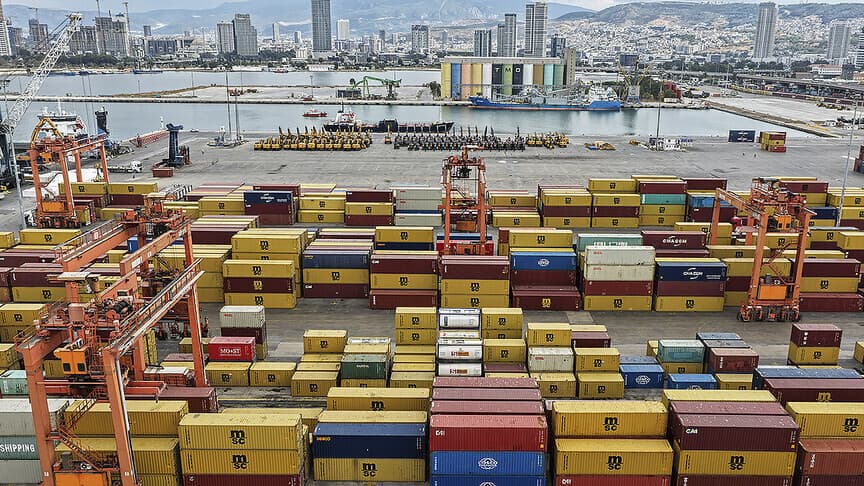
In October 2026, Turkey achieved a historically record-high volume of goods exports for this month: $25.9 billion, up 8.1% from a year earlier. Turkish Trade Minister Ömer Bolat announced this, reports Anadolu. According to him, the annual volume of goods exports reached $285.6 billion, exceeding the government target of $282 billion, while total annual exports of goods and services amounted to $413 billion — above the planned $410 billion.
Deficit narrowed, imports grew more moderately
Data from the ministry's monthly foreign trade bulletin show that imports in October rose 3.4% to $32.58 billion. Since exports grew faster, the foreign trade deficit narrowed by 11.4% — from $7.56 billion a year earlier to $6.7 billion. Total trade turnover increased by 5.4% to $58.47 billion, and the export-to-import ratio rose by 3.4 percentage points to 79.4%. Excluding energy, this indicator reaches 100%, and excluding energy and gold — 101.7%. In the first ten months of 2026, exports grew 5.5% to $236.84 billion, imports 5.1% to $314.5 billion, with the trade gap amounting to $77.67 billion.
Who are the main partners
Germany remained the largest export destination ($2.07 billion), followed by the United States ($1.86 billion) and the United Kingdom ($1.38 billion); the top ten buyers accounted for 45.3% of shipments. In imports, China leads with $4.41 billion, followed by Germany ($2.22 billion) and the United States ($1.77 billion). By country groups, the EU received $10.4 billion worth of Turkish goods, and the countries of the Near and Middle East — $4.25 billion; the main source of imports is Asia ($9.77 billion), followed by the EU ($9.39 billion). In the export structure, 93.3% ($24.15 billion) came from manufacturing products, 3.2% from agriculture, forestry and fishing, and 2.5% from mining. Intermediate goods dominate both flows: 50.4% of exports ($13.04 billion) and 71.7% of imports ($23.36 billion).