The key facts
- Uganda has begun a phased withdrawal of troops from Somalia; the first group of 109 soldiers left Mogadishu on Friday
- The full withdrawal of about 4,500 AUSSOM troops and roughly 2,000 deployed under bilateral agreements is planned by the end of 2027
- The withdrawal comes as the US stops funding the UN logistics office and the UN political mission in Somalia is closed
The beginning of the phased withdrawal
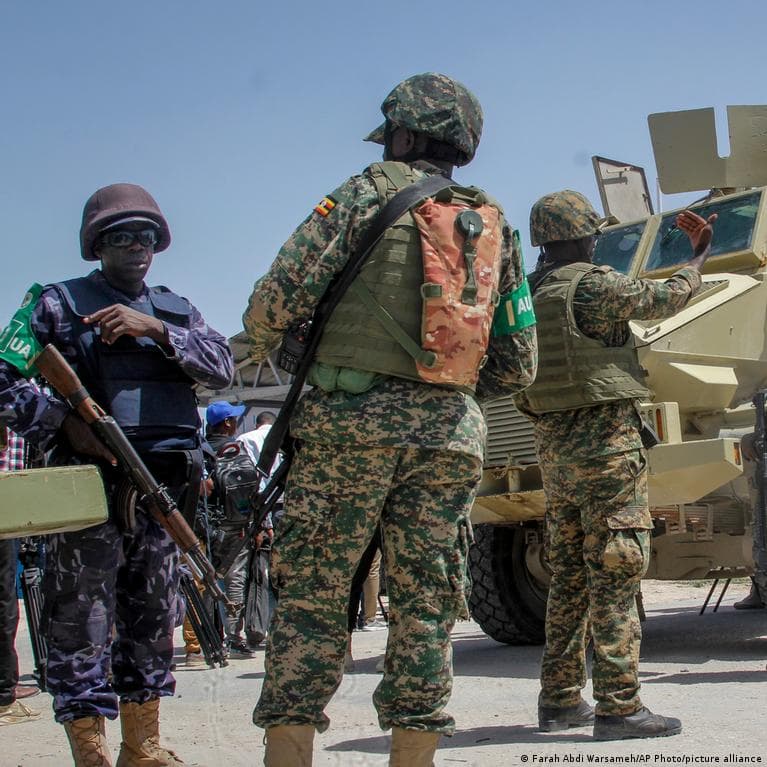
Uganda announced on Monday that it had begun withdrawing its troops from Somalia, where they had taken part in operations against militants for nearly two decades. “The first cohort of troops under the phased withdrawal operation has already arrived back in Uganda,” the Ugandan army said in a statement. According to local media, an initial contingent of 109 Ugandan soldiers left the Somali capital Mogadishu on Friday. Uganda was the first country to send troops to Somalia as part of the African Union peacekeeping forces, established in 2007 to support the Somali government in its fight against the Islamist militants of the Al-Shabaab group (Deutsche Welle).
Timeline and scale of the withdrawal
According to the military, Uganda “will gradually withdraw all its forces from Somalia, including those currently deployed under the African Union Support and Stabilization Mission in Somalia (AUSSOM), by the end of 2027.” At present, about 4,500 Ugandan troops are in Somalia as part of AUSSOM, with another roughly 2,000 deployed under bilateral agreements. The army noted that the withdrawal “will mark the end of Uganda’s 20-year peacekeeping and stabilization operations in Somalia,” after which responsibility for security in the country will pass entirely to the Somali armed forces.
Context: shrinking international support
The future of the AUSSOM mission has been thrown into question after the recent US decision to stop funding the UN logistics office on which the coalition depends. Washington — the coalition’s largest donor — has expressed dissatisfaction with the lack of progress in the fight against Al-Shabaab, which continues to control significant territory in central Somalia, and has also accused the Somali government of failing to unite the country and carry out political reforms. The withdrawal announcement also coincided with the closure of the UN political mission: the UN Assistance Mission in Somalia ceased operations on Saturday after more than three decades of peacebuilding, handing over responsibility to the Somali government and various UN structures.
What is known about the situation in Somalia
Somalia has been gripped for more than two decades by a deadly insurgency led by Al-Shabaab. Ugandan forces played a key role in driving the militants out of the capital and a number of major cities, but in recent years the group has regained territory and now controls significant areas in the center and south of the country. Elections are due to be held in Somalia in May of next year, but, as Deutsche Welle notes, insecurity and disputes with the opposition threaten to derail the process.