The key facts
- Runware plans to establish assembly-line production of modular data centers with a capacity of up to 30 MW per day by 2028.
- Commissioning a module takes 48 hours after delivery, and assembly time is reduced to one day.
- The startup raised $50 million in a Series A round and faces scaling risks similar to those of other manufacturing startups.
Mass production of AI data centers
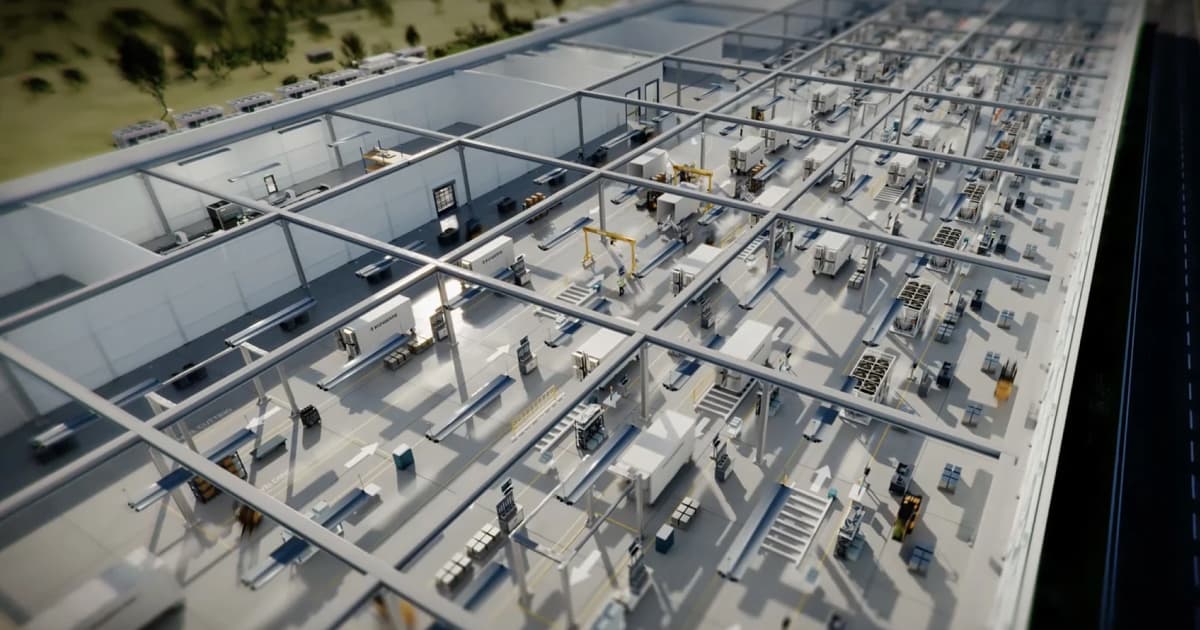
The startup Runware, specializing in artificial intelligence infrastructure, has announced plans to establish assembly-line production of modular data centers, similar to car manufacturing. The company, founded by Flavius Radulescu, already operates a factory in Romania and is building a second facility whose launch is scheduled for early next year. The goal is to scale production to 30 megawatts of capacity per day by 2028, which amounts to roughly 1 gigawatt per year. This is comparable to the projected annual growth of data center capacity across the entire United States, estimated at about 10 gigawatts.
Difference from competitors and deployment speed
Although the market offers products from companies such as Crusoe and Schneider Electric, as well as announced solutions from Nvidia, including Vera Rubin AI factories and DSX POD, Runware is betting on actually having production lines in place, not just on infrastructure design. The startup's key advantage is reducing module assembly time from three weeks to one day at full-scale launch. After delivery to the customer's site, installation and commissioning take no more than 48 hours. The modules can be adapted to specific customer requirements and the latest graphics processors, allowing the company to stay ahead of standard chip delivery timelines.
Funding and scaling risks
To implement its ambitious plans, Runware raised $50 million in a Series A round last December, bringing total funding to over $60 million. The company plans to hold a Series B round, but current operations will be financed from the investments already raised. Experts point to the risks associated with attempts to establish mass production in a high-tech sector, citing the example of the electric vehicle startup Arrival, which ran into difficulties when trying to reduce production costs. Runware, for its part, claims that its cost structure is different thanks to the use of affordable components and the hiring of an experienced plant manager from the automotive industry.
Power consumption and environmental aspects
Amid growing electricity demand from data centers, which, according to Goldman Sachs forecasts, could double by 2027, Runware positions its modules as a solution that requires no water connection thanks to a closed-loop liquid cooling system. The company says it is working with energy providers on projects totaling 397 megawatts, with the potential to expand to 1.2 gigawatts. The modules are designed to operate in locations that already have access to electricity, which, according to management, should not place additional strain on the grid. The priority is the use of renewable energy sources, and the systems themselves operate silently.