The key facts
- The Hebron municipality reports 4,969 people forcibly displaced from 780 families over five days of the operation
- Among the displaced are 336 infants, 441 elderly people, 216 pregnant and breastfeeding women, 44 people with disabilities and 312 with chronic illnesses
- According to the Palestinian Prisoners' Society, 85 Palestinians have been arrested in the Hebron governorate since Friday
Operation in Hebron and sealed entrances
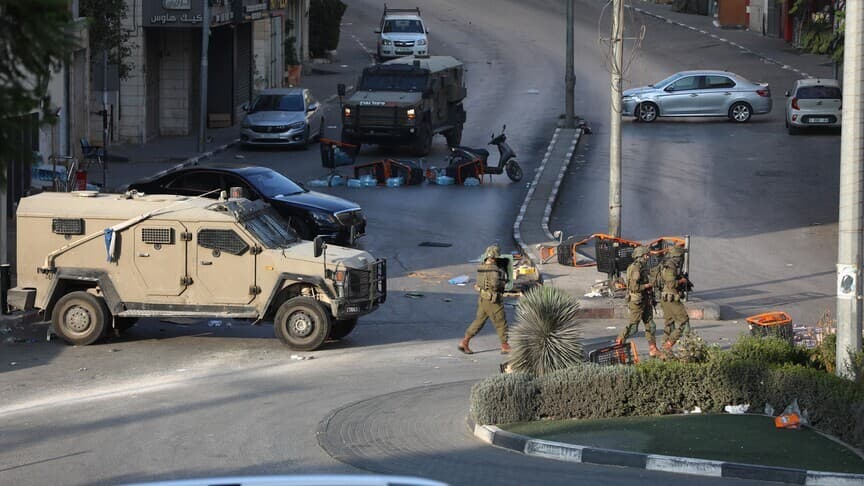
The Israeli army on Tuesday continued its large-scale operation in Hebron in the West Bank for the fifth consecutive day. According to the Hebron municipality, since the campaign began on Friday, 4,969 Palestinians from 780 families have been forcibly displaced from the Deir Bahha and Al-Jilda neighborhoods. The municipality separately lists vulnerable groups among the displaced: 336 infants, 441 elderly people, 216 pregnant and breastfeeding women, 44 people with disabilities, and 312 people with chronic illnesses, emphasizing that the figures document the campaign's impact primarily on those who need special care.
Military raids across the West Bank
The army sealed all entrances to Hebron and the surrounding villages on Friday — after an attack in which two Israeli soldiers were killed. Anadolu footage shows Palestinians being stopped, searched and, according to the agency, subjected to mistreatment at checkpoints near the Al-Jilda roundabout. Witnesses reported new military reinforcements in Ein Deir Bahha, where forces took control of several Palestinian buildings and converted them into military posts. According to the Palestinian Prisoners' Society, 85 Palestinians have been arrested in the Hebron governorate since Friday.
Raids in other governorates
At the same time, operations were also underway in other parts of the West Bank. In Ramallah, Israeli forces closed all main entrances, including the Ein Siniya and Atara checkpoints, the Rawabi gate, and the entrances near Nabi Saleh and Abud, and set up additional checkpoints on detour roads. In Al-Bireh, according to local sources, the army turned a Palestinian home into a military post, held four residents inside and confiscated their phones. Palestinian farmers were driven off their land in Turmus Ayya north of Ramallah; in Tuqu southeast of Bethlehem, forces entered with tracked military vehicles. In the north of the region, raids took place in the eastern neighborhood of Jenin and in the towns of Meithalun, Jaba and Qabatiya, where, according to local sources, at least six people were detained; another man was detained in Aqraba southeast of Nablus, and in the Tulkarm governorate forces searched the southern Al-Hawz neighborhood of Kafrin and a house in the western part of the city. In Hebron itself, troops also repeatedly stormed the Taffuh town and searched the homes of former prisoners; in the south of the governorate, in the Hawara area, soldiers, according to local sources, beat a Palestinian and then detained him and his son.
Attacks by settlers and new outposts
Separately, Anadolu describes the actions of Israeli settlers. Early on Tuesday in the village of Umm Safa west of Ramallah, a group of settlers set fire to three Palestinian cars around midnight, said municipality head Marwan Sabah. According to him, clashes broke out between residents and the attackers, forcing the settlers to retreat; he added that the village has been repeatedly attacked — with residents beaten, cars set on fire and intimidation — and that settlers have seized large areas of its land. The Al-Baidar rights group, which defends Bedouins, reported that settlers also set up a new outpost at the northern entrance to Al-Bireh, overlooking the Al-Balu neighborhood. According to the Colonization and Wall Resistance Commission, in September settlers attempted to establish 21 new outposts across the West Bank, including 10 in the Ramallah and Al-Bireh governorate.
Context
Anadolu links the events described to the overall escalation in the occupied West Bank: according to the agency, intensified army raids and settler attacks on Palestinians have continued since the start of Israel's war in Gaza in October 2023. The report is based on statements by Palestinian municipalities, human rights organizations and local sources; the Israeli side is not represented in the publication.