The key facts
- On 26 October, an international conference dedicated to the shared heritage of the two countries was held in Baku
- The Center of Islamic Civilization in Uzbekistan and ANAS of Azerbaijan signed a memorandum of cooperation
- Joint study of the historical heritage and the development of scientific ties between Baku and Tashkent were discussed
The conference in Baku and its participants
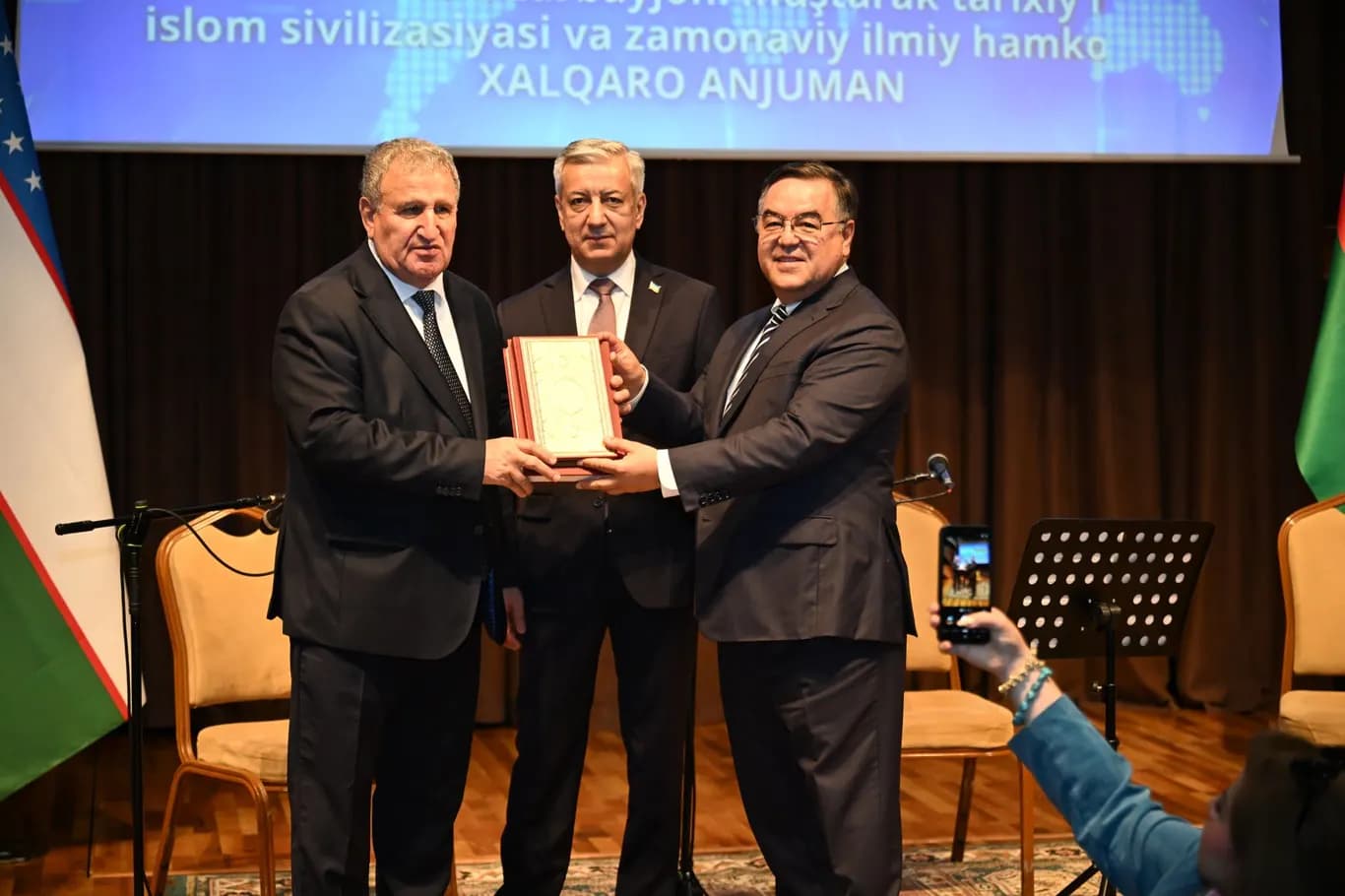
On 26 October 2026, an international conference on the theme 'Uzbekistan and Azerbaijan: shared historical heritage, Islamic civilization and modern scientific cooperation' was held at the International Mugham Center in Baku. Zamon.uz reported this. Participants included the Ambassador of Uzbekistan to Azerbaijan, Bakhrom Ashrafkhanov, the President of the National Academy of Sciences of Azerbaijan, Isa Habibbeyli, the Director of the Center of Islamic Civilization in Uzbekistan, Firdavs Abdukhalikov, representatives of the Muslim Board of Uzbekistan, museum directors, scholars and cultural figures. At the start of the conference, a video about relations between the two countries and a documentary film about the activities of the Center of Islamic Civilization were shown, and an exhibition of books published by the Center was also held.
Shared heritage as a theme of the speeches
Ambassador Bakhrom Ashrafkhanov emphasized the significance of the historical closeness and strategic partnership of the two peoples, noting the role of the Great Silk Road in the exchange of knowledge and the legacy of thinkers such as Muhammad al-Khwarizmi, Abu Rayhan Beruni, Ibn Sina, Mirzo Ulugbek, Nizami Ganjavi, Imadaddin Nasimi and Muhammad Fuzuli. He also spoke of the need to turn the Center of Islamic Civilization into a platform for scientific and cultural dialogue and to strengthen ties between Baku and Tashkent.
Examples of scientific and literary ties
The Director of the Center of Islamic Civilization, Firdavs Abdukhalikov, noted that the ties between the two peoples go back to pre-Islamic times, and gave examples: Ibn Sina and his Azerbaijani student Bahmanyar, the scientific schools of Nasir al-Din al-Tusi in Maragha and of Mirzo Ulugbek in Samarkand. According to him, Nizami Ganjavi's 'Khamsa' inspired Alisher Navoi, who created his own 'Khamsa' in the Turkic language, and Navoi's work influenced the Azerbaijani poet Kishvari. A manuscript kept in Tashkent, in which the works of Navoi and Fuzuli are bound under one cover, was also mentioned. As an example of modern ties, Abdukhalikov cited the opening of a school named after Mirzo Ulugbek in Fuzuli with the participation of the heads of the two states.
A practical outcome — the memorandum
The main result of the conference was the signing of a memorandum of cooperation between the Center of Islamic Civilization in Uzbekistan and the National Academy of Sciences of Azerbaijan. The agreement is aimed at jointly studying the historical heritage, strengthening ties between scientific institutions and developing joint research. The President of ANAS, Isa Habibbeyli, assessed the Center of Islamic Civilization as a significant project not only for Uzbekistan but for the entire Turkic world, emphasizing the importance of presenting the heritage using modern technologies.
The religious and musical dimension
The First Deputy Chairman of the Muslim Board of Uzbekistan, Khamidjon Ishmatbekov, declared the Board's readiness to develop religious and spiritual cooperation with religious institutions and scholars of Azerbaijan, citing the legacy of Ahmad Yasawi, Bahauddin Naqshband and Sayid Yahya Bakuvi as evidence of the strong ties between the Turkic peoples. The conference also highlighted the commonality of musical traditions — Azerbaijani mugham and Uzbek maqom; it concluded with a concert program featuring their performers.