The key facts
- A 42-year-old Swiss citizen was evacuated from Abuja to Switzerland; the infection is believed to have occurred in Uganda
- Uganda requires 21 days of quarantine at one's own expense for those returning from the DR Congo and bans them from transiting through the country
- The outbreak in the DR Congo is the deadliest in the country's history: 9,800 cases and more than 4,700 deaths as of 21 October
Patient evacuation and Uganda's response
The only confirmed Ebola patient in Nigeria during the current outbreak was flown from Abuja to Switzerland on Monday, euronews reports. She is a 42-year-old Swiss citizen, the wife of an embassy employee working in the Nigerian capital. According to the Swiss Federal Department of Foreign Affairs, as relayed to the Associated Press, she travelled to Uganda with her husband, then returned to Nigeria, and had not been to the DR Congo — the infection is believed to have occurred in Uganda. Uganda's Ministry of Health said on 23 October that the patient had no symptoms at the time of leaving the country, and the investigation is ongoing.
Patient's condition and contact tracing
Nigeria's Health Minister Muhammad Ali Pate wrote on Xthat the woman's condition has 'improved significantly: she is stable, conscious and responsive', but stressed that 'this does not mean she is no longer contagious'. Nigerian authorities have identified 53 of the patient's contacts — healthcare workers, relatives and household staff — and on Sunday reported that nine more contacts had been traced. Her husband has no symptoms and is in isolation. According to Pate, the infection appears to be closely linked to the first case in Kenya, although this does not make it possible to definitively establish the route of transmission.
Uganda's new border measures
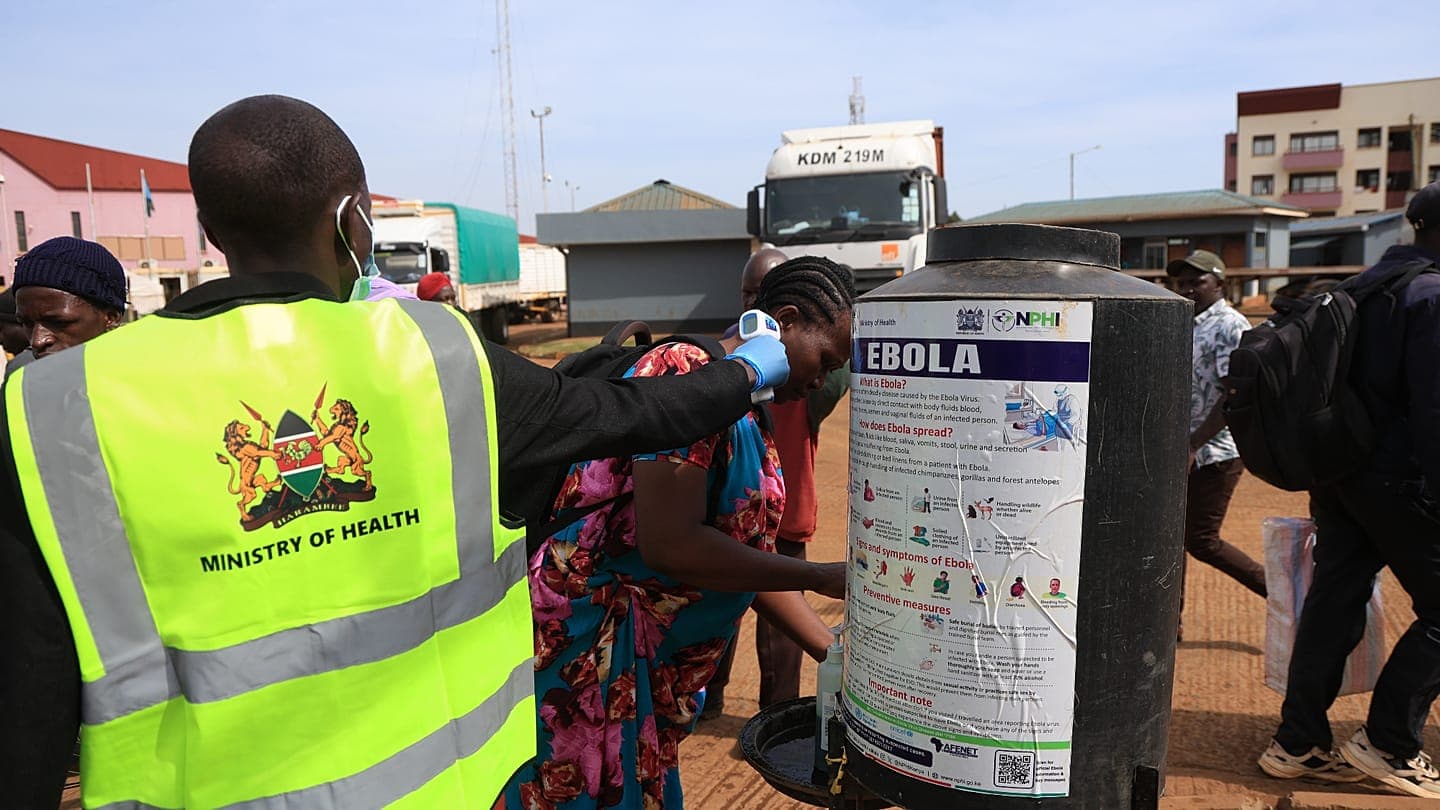
In response to the situation, Uganda, which the WHO declared Ebola-free on 27 August after 42 days without new cases, tightened border controls on Sunday. Citizens returning from the neighbouring DR Congo are now required to spend 21 days in quarantine at their own expense; anyone who has been in the DR Congo is banned from transiting through Uganda, including on charter flights. Non-essential travel by Congolese nationals will be interrupted, and travellers will be sent back at their own expense through the nearest border post; those who cross the border illegally face prosecution. 'The end of local virus transmission does not mean the risk has disappeared. We border the DR Congo, where transmission is ongoing,' Uganda's Ministry of Health stated. Earlier, Africa CDC reported that the first patients in Nigeria and Kenya on 3 October had passed through Entebbe airport.
Scale of the outbreak in the DR Congo
The outbreak, which began in the DR Congo in May, according to the country's data as of 21 October, has affected nearly 10,000 people and claimed more than 4,700 lives — the fastest-growing and deadliest Ebola outbreak in the country's history. The epicentre is Ituri province in the north, where 3,298 people have died; the virus has spread to seven more provinces. The response is hampered by instability in the region and violence against medical workers: according to the WHO, in the latest incident a nurse was killed and another health worker seriously injured while responding to an Ebola alert. Kenya has reported its first-ever case and two deaths, with seven more patients being treated in isolation. Since May 2026, three infected people — medics and humanitarian workers from Congo — have been evacuated to Europe (two to Germany, one to the Netherlands), and in July another person with potential exposure to the virus was taken to the United Kingdom.