The key facts
- Chinese physicists produced a glowing plasma ball about 80 micrometers in diameter using a laser pulse on a tungsten needle
- The ball retained its structure considerably longer than the original pulse and behaved like an electromagnetic soliton
- Modeling showed that when excited by microwaves, such structures could theoretically reach meter-scale sizes and exist for seconds
A laboratory plasma ball
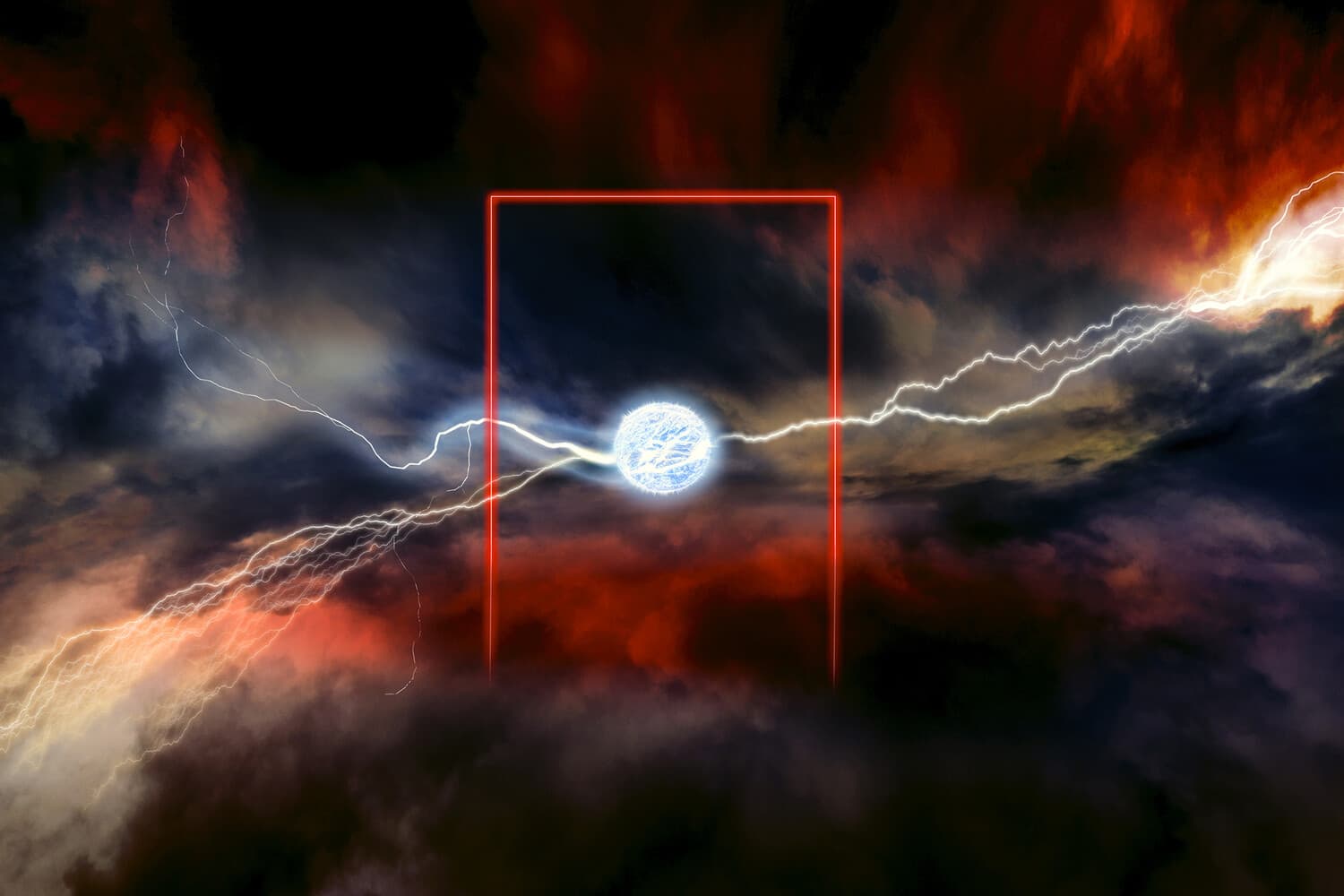
Chinese physicists have created a glowing plasma ball that retained its structure considerably longer than the pulse that produced it. The experiment was aimed at testing one of the hypotheses about the nature of ball lightning — a rare atmospheric phenomenon that has no generally accepted explanation. The work was published in the journal Nature Photonics; Gazeta.Ru reported on it.
How the experiment was conducted
Researchers at the Chinese Academy of Sciences directed an ultrashort laser pulse at a tungsten needle with a tip about 100 nanometers wide. A powerful electromagnetic wave propagated along the needle: at the tip the energy became concentrated, and the resulting field knocked electrons out of argon atoms, turning the gas into plasma. This is how a glowing ball appeared, with an initial diameter of about 80 micrometers. Over the next 100 nanoseconds it expanded to several hundred micrometers, but retained a fairly clear structure. Compared with the original pulse, the lifetime of the formation was longer.
A soliton instead of ordinary plasma
The observed expansion was compared with calculations and computer models: it matched the behavior of an electromagnetic soliton — a stable, localized wave formation. According to this model, the energy remains trapped inside the plasma shell and sustains the glowing ball; ordinary hot plasma dispersed differently in the calculations. Additional modeling showed that if excited by microwaves instead of terahertz radiation, such structures could theoretically reach meter-scale sizes and exist for seconds — which is closer to some descriptions of natural ball lightning.
What this means
The authors and the publication emphasize that the laboratory ball cannot yet be considered an exact copy of the atmospheric phenomenon, since the experimental conditions differ greatly from a thunderstorm. The work gives physicists a controllable model for testing hypotheses, rather than a final solution to a centuries-old mystery. For the science of ball lightning, this is a practical step: for the first time, the described parameters — size, lifetime, and correspondence to the soliton model — make it possible to reproduce and study such structures under controlled conditions, while the conclusions about microwave excitation set the direction for further experiments.