The key facts
- Jensen Huang arrived in Astana on October 23 and met with President Kassym-Jomart Tokayev
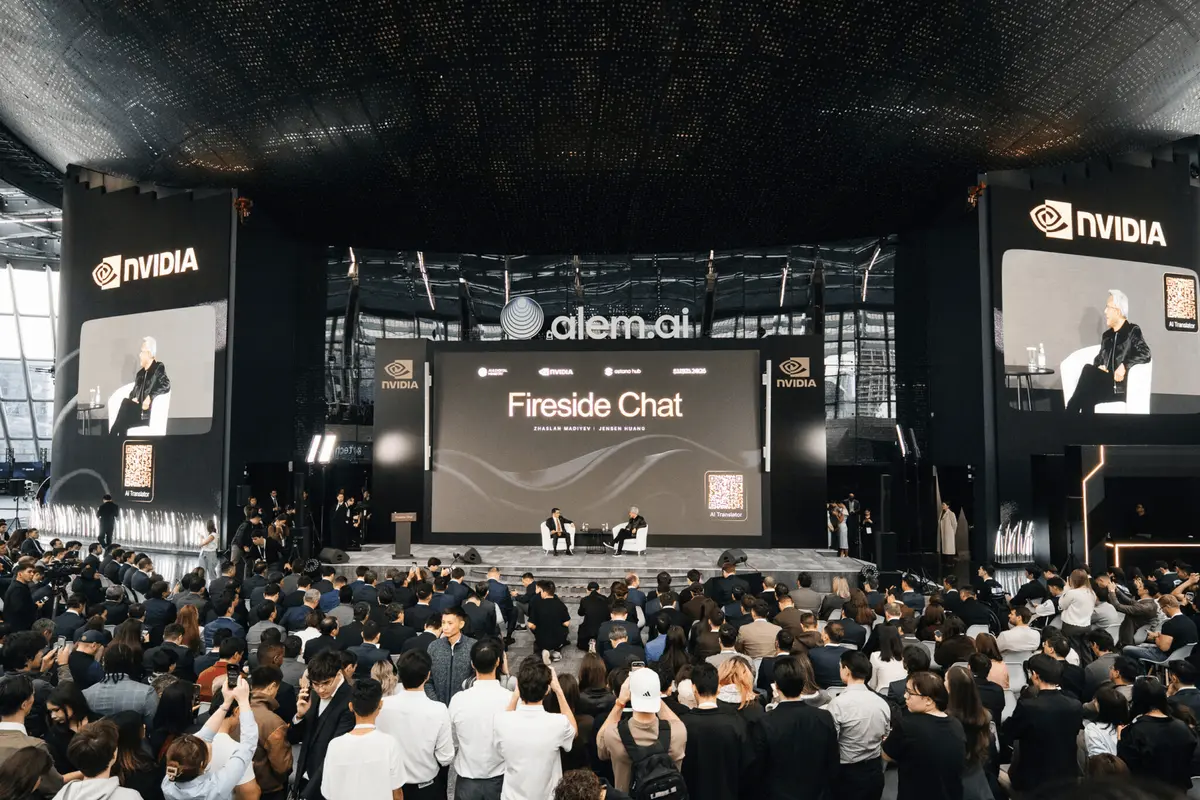
- The open conversation with Minister Zhaslan Madiev at the alem.ai center was broadcast live on YouTube
- Huang said Kazakhstan could become an international center in the field of Physical AI
Nvidia CEO's visit to Astana
Nvidia founder and CEO Jensen Huang arrived in Astana on October 23. He met with President of Kazakhstan Kassym-Jomart Tokayev and familiarized himself with the country's artificial intelligence infrastructure and technology ecosystem, Kun.uz reports. Nvidia is a major American company developing graphics processors and computing technologies for AI; its chips are widely used in training and running AI models, building supercomputers and data centers.
Open conversation at alem.ai and assessment of potential
One of the main events of the visit was an open conversation between Huang and Deputy Prime Minister — Minister of Artificial Intelligence and Digital Development Zhaslan Madiev at the international AI center alem.ai in Astana; it was broadcast live on YouTube. Huang highly praised Kazakhstan's energy resources, engineering potential, and the elevation of AI to the level of state policy. In his view, the country should not limit itself to exporting energy resources, but use them to produce AI products and services for foreign markets. «In the future, instead of exporting only energy, you can turn energy into intelligence and export intelligence», said the head of Nvidia. He noted that AI development requires large amounts of electricity, data, and computing power, and from this point of view, natural resources and the ability to train technical personnel could give Kazakhstan an advantage in international competition.
Physical AI and areas of application
Huang also stated that Kazakhstan could become an international center in the field of Physical AI — a direction encompassing the interaction of AI with robots, autonomous transport, manufacturing equipment, and other physical systems. According to him, the country's developed industries — mining, agriculture, logistics, and energy — create opportunities for developing and testing such technologies.
Why this matters
The visit of the head of one of the key companies in the AI industry underscores Kazakhstan's course of turning energy resources into a foundation for computing and AI products, which Huang spoke about directly. For the country's residents and businesses, the practical significance lies in the stated areas of application — mining, agriculture, logistics, and energy — as well as the development of the alem.ai center as an international-level platform. For now, this concerns statements and assessments made during the visit: no specific investments, agreements, or implementation timelines for projects are reported in the publications.