The key facts
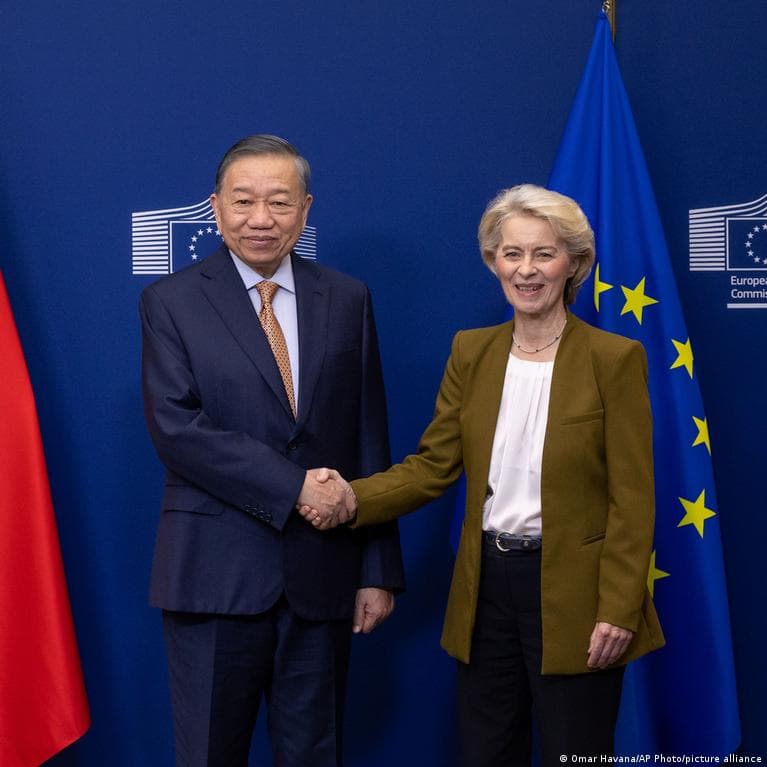
- To Lam arrived in Brussels on Wednesday, October 21, amid deepening EU-Vietnam trade ties
- The EU's goods trade deficit with Vietnam reached €51.7 billion in 2025 versus ~€24 billion in 2019
- 12 human rights organizations in an open letter urged von der Leyen and Costa to demand reforms from Hanoi
A visit amid growing trade
General Secretary of the Communist Party and President of Vietnam To Lam arrived in Brussels on Wednesday for an official visit to the European Union and Belgium. The visit took place just days after Vietnam signed a free trade agreement with EFTA (Norway, Switzerland, Iceland and Liechtenstein) in Hanoi on October 18, 2026. The EVFTA agreement between the EU and Vietnam has been in force since August 2020. Vietnam has become the EU's largest trading partner in Southeast Asia and 14th in the world; the EU is Vietnam's fourth-largest trading partner and a major source of foreign investment. In January, the sides upgraded their relations to a Comprehensive Strategic Partnership — the EU's first such agreement with a Southeast Asian country.
Strategic significance and security
Alfred Gerstl, an expert at the University of Vienna, called Vietnam a key strategic partner of the EU in the Indo-Pacific region, important for the EU's economic security and its strategy of reducing dependence on China. Several European states have signed defense agreements with Hanoi. On Wednesday, the EU's chief diplomat Kaja Kallas held talks with Vietnam's Foreign Minister Le Hoai Trung on developing security cooperation, including in the South China Sea, where Vietnam has territorial disputes with China. Khac Giang Nguyen, an expert at the ISEAS–Yusof Ishak Institute, described the relationship as 'mutually beneficial': Vietnam offers Europe a manufacturing base and a place in Asian supply chains, while Europe offers capital, technology and a market.
Human rights criticism
12 international human rights organizations this week sent an open letter to European Commission President Ursula von der Leyen and European Council President Antonio Costa expressing 'serious concern about the Vietnamese government's intensifying repression' and calling for reforms to be demanded. Human rights defenders note that Vietnam remains a one-party state restricting political opposition, independent media and civil society, and that repression has intensified under To Lam, who previously headed the Ministry of Public Security. Under the EVFTA, Hanoi committed to reforming labor legislation and aligning its standards with ILO standards, but has not ratified the convention on freedom of association, and independent trade unions remain banned. 'The EU has taken no action in response to Vietnam's repeated violations of its EVFTA commitments, and in January it upgraded the level of bilateral relations,' the letter states.
Uneven benefits and trade imbalance
Hai Tiem Bui, a researcher at the Stockholm Center for Global Asia, noted that the benefits of the EVFTA are distributed unevenly: large foreign manufacturers have benefited more from tariff reductions than small Vietnamese businesses, which struggle to meet EU requirements, including the carbon border mechanism and rules on deforestation. The EU's goods trade deficit with Vietnam grew from about €24 billion in 2019 to €51.7 billion ($57.9 billion) in 2025. The investment protection agreement, signed in 2019, has still not entered into force: Germany ratified it in February, Poland in April, while France, the Netherlands and a number of other countries have not yet completed ratification. According to Chris Humphrey, executive director of the EU-ASEAN Business Council, European investment in Vietnam is growing even without this agreement, and trade, he expects, will continue to grow, although businesses are closely watching the legislative agenda of Vietnam's new government.