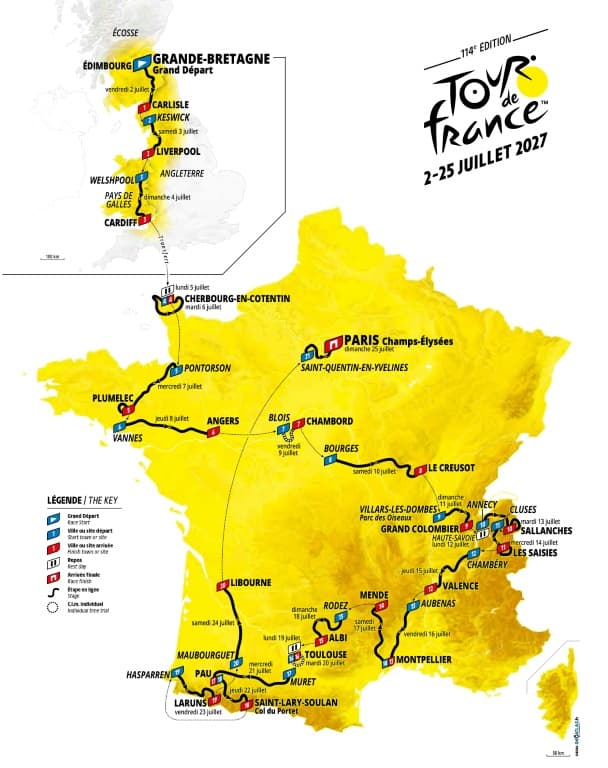
The key facts
- Start in Edinburgh — the northernmost Grand Départ in history; three stages in Scotland, England and Wales
- Two time trials: 38 km on stage 7 and 33 km around Toulouse on stage 16
- 28 climbs, 53,450 m of total elevation gain, three summit finishes; highest point — the Col du Portet (2,215 m) on stage 18
Route of the 114th Tour Presented in Paris
ASO organisers on Thursday, 22 October, published the full route of the 2027 Tour de France. A year after the race's southernmost start in Barcelona, the peloton will set off from Edinburgh — this will be the northernmost start in the history of the Tour, surpassing the 2022 Grand Départ in Copenhagen. It is the fifth time in six years that the race starts abroad. The Edinburgh start had been known for more than a year, and the first three stages across Britain — in Scotland, England and then Wales — were revealed back in January.
The First Ten Days — for the 'Puncheurs'
Tour director Christian Prudhomme told AFP that the first ten days of the route are designed so that the lead changes hands: 'the world's best puncheurs against the general classification favourites.' About the third stage in Wales he said: 'Wales is Liège–Bastogne–Liège,' comparing it to the famous hilly one-day race. According to Prudhomme, the route design is meant to avoid a repeat of the 2026 edition, when Slovenian Tadej Pogačar — who in 2027 will be chasing a record sixth yellow jersey — led almost from start to finish. 'I want to muddy the waters, make a route that allows anything,' he added.
Time Trials and Wind in Normandy
The fourth stage will run mainly along the coast of the Cotentin Peninsula in Normandy, where the riders will get a windy welcome to France. The first individual time trial — 38 km on an absolutely flat course on stage seven — should favour Olympic champion and world champion in the discipline Remco Evenepoel, who in July finished second behind Pogačar. The second time trial, 33 km around Toulouse on stage 16, is again considered favourable for the Belgian.
Mountains: The Pyrenees Instead of the Classic Summits
The route features 28 climbs and a total elevation gain of 53,450 m, but only three summit finishes across six mountain stages. The highest point is the Col du Portet (2,215 m) in the Pyrenees on stage 18. In 2027 there will be no Alpe d'Huez, Ventoux, Galibier or Izoard, but the race will cross the Tourmalet and pass through Domaency, where the world championships will be held a month after the Tour. 'If you want to open up other climbs, you have to accept that we do not systematically use the most famous ones,' said Prudhomme. According to him, the Tourmalet and the Portet will be linked in a single stage for the first time, and the next day the Basque climbs of Burdinkurutxeta and Bagargi will return — for the first time since 2023.
Finish on Montmartre
The race will conclude with a stage around Paris featuring the climb of Montmartre — for the third year in a row. The two previous finales produced dramatic endings: in 2025 the Belgian Wout van Aert won, and in July Mathieu van der Poel, with some help from overall winner Pogačar, held off the attacking peloton by a minimal margin. Notably, the 20th, penultimate stage is designed for sprinters, so the battle for the general classification will probably be decided two days before the Parisian finale.