The key facts
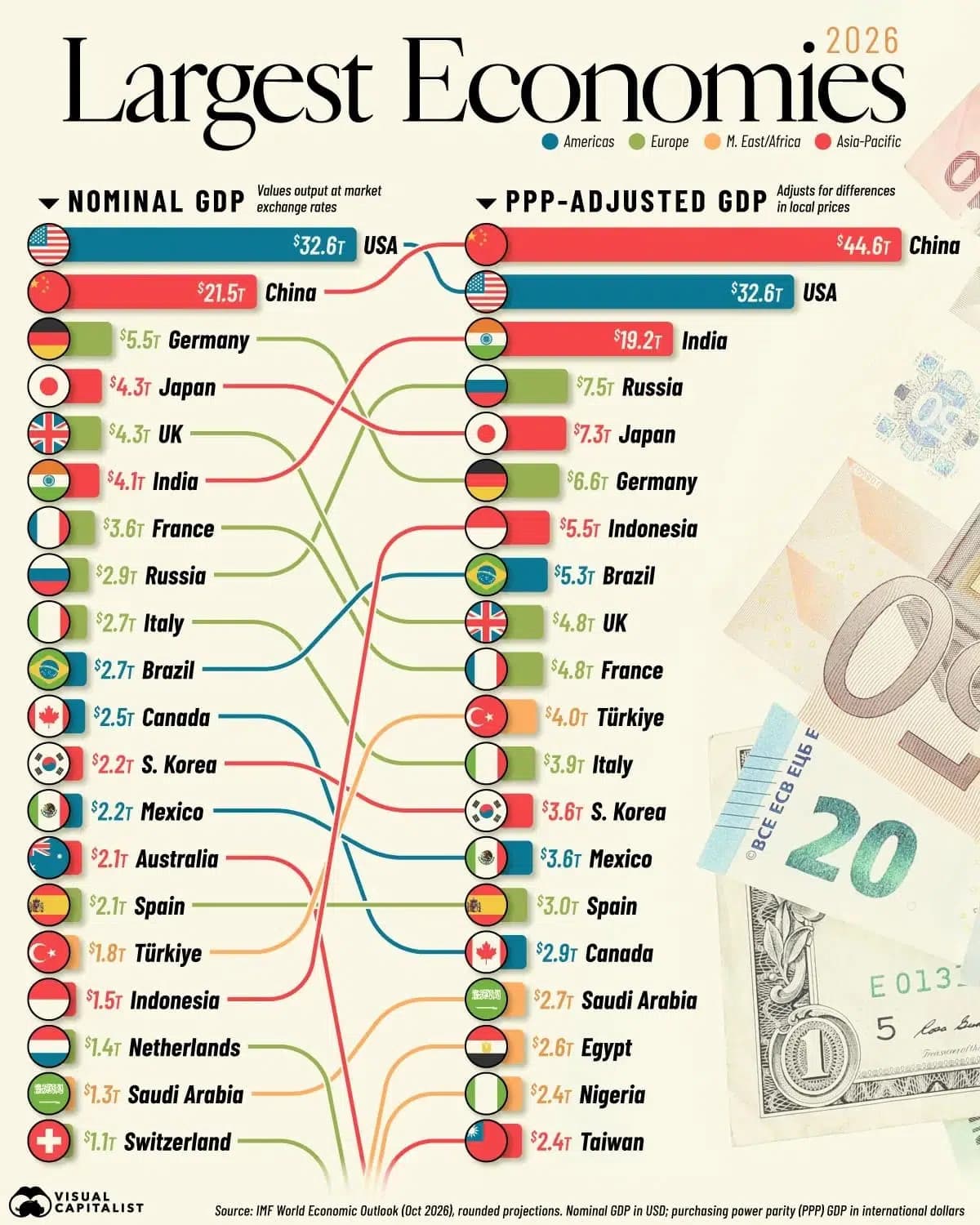
- By nominal GDP for 2026: the US — $32.6 trillion, China — $21.5 trillion (IMF forecast).
- By purchasing power parity China is at $44.6 trillion international dollars, roughly 37% more than the US; China first overtook the US on this measure in 2014.
- Indonesia (17th by nominal GDP, 7th by PPP), India (6th → 3rd) and Russia (8th → 4th) rise notably in the PPP ranking.
Two ways of measuring economies
Visual Capitalist compared the world's 20 largest economies based on the IMF's October World Economic Outlook forecast for 2026, using two measures: nominal GDP and GDP by purchasing power parity (PPP). Nominal GDP is converted into dollars at market exchange rates, whereas PPP accounts for price differences between countries — that is, how many goods and services the same amount of money can buy in different states.
The US and China: the result depends on the methodology
By nominal GDP, the US economy in 2026 is forecast to reach $32.6 trillion, and China's $21.5 trillion. By purchasing power parity the picture is reversed: China's GDP is estimated at $44.6 trillion international dollars, roughly 37% higher than the US figure. By this methodology China first overtook the US back in 2014.
Who rises in the PPP ranking
The largest difference in positions among the listed countries belongs to Indonesia: 17th place by nominal GDP and 7th by PPP, where it ranks above Canada, France and the United Kingdom. India rises from sixth place by nominal GDP to third by PPP, ahead of Germany, Japan and the United Kingdom: its GDP by PPP is estimated at $19.2 trillion international dollars versus Germany's $6.6 trillion — almost three times as much. Russia holds eighth place by nominal GDP and fourth by PPP with a figure of $7.5 trillion international dollars, above Japan and Germany.
Caveats
The difference in positions does not mean that a country's economy grew sharply over a short period — two different measurement methodologies are applied for a single year. Moreover, the overall size of an economy is not identical to per capita income or the standard of living. The figures given are not final results for 2026 but forecasts by the International Monetary Fund.