The key facts
- Meta's net profit in Q3 rose 264% to $9.9 billion, while Tesla's fell 43% to $787 million
- Brent (December) rose 1.8% to $110.7 per barrel; French 10-year bond yields exceeded 5% — a 24-year high
- Asian indices fell on Thursday: Kospi −3.7%, Hang Seng −2.9%, Nikkei −2.1%, Shanghai Composite −1.3%
Mixed dynamics amid earnings and geopolitics
Global markets are trading mixed: despite strong earnings from American technology companies, investors are worried about the financing of artificial intelligence investments and the risk of escalating tensions in the Middle East, Anadolu reports. Rising oil prices and inflation risks support expectations of monetary policy tightening worldwide. According to money market estimates, the Fed will keep rates unchanged at next week's meeting with an 86% probability, and in December, as expected, will raise them by 25 basis points.
Meta and Tesla earnings
Meta reported a 264% increase in net profit in the third quarter — to $9.9 billion. Tesla's net profit, by contrast, fell 43% — to $787 million. The incoming earnings do not dispel investors' concerns about the profitability of massive AI investments, which makes it difficult for asset prices to rise.
Middle East and oil
US President Donald Trump said the cause of the war with Iran was preventing, in his words, Tehran from obtaining nuclear weapons, calling it 'one of the best things we have done' and claiming that without Washington's intervention Tehran would already have carried out a nuclear strike. According to the New York Times, citing unnamed American officials and sources involved in discussions about the war, the US and Israeli militaries have already planned new strikes on Iran after the midterm elections. The US is preparing to evacuate diplomats from Saudi Arabia amid ongoing attacks, but State Department spokesman Tommy Pigott denied reports of an allegedly planned evacuation of personnel from the entire Persian Gulf region. The price of the December Brent contract rose 1.8% — to $110.7 per barrel.
US and European markets
On Wednesday, US indices closed higher: the S&P 500 gained 0.58%, the Nasdaq Composite 1.05%, and the Dow Jones 0.69%. On Thursday, American indices opened lower. The yield on 10-year US Treasury bonds fell three basis points on Thursday after neutral trading on Wednesday, and the dollar declined 0.1% — to 101.5. European markets found support on Wednesday after declining since the start of the week amid protests in France: the DAX 40 rose 1.35%, the FTSE MIB 30 by 1.17%, the CAC 40 by 1.06%, and the FTSE 100 by 0.19%. On Thursday, European indices also opened lower. SAP's revenue in the third quarter exceeded €10 billion ($11.2 billion), and the company forecasts revenue of up to €36.8 billion ($41.3 billion) for the full year. The yield on French 10-year bonds exceeded 5% — a 24-year high — with the spread over German bonds approaching 160 basis points. UK inflation accelerated to 3.5% in September — the highest since October 2025 — driven by rising fuel prices; the country's public debt is estimated to have exceeded £3 trillion ($4 trillion) at the end of September.
Selloff in Asia
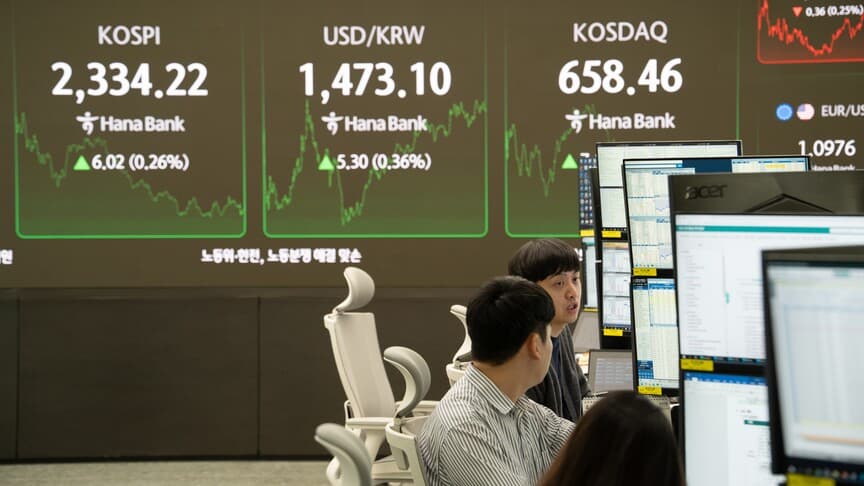
Strong earnings from SpaceX and Meta failed to support Asian markets on Thursday: the region's attention is focused on AI financing issues, and rising oil prices due to Middle East tensions are hurting economies dependent on energy imports. High inflation and the likelihood of rates staying higher for longer than expected are weighing on technology stock valuations. By the close of trading, the Nikkei 225 index in Japan fell 2.1%, the Shanghai Composite in China by 1.3%, the Hang Seng in Hong Kong by 2.9%, and the Kospi in South Korea by 3.7. Market attention is focused on the Turkish central bank's decision on Thursday: after keeping the rate at 37% in September, a cut of 100 basis points is expected.