The key facts
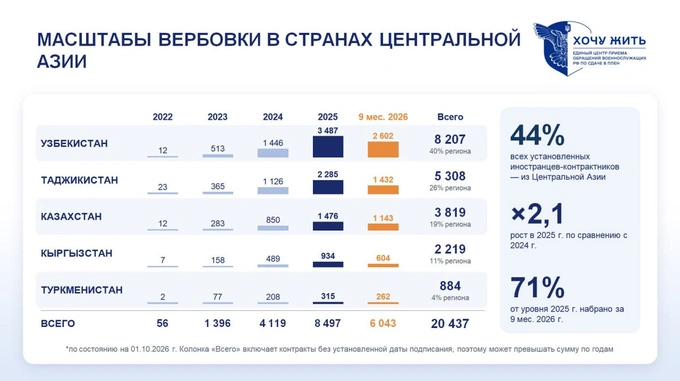
- According to the 'I Want to Live' project, as of October 1, 2026, 20.4 thousand citizens of Central Asia have signed contracts with the Russian Armed Forces; 40% are citizens of Uzbekistan (8,200+).
- In 2025, the number of contract signatories grew 2.1-fold — from 4,119 to 8,497 people; in the first nine months of 2026, another 6,043 people signed.
- Among foreign prisoners of war from Central Asia, the main motive is obtaining Russian citizenship (32% of responses); 82% plan to return to Russia.
Data from the 'I Want to Live' Project
The Ukrainian project 'I Want to Live' presented statistics at an October 20 briefing for regional media: as of October 1, 2026, more than 20.4 thousand citizens of Central Asian countries have signed contracts with the Russian Armed Forces to participate in the war against Ukraine. More than 8,200 of them (40% of the total figure for the region) are citizens of Uzbekistan. They are followed by Tajikistan (5,308 people, 26%), Kazakhstan (3,819, 19%), Kyrgyzstan (2,219, 11%), and Turkmenistan (884, 4%). According to the project, citizens of Central Asia account for 44% of all identified foreign contract soldiers of the Russian army. A project representative emphasized that ethnic natives of Central Asia who have received Russian citizenship are not included in the statistics; if they were counted, the figure would be higher.
Dynamics for 2025–2026
According to the project's data, the number of Central Asian citizens who signed contracts with the Russian Armed Forces grew 2.1-fold over the past year: from 4,119 people in 2024 (of whom 1,446 were from Uzbekistan) to 8,497 in 2025 (3,487 from Uzbekistan). In the first nine months of 2026, another 6,043 people signed contracts (2,602 from Uzbekistan), which is 71% of the 2025 figure. The project's conclusions note that recruiting the population of neighboring states is 'especially convenient' due to language, culture, and migration ties.
Foreign Prisoners of War
According to 'I Want to Live' data as of October 12, 2026, hundreds of foreigners who fought as part of the Russian Armed Forces — citizens of 59 states — are in Ukrainian captivity, and, according to a project representative, this number grows every year. The top seven countries by the number of foreign prisoners of war, in the order given in the presentation, include citizens of Uzbekistan, Tajikistan, Belarus, Colombia, Kazakhstan, Azerbaijan, and Kyrgyzstan. The project did not disclose the exact number of prisoners by country.
Recruitment Methods
The project identifies three main methods of attracting foreigners to the Russian Armed Forces: monetary incentives, deception, and coercion. Recruiters promise a relatively high salary (from $2,000 to $3,000 per month), Russian citizenship, and benefits; many, according to the project, agree for the sake of earnings. Deception consists of offering 'highly paid work' — in construction, security, warehouses, or as a driver — without mentioning participation in combat operations; after signing the contract, the person is sent to a short course at a training ground and then to the front. According to the project, citizens of Sri Lanka, Cuba, Nepal, and African countries are most often recruited this way. Coercion is linked to police raids against illegal migrants and people with expired documents: under the threat of imprisonment or deportation, they are offered an 'alternative' — a contract with the Russian Ministry of Defense in exchange for money and citizenship. According to the project's authors, this is one of the most common scenarios for natives of Central Asia.
Motives and Plans of the Prisoners
According to a project representative, more than 90% of foreign prisoners of war took a survey about the reasons for signing the contract and their plans for the future; the total number of respondents was not disclosed. Responses were grouped by region: Central Asia, Eastern Partnership countries (Armenia, Belarus, Moldova, Georgia), Latin America, Africa, the Middle East and North Africa, Asia; respondents could choose several options. Among prisoners from Central Asia, the main motive is the desire to obtain Russian citizenship (32% of responses). Another 20% of responses are related to release from imprisonment or avoidance of criminal prosecution — on this indicator, the region surpasses all other groups. 10% of responses are related to earnings, 6% to the desire to avoid deportation from Russia. In 12% of responses, the contract was indicated as voluntary, out of support for Russia's actions; according to a project representative, in personal conversations this was explained, in particular, by ethnic Russians who lived in Central Asian countries before the war. When asked about plans for the future, the majority of prisoners from Central Asia (82%) chose the option 'return to Russia' and only 11% chose to return to their homeland. A project representative reported that the prisoners consider themselves Russian citizens, even if they received a passport only after signing the contract; they are afraid to return home due to criminal liability for mercenarism in the countries of the region and want to receive the monetary payments due to them for participation in combat operations.