The key facts
- Vlad Shlepchenko suggested that without a response from Moscow to drone overflights through the Baltics, a surprise missile strike on facilities of the Leningrad Military District is possible.
- Routes through the Baltics toward the ports of Primorsk and Ust-Luga were earlier reconstructed by war correspondent Alexander Kots.
- On October 18, a drone fell in Lithuania on a road between Biržai and Pasvalys, damaging a car.
Expert links drone flights over the Baltics to risk for Leningrad Region
The use of the airspace of the Baltic states by Ukrainian drones could create prerequisites for future missile attacks on the Leningrad Region. This scenario was suggested by Tsargrad military commentator Vlad Shlepchenko, who warned that the absence of an effective response from Moscow to such incidents could lead to a further escalation of the situation.
Routes and the incident in Lithuania
According to the expert, during the recent massed raids on northwestern Russia, drones again flew through the territory of neighboring states. He recalled that similar routes were recorded in the spring, when the ports of Ust-Luga and Primorsk, as well as the Kirishi oil refinery, came under attack. Shlepchenko considers the October 18 incident one of the confirmations of such routes, when in Lithuania a drone fell on a road between Biržai and Pasvalys and damaged a car.
Assessments and proposed measures
The commentator noted that the current routes differ from the spring ones: in his assessment, the drones have begun penetrating significantly deeper into the airspace of the Baltic republics. At the same time, he considers it unlikely that the local authorities fail to notice such movements. Shlepchenko fears that the absence of consequences for the transit states may push Kyiv toward using more dangerous weapons, including an attempt at a surprise missile strike on facilities of the Leningrad Military District. As a countermeasure, he proposed using similar air routes for Russian drones heading toward targets in western Ukraine — in his view, this would force the Baltic states to strengthen their air defenses and reconsider their attitude to Ukrainian drone overflights.
Other experts' positions and the reconstructed route
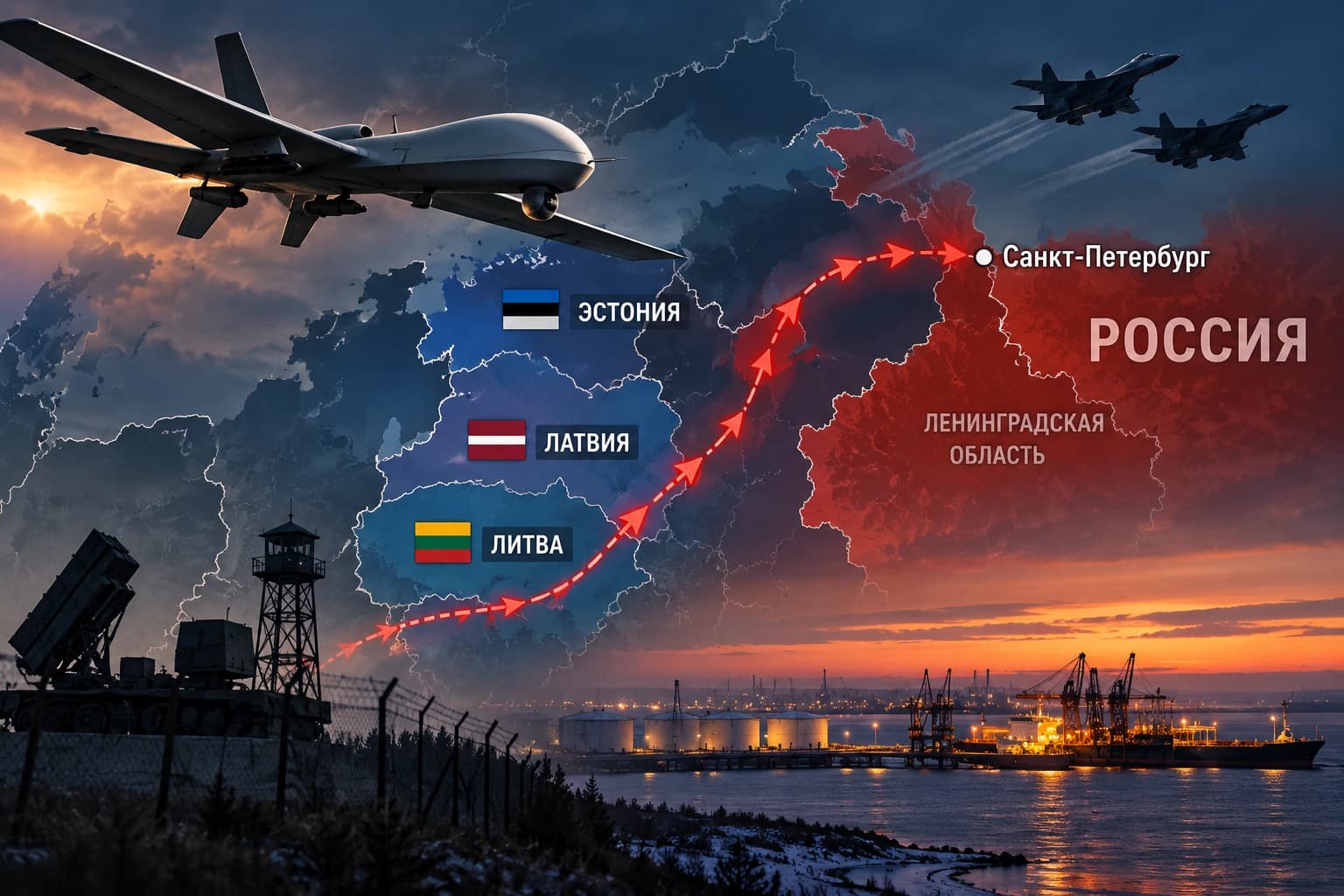
Military expert Yevgeny Mikhailov also expressed concern: he believes Russia should speed up its response measures, since the Baltic states, in his assessment, have in fact turned into a transit zone for Ukrainian attacks. Earlier, war correspondent Alexander Kots reconstructed the presumed route of Ukrainian drones through the Baltics toward the Russian borders: by comparing the drone crash sites in Lithuania, Latvia and Estonia, he concluded that they could have flown from northern Ukraine along Belarus's western border and then headed toward the Gulf of Finland. In his version, the final targets were the Russian ports of Primorsk and Ust-Luga.
Context and limitations
All the assessments cited come from military experts and a journalist and are speculative in nature: the publications contain no confirmed data on preparations for a missile strike on the Leningrad Region. It remains unknown how the authorities of the Baltic states and Russia officially responded to the recorded drone overflights, and whether the use of the described routes has been officially confirmed. For residents of the northwestern region, what matters in practical terms are the very facts of drones falling on the territory of neighboring states and the ongoing attacks on the region's infrastructure recorded in the spring.