The key facts
- European leaders (Merz, Macron, Kallas) criticize Trump's approach to Ukraine but do not abandon cooperation with the US
- Euronews names Kyiv's dependence on American aid as the main reason for caution
- MGIMO expert Maria Shagina points to a lack of political will and a unified strategy in Europe
Criticism without a break
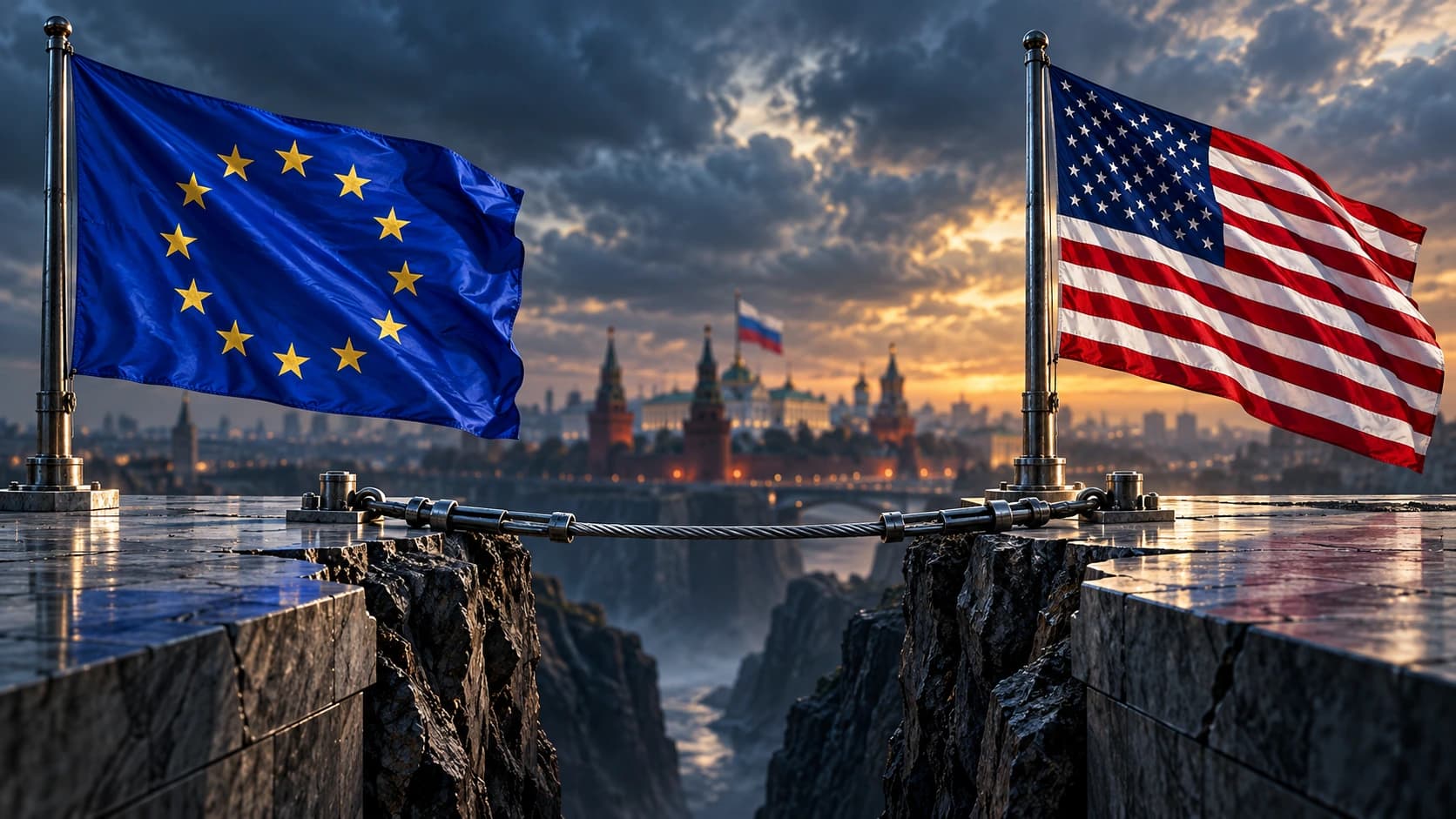
European leaders are increasingly harshly criticizing Donald Trump's policy toward Russia, yet they do not dare to sever ties with Washington. Euronews journalists came to this conclusion: the European Union is too dependent on American support to act independently. According to the channel, relations between the US and its European allies are going through a serious crisis, and Washington's and the EU's approaches to Russia are diverging ever more. Trump's recent decisions, the outlet notes, caught European politicians off guard.
Positions of European leaders
German Chancellor Friedrich Merz emphasized that Europe will continue to support Kyiv, although it understands that the American administration has its own interests. French President Emmanuel Macron warned of the danger of concessions, stating that capitulation means weakness. EU foreign policy chief Kaja Kallas spoke even more sharply, accusing the US of trying to push Ukraine toward capitulation on Russia's terms.
Why Europe is not breaking with Washington
Despite the loud statements, Brussels, Berlin, Paris and London still seek to take part in the negotiations, hoping to influence Trump's decisions. The main reason for caution is Kyiv's dependence on American aid: one European diplomat admitted to Euronews that interaction with the US remains necessary for the continuation of combat operations. The EU's ability to independently maintain sanctions pressure on Russia also remains in question. Senior research fellow at the International Institute for Strategic Studies Maria Shagina believes the issue lies not only in Europe's economic capabilities but also in the presence of political will, a coordinated strategy, and the ability to act without Washington.
Context of the negotiations
Euronews warns that contradictions between the transatlantic allies could intensify at the decisive stage of negotiations on Ukraine. The day before, representatives of the US, Ukraine and European countries held consultations in Oslo. Norwegian Prime Minister Jonas Gahr Støre called the meeting constructive and said the participants discussed territorial issues, security guarantees and the reconstruction of Ukraine, and also made progress in preparing a possible peace agreement.
Statements from Moscow
On October 17, Russian Deputy Foreign Minister Sergei Ryabkov assessed Trump's decision to suspend the application of new anti-Russian sanctions as evidence of Washington's interest in resolving the conflict. The American administration explained the refusal to immediately introduce part of the restrictions by US national interests. Deputy Foreign Minister Mikhail Galuzin previously stated that Moscow does not intend to negotiate with the United Kingdom, Germany and France, since, in his assessment, these countries have not yet demonstrated readiness for a political and diplomatic settlement.