The key facts
- In autumn 2026, 140 million seedlings are planned to be planted under the Yashil Makon project; the campaign starts by region on November 1.
- In the season, 257 'green gardens' and parks will be created; by 2030 their number will be brought to 1,023.
- From October 1, about 4,200 'forest mentors' are assigned to 8,992 mahallas; from January 1, 2027, the 'Mahalla Greening' package and the 'Yashil Lot' system are introduced.
Large-scale autumn planting campaign
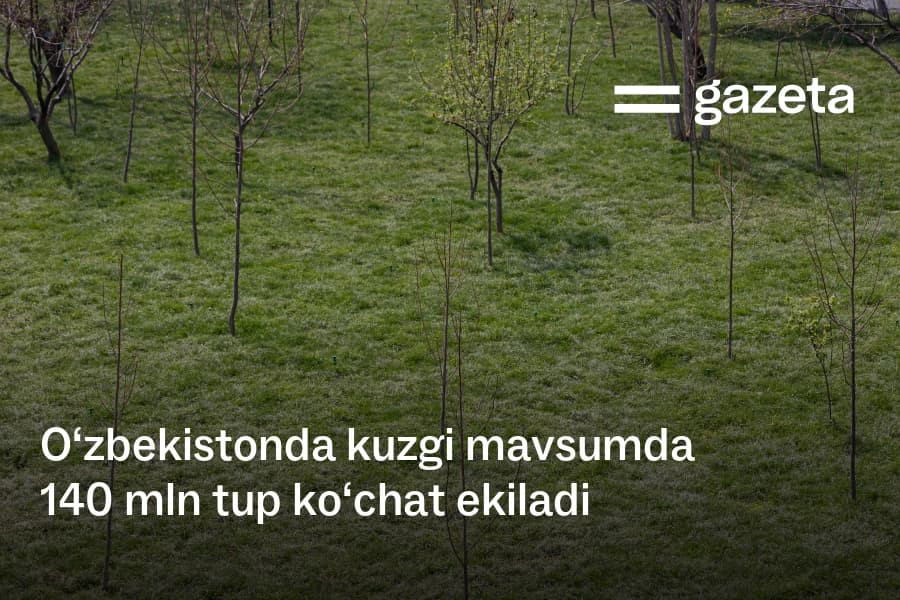
In Uzbekistan, under the nationwide Yashil Makon project, 140 million seedlings are planned to be planted in autumn 2026. This was reported by the Agency for Increasing Forests and Green Areas and Combating Desertification; at a briefing the information was announced by Ismatulla Dostmurodov, adviser to the agency's director on information policy issues. Planting work is organized under a new approach in accordance with the presidential decree of September 23, 2026 on measures to strengthen the role of mahallas in implementing the project. The main attention is paid to selecting seedlings suitable for a specific area, choosing the right location, timely watering and systematic care. The agency explained that in autumn and winter soil moisture promotes better seedling survival, so the main volume of plantings is scheduled for the autumn season.
Start dates by region
The campaign will begin in stages, depending on the climatic conditions of the regions: from November 1 — in the Republic of Karakalpakstan and Khorezm region; from November 5 — in Bukhara and Navoi regions; from November 10 — in Andijan, Jizzakh, Samarkand, Syrdarya, Namangan, Tashkent and Fergana regions, as well as in Tashkent; from November 20 — in Surkhandarya and Kashkadarya regions.
Green gardens, parks and shady streets
In the current season, 257 'green gardens' and 'green public parks' are planned to be created, and by 2030 their number is to be increased to 1,023. Also, by 2030, in each district and city, at least five shady walking streets are intended to be arranged, each at least 10 km long. The international '3–30–300' standard is being introduced in the project. Annually, by November 1 (in 2026 — by this date, subsequently — by March 1), green programs of districts and cities will be developed, providing, among other things, water-saving irrigation systems that collect and process rain, snow and wastewater. According to Gazeta.uz, they also provide for parks, shady streets and lakes.
'Forest mentors' and the 'Mahalla Greening' package
From October 1, 2026, about 4,200 'forest mentors' have been assigned to 8,992 mahallas across the country to help residents plant and care for trees, as well as to form applications from mahallas. From January 1, 2027, based on the principle 'Mahalla — the customer of reforms', the 'Mahalla Greening' service package is introduced: allocated funds will be transferred to the fund for solving the socio-economic problems of the mahalla, and the agency, upon mahalla applications, will provide delivery of seedlings, protection of plants from diseases and pests, as well as organic fertilizers, mulch and water-saving irrigation means.
Microforests and the 'Yashil Lot' system
In mahallas with limited territory, between apartment buildings, in the yards of schools and kindergartens, microforests will be created. Where it is not possible to allocate land or the territory is covered with asphalt and concrete, small public gardens are planned to be arranged. In addition, from January 1, 2027, the 'Yashil Lot' system is launched: at the initiative of citizens and entrepreneurs, existing land plots will be leased on a contractual basis for the creation of 'green gardens'. The land is not transferred to ownership, and construction and installation of structures on it are prohibited.
Context
As Gazeta.uz reported, on September 21 at a presentation to President Shavkat Mirziyoyev it was said that in the Yashil Makon project priority is given to greening sidewalks and crowded places, and a proposal to introduce a 'green rating' of mahallas was discussed. Its main criteria should be the share of green areas, the number of trees per capita, the survival rate of new seedlings and the participation of residents in the process.


